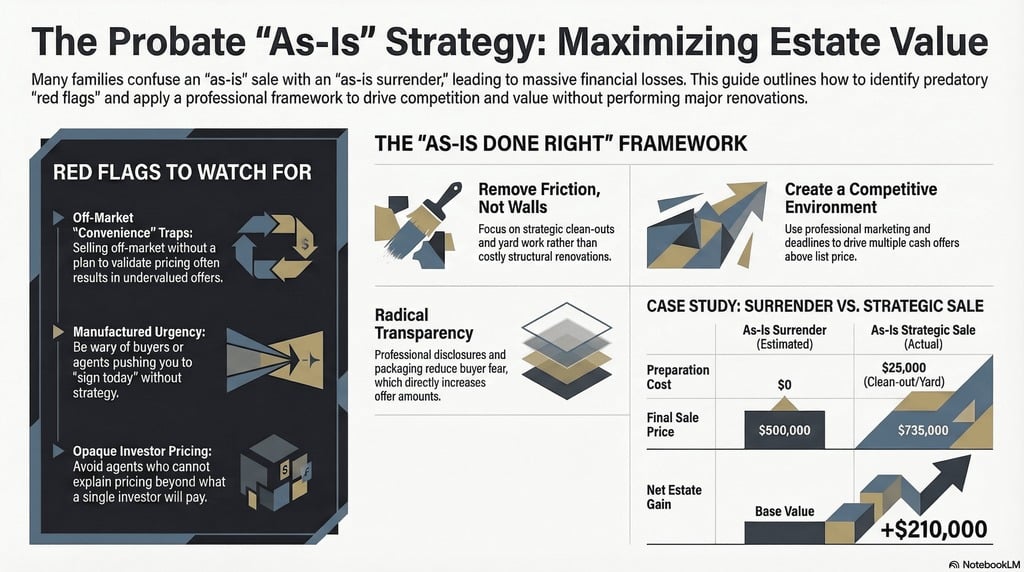
An as-is probate sale costs estates money when buyers are left guessing. Investors price every unknown as the expensive version, so a dark house shown without paperwork draws low offers even when the actual repairs are modest. You do not need a remodel to fix that. Get a valuation built on closed comparable sales and an honest condition category, remove friction with a trash-out and good lighting, disclose what you know, market to contractors and investors with a firm offer date, and weigh the deposit and the contingencies alongside price. In a court confirmed sale, the price must also be at least 90 percent of a recent appraisal.[2]
- What an As-Is Probate Sale Really Means in California
- Why the As-Is Label Pulls the Price Down
- Get the Value Truth Before Anyone Names a Price
- How to Sell a Hoarder House Without Repairing It
- When Selling Truly As-Is Is the Right Fiduciary Call
- Hazards in a Hoarder House: The Anaheim Hills Lesson
- Create Transparency: Disclosures That Raise Offers
- Who Buys a Hoarder House: Marketing to the Right Buyer Pool
- Court Confirmation and Overbids in an As-Is Probate Sale
- Negotiate Like an Advisor, Not a Price Taker
- Red Flags That an As-Is Sale Is Heading the Wrong Way
- How I Run an As-Is Probate Listing in Orange County
- Frequently Asked Questions
- Sources and How This Guide Was Written
Most families who choose an as-is probate sale are trying to do the sensible thing. The house is old and the estate has limited cash, so selling the inherited home exactly as it stands sounds like the clean way out.
The trouble is what "as-is" often turns into in practice: a dark, cluttered house shown with no paperwork, priced off the first investor phone call. Buyers fill every gap with their worst guess, and the estate pays for those guesses at closing. This guide walks through where that money goes and how to keep it, from valuation and cleanup to disclosure, marketing, court confirmation and the offers themselves. Very little of it requires a hammer.
What an As-Is Probate Sale Really Means in California
Families hear "as-is" and assume it means two things: the estate fixes nothing, and the estate says nothing. Only the first half is true.
California does give estates a real break on paperwork. The Transfer Disclosure Statement article of the Civil Code lists the transfers it does not apply to, and one of them is a sale or transfer "by a fiduciary in the course of the administration of a trust, guardianship, conservatorship, or decedent's estate."[6] So an executor or administrator selling a parent's house in Fullerton or Mission Viejo is generally not filling out the same seller questionnaire a living homeowner would. There is a carve out worth knowing if the house sits in a living trust rather than a probate estate: the exemption does not apply when the trustee is a natural person who is a trustee of a revocable trust and was a former owner of the property or lived in it within the preceding year.[6]
What the exemption does not do is make defects disappear. Federal lead paint rules still reach most homes built before 1978, and the EPA's list of exemptions names foreclosure sales but says nothing about probate.[7] Many of the estate homes I list in Anaheim, Garden Grove, Westminster and Costa Mesa were built in the 1950s and 1960s, so that rule applies more often than families expect.
As-is is a condition promise, not a disclosure shield
The phrase tells a buyer that the estate will not make repairs and will not credit for them after inspection. It does not tell the buyer that the estate is hiding anything, and the way you package an as-is listing decides which of those two messages the buyer hears. Ask the estate's attorney what the estate must disclose in your specific case. My own rule is simpler: if the personal representative knows about it, it goes in writing.
That is the first place an as-is probate sale starts costing money. A buyer who suspects concealment prices the house as if the worst were true.
If the house needs light preparation rather than a cleanout, should you sell an inherited house as is or fix it up walks through that decision, and should an executor make repairs before selling covers what an executor can spend on the house.
Why the As-Is Label Pulls the Price Down
Buyers do not discount a house for what is wrong with it. They discount it for what they cannot see.
Walk an investor through a vacant estate home with thirty years of belongings stacked in the garage, a yard gone to weeds, the blinds shut and half the bulbs burned out. He cannot tell whether the stains on the ceiling are from a roof leak fixed in 2009 or one that is still active. He cannot see the foundation behind the boxes. So he does what any careful buyer does: he assumes the expensive version of every unknown, adds a margin for his own time, and writes a number that protects him.
Multiply that by every buyer who walks through. The offers cluster low, and they cluster low for the same reason.
This is what I call the fear discount, and in my experience it is the single largest cost in most as-is probate sales. It is usually bigger than the commission, and almost always bigger than what it would have cost to remove the fear in the first place. The repairs themselves are often modest. The uncertainty is what gets priced.
The question to ask yourself. If a buyer walked through this house tomorrow, what would they have to guess about? Every guess is a deduction from the offer. The job before listing is to shorten that list, and most of it can be done without hiring a contractor.
We wrote about a larger version of this problem in why "as-is" might be the most expensive mistake in a probate sale. The same logic applies whether the estate is a modest tract home or a Newport Beach property.
Get the Value Truth Before Anyone Names a Price
Do not rely on investor numbers or on fearful guesses. The first offer an estate receives, often by phone, often before the house is even clean, is a number designed to be accepted by a grieving family in a hurry. It is not a valuation.
A real valuation of an as-is estate property rests on three inputs: comparable sales that actually closed nearby, current buyer demand for that type of house, and an honest condition category. That last one is where most estate pricing goes wrong. A house that needs paint and carpet is a completely different product from a house that needs a new sewer line and a roof, and pricing them off the same comps is how estates leave money behind or sit on the market for months.
| Condition category | What it usually looks like | Who tends to buy it |
|---|---|---|
| Dated but sound | Original kitchen and baths with working systems | Owner occupants willing to update over time, plus some investors |
| Deferred maintenance | Old roof, tired plumbing, aging electrical, overgrown lot | Contractors and experienced owner occupants with cash reserves |
| Full renovation | Systems at end of life and layout problems | Flippers and builders pricing a complete rehab |
| Hazard or heavy debris | Hoarding conditions or unsafe items on site | A narrow investor pool until a controlled cleanup is done |
How the court's appraisal fits in
In a court supervised probate sale the appraisal is not optional. A court may confirm a private sale of real property only if the property was appraised within one year before the confirmation hearing and the offered price is at least 90 percent of the appraised value, with narrow exceptions.[2] If the court is satisfied that the latest appraisal is too high or too low, a new one can be obtained before confirmation.[2]
When the personal representative holds full authority under the Independent Administration of Estates Act, the picture changes. For those sales the code sets aside several court confirmation requirements, including the rule that real property sell for at least 90 percent of appraised value.[5] That flexibility is useful. It also removes a floor that was protecting the heirs, which makes an independent, comp based opinion of value more important rather than less.
My position: the appraisal tells you the minimum the court will tolerate. The market tells you what the house is worth. Never confuse the two.
How to Sell a Hoarder House Without Repairing It
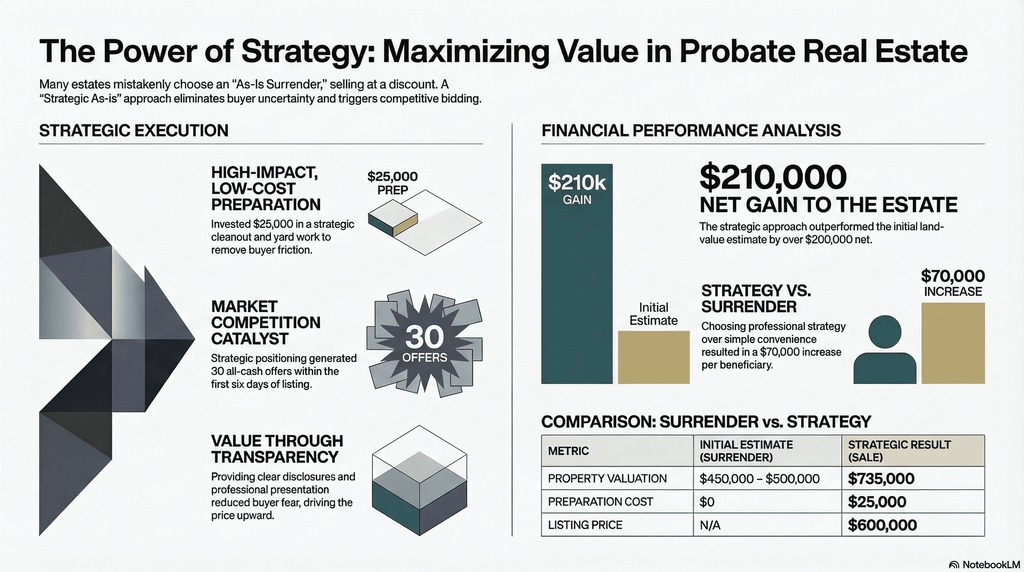
You do not need a remodel to increase value. You need to take away the reasons a buyer has to guess.
The work I recommend before an as-is estate listing is deliberately cheap and fast, and none of it involves pulling a permit:
- A full trash-out, so buyers can see the floors and the garage slab
- Yard cleanup, including trimming whatever hides the foundation and the roofline
- A deep clean, especially kitchens and bathrooms, where odors do the most damage
- Working light bulbs in every fixture and blinds open for every showing
- Utilities on, so buyers and inspectors can run water and test outlets
- A folder of whatever paperwork exists: old permits, roof receipts, pest reports, prior inspections
Light is underrated. A vacant house with dead bulbs in the hallway photographs like a problem and shows like one. The same house at two in the afternoon with every fixture working reads as a house someone could live in.
None of this changes the condition category. A house that needs a roof still needs a roof. What changes is that the buyer can see the whole house and stops pricing in the things that turn out to be fine.
Spend on visibility, not on finishes. New countertops in an estate house rarely return what they cost, because the buyer pool for an as-is home often plans to tear them out. Money spent so a buyer can see the house clearly almost always comes back.
The tradeoff between preparing and selling untouched is the subject of its own guide for trustees: should you sell a trust property as-is or prepare it for the market. The fiduciary reasoning is close to identical for an executor.
When Selling Truly As-Is Is the Right Fiduciary Call
I am not against as-is sales. Sometimes they are exactly the right decision, and a personal representative who renovates in the wrong situation can do more damage than one who sells too quickly.
The legal frame matters here. A personal representative has management and control of the estate and must use ordinary care and diligence, and what counts as ordinary care is "determined by all the circumstances of the particular estate."[1] The code also says the representative shall not exercise a power to the extent ordinary care requires that it not be exercised.[1] Put plainly, sometimes the careful choice is to do less.
| Situation | Why selling as-is can be the smarter move |
|---|---|
| Construction risk | The estate should not shoulder the liability of complex structural repairs. |
| Diminishing return | The projected cost and time of a remodel will not be fully recovered in the final sale price. |
| Hoarding and hazard | With extreme debris or environmental issues, a controlled cleanup is a smarter fiduciary move than a renovation. |
| Liquidity and time pressure | Monthly carrying costs such as property taxes, insurance, utilities and any association dues are draining the estate's cash. |
| Occupancy complications | The legal or physical presence of occupants makes significant work impossible. |
| Family dynamics | A renovation would deepen conflict among beneficiaries or delay distribution by an unacceptable amount. |
Notice what every row has in common. Each one is a reason not to renovate. None of them is a reason to skip the cleanup or the marketing. That distinction is the whole argument of this article.
The family dynamics row deserves a second look
When three siblings disagree about whether to put $80,000 into a kitchen, the kitchen is rarely the real argument. A renovation creates months of decisions, each one a fresh opportunity to fight, and the estate pays carrying costs the entire time. I have watched families choose the as-is route specifically to shorten the period in which they have to agree on things, and I think that was usually wise.
Hazards in a Hoarder House: The Anaheim Hills Lesson
The Anaheim Hills story in the title, the live grenade, is told in full on the Aragone & Associates YouTube channel, and I would rather you hear it there than read a secondhand version here.
The lesson is the part that applies to every estate. Families walk into a parent's house expecting furniture and a garage full of old tools. Sometimes they find things nobody should be moving on their own: old ammunition, chemicals in unlabeled containers, firearms, medications, mold behind stacked boxes. In a long held Orange County home, especially one where a parent lived alone for years, the house can hold decades of decisions nobody else ever saw.
If anything looks like an explosive or military ordnance, do not touch or move it, and keep the cleanout crew away from it. Leave the house and call 911. That is not a real estate decision, and no listing timeline is worth anyone's safety.
Why a controlled cleanup comes before any pricing talk
A house with hazards on site cannot be shown safely or inspected properly. Every investor who hears about it before it is resolved will price in the worst case. A controlled cleanup, done by people who handle hazardous items and documented as it happens, turns an unknown into a known. That is the moment the buyer pool widens again.
Document what was found and what was done. Photographs and receipts from the companies involved belong in the disclosure folder. A buyer who reads "hoarding conditions were professionally remediated in March, report attached" behaves very differently from a buyer who hears a rumor from a neighbor.
Selling an estate property as-is?
Paula is a Certified Probate Real Estate Specialist with a legal background. She will walk the house with you and tell you what is worth doing before it lists.
Schedule a Free ConsultationCreate Transparency: Disclosures That Raise Offers
"As-is" is not a license to hide defects. Professional packaging and clear disclosures reduce buyer fear, and when fear drops, the number of offers and the price both rise.
The estate's statutory obligations are narrower than a regular seller's, as covered above. The practical obligation, the one the market imposes, is broader. Here is how I think about the paperwork for an as-is probate listing:
| Item | Status in a probate sale | What I recommend |
|---|---|---|
| Transfer Disclosure Statement | Fiduciary sales in the administration of a decedent's estate are listed as exempt from that Civil Code article[6] | Confirm with the estate's attorney, then provide a written summary of what the representative knows |
| Lead-based paint disclosure for pre-1978 homes | Federal rule; the EPA's exemption list names foreclosure sales, not probate[7] | Give the EPA pamphlet and disclose any known lead information |
| Buyer's lead inspection window | 10 days to test unless the parties agree otherwise in writing or the buyer waives it[7] | Build it into the timeline instead of fighting it |
| Pre-listing inspections | Not required | Often worth ordering on older homes, so buyers bid on facts |
| Cleanup and remediation records | Not required | Always include them |
On the lead rule, the EPA also expects sellers to keep a signed copy of the disclosures for three years after the sale.[7] Executors close estates and move on, so make sure that file goes somewhere permanent.
Pre-listing inspections: my opinion
On an older estate home I almost always prefer to order a general inspection, and often a sewer line camera and a roof report, before listing. Some attorneys and some families resist this because it creates knowledge the estate then has to disclose. I understand the concern. I still think the math favors inspecting. The buyer is going to inspect anyway, and a defect discovered in escrow becomes a renegotiation with a deadline attached. The same defect disclosed up front is already in the price, and it does not cost the estate a second round of negotiation.
There are exceptions. If the house is clearly a teardown or the buyer pool is entirely builders, a full inspection report tells them nothing they did not already assume.
Who Buys a Hoarder House: Marketing to the Right Buyer Pool
An as-is property is a specific product. Treating it like a turnkey listing wastes the first two weeks, and treating it like an off-market wholesale deal wastes the money.
The buyers who pay the most for an as-is estate home are usually the ones who can see what it becomes: general contractors, flippers, high-net-worth investors who hold rentals, and owner occupants who have renovated before and know what a kitchen costs. Each of them responds to slightly different information, and a good campaign gives all of them what they need to bid with confidence.
- Professional photography after the cleanup. Wide, bright, honest images of every room, including the ones that need work. Hiding the bad bathroom only makes buyers assume it is worse.
- A disclosure package ready on day one. Inspections, cleanup records, lead forms and any permits, available before the first showing rather than after the first offer.
- Listing remarks written for the real buyer. Lot size, zoning, what the systems are and how old they are. Investors scan for facts, not adjectives.
- Direct outreach to the contractor and investor network. The MLS plus phone calls to the people who buy this kind of house every month.
- A deadline-driven showing schedule. Concentrated open house windows and a stated offer review date, so buyers see each other in the driveway and know they are competing.
- A clean offer review. Every offer goes into the same comparison sheet so the personal representative can see terms side by side.
The deadline matters more than people expect. An as-is listing with open ended showings invites slow, conditional offers. A listing with a firm review date tells every buyer that the estate will choose among competing bids, and that is when the investor who was going to write a low number decides to write his real one.
Location changes the playbook too. An as-is house in Anaheim Hills, Yorba Linda, Orange or Villa Park draws a different mix of buyers than one in Westminster or Stanton, and the outreach list should reflect that.
Court Confirmation and Overbids in an As-Is Probate Sale
Not every probate sale goes to court, and the difference changes how you negotiate.
A personal representative who has obtained only limited authority under the Independent Administration of Estates Act is required to obtain court supervision for a sale of real property.[4] With full authority, the representative can sell without the confirmation hearing, subject to the code's notice requirements.[5] Ask the estate's attorney which one you have before you list, because buyers will ask you.
How overbidding works at the hearing
In a court confirmed sale, the accepted offer is not final until the hearing. Another buyer can show up and bid. The court must accept a written overbid and confirm the sale to that bidder if it is at least 10 percent higher on the first $10,000 of the original bid and 5 percent higher on the amount above that, and made by a responsible person.[3] If several qualifying overbids come in, the court accepts the highest, and it has discretion to decline them and order a new sale instead.[3] Bid amounts are calculated without regard to commissions.[3]
| Accepted offer | 10% of first $10,000 | 5% of the remainder | Minimum first overbid |
|---|---|---|---|
| $600,000 | $1,000 | $29,500 | $630,500 |
| $800,000 | $1,000 | $39,500 | $840,500 |
| $1,200,000 | $1,000 | $59,500 | $1,260,500 |
Those are illustrations of the statutory formula, not market figures. They show why the overbid process matters to an as-is strategy: if the house was underexposed before the offer was accepted, the courtroom becomes the first real auction. If it was marketed well, the accepted price already reflects the competition, and overbids are less likely.
I would rather win the price in the marketing period than hope for it in the courtroom. The timing of all this is covered in how long a probate sale really takes in California.
Negotiate Like an Advisor, Not a Price Taker
Price is only one variable. In an as-is estate sale it is often not the most important one.
When offers come in, I evaluate the strength of the deposit, how quickly and cleanly contingencies are removed, proof of funds that matches the offer, and the buyer's actual track record for closing. An offer that is $15,000 higher from a buyer who has never closed a cash deal and wants a long inspection period is frequently worth less to the estate than the lower one.
| Term | Weaker offer looks like | Stronger offer looks like |
|---|---|---|
| Deposit | Small, refundable for weeks | Meaningful, at risk early |
| Inspection contingency | Long period with vague scope | Short period, or waived on an as-is home |
| Financing | Loan approval pending, appraisal contingent | Cash or verified approval with appraisal gap covered |
| Proof of funds | Letter from a friend's company, or nothing | Recent bank or lender statement matching the price |
| Track record | No history the agent can verify | Closed comparable purchases you can confirm |
| Assignment clause | "And or assignee" written in | Buyer named, no assignment |
That assignment row is worth a sentence of its own. A buyer who writes "and or assignee" may be planning to sell the contract to someone else, which means the estate is negotiating with a middleman. Sometimes that is acceptable. The personal representative should know it is happening.
A failed escrow costs more than the lost weeks. It leaves the stigma of a property that came back on the market, which every investor in the area will notice and price in.
Red Flags That an As-Is Sale Is Heading the Wrong Way
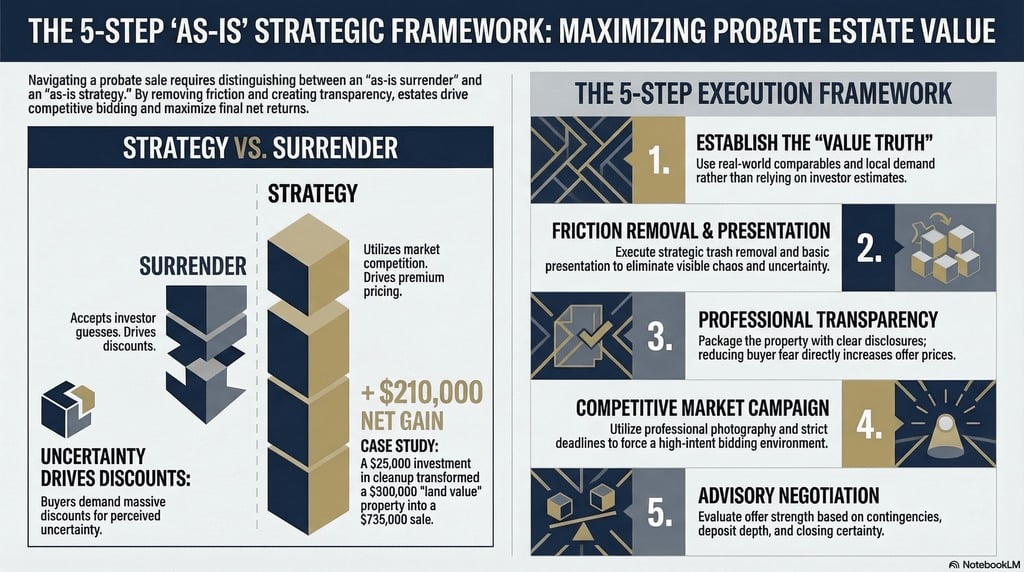
Estates get pressured. The executor is tired and someone always seems to have a buyer ready today. Here are the warning signs I see most often:
- The off-market trap. Being pushed to sell quickly without any plan to test the price against the open market.
- Manufactured urgency. Pressure to sign today, before you can get a second opinion.
- Vague buyers. Investors who want to skip normal inspections or will not be transparent about their funding.
- No positioning strategy. An agent who suggests just throwing it on the MLS without removing friction first.
Any one of these alone can have an innocent explanation. Two together should make you stop and call the estate's attorney.
The off-market trap deserves the strongest warning, because it feels like the responsible choice. A private sale to the first cash buyer looks quick and quiet. What it gives up is the competition that sets the price, and the personal representative is the one who has to explain the number to the beneficiaries later. If you are weighing a cash offer right now, read cash offer or open market for an inherited house before you sign anything.
A simple test. Ask whoever is recommending a quick sale how they arrived at the price, in writing, with the comparable sales attached. A professional will send it the same day. Someone who changes the subject has told you what you needed to know.
How I Run an As-Is Probate Listing in Orange County
My background in law school shapes how I approach estate property. I am not the estate's attorney and I do not give legal advice, but I ask about the letters and the authority level on the first call, and I build the listing timeline around the legal process rather than the other way around.
The sequence on a typical as-is estate listing looks like this. First, a walk-through with the personal representative to sort the house into its condition category and spot anything that needs specialists. Then a valuation built from closed comps, not from what the last investor offered. Then the cleanup and the paperwork folder, then photography, then a concentrated launch with a firm offer date. Every offer goes into a comparison sheet before the representative decides anything.
Families sometimes ask whether all of this is worth it on a house that is "just going to an investor anyway." My answer is yes, because which buyer you end up with, and on what terms, is exactly what the process decides. The executor's job is to get the best reasonably available result, and the duties that come with that role are laid out in what every executor needs to know before selling estate property in California.
If you are still earlier in the process, before probate has even opened, the broader planning conversation is in why most families lose wealth in court and how to avoid it.
Frequently Asked Questions
Can you sell a hoarder house as is in California?
Yes. A hoarder house can be sold as is, and the estate does not need a remodel to get a fair price. Remove the guesswork instead: a controlled cleanup, good lighting, disclosure of what you know, marketing to contractors and investors with a firm offer date, and a valuation built on closed comparable sales. In a court confirmed probate sale, the price must also be at least 90 percent of a recent appraisal.
Does an as-is probate sale mean the estate does not have to disclose anything?
No. California exempts fiduciary sales in the administration of a decedent's estate from the Civil Code article that requires the Transfer Disclosure Statement[6], but federal lead paint disclosure still applies to most pre-1978 homes[7]. In practice I tell every personal representative to put what they know in writing. Confirm the estate's specific obligations with its attorney.
Is it better to sell an inherited house as-is or fix it up first?
Usually the best answer sits between the two: no remodel, but a full trash-out, yard cleanup, deep clean and working lights, plus whatever inspections and records help buyers bid on facts. A full renovation makes sense far less often than families think, and it carries real construction risk for the estate.
How much is a fear discount worth on an as-is estate home?
There is no published figure I would trust, and it varies with the house. What I can tell you is the mechanism: every unknown a buyer cannot see gets priced as the expensive version. Removing those unknowns is cheaper than most repairs and usually returns more.
Does a probate house have to sell for at least 90 percent of the appraisal?
In a court confirmed private sale, yes, with narrow exceptions: the property must have been appraised within one year before the hearing and the price must be at least 90 percent of that appraised value[2]. A personal representative with full authority under the Independent Administration of Estates Act is not held to that 90 percent requirement[5].
Can someone outbid my buyer at the probate court hearing?
Yes, in a court confirmed sale. A qualifying overbid must be at least 10 percent higher on the first $10,000 of the original bid and 5 percent higher on the rest, from a responsible person[3]. On an $800,000 accepted offer, that means a first overbid of at least $840,500.
When is selling as-is actually the right decision?
When renovation would expose the estate to structural construction risk, when the remodel would not pay for itself, when hoarding or hazards call for a controlled cleanup instead, when carrying costs are draining the estate, when occupants make work impossible, or when a project would deepen conflict among beneficiaries. Even then, the cleanup and the marketing still matter.
What should I do if I find something dangerous in a parent's house?
If it looks like an explosive or ordnance, do not touch or move it. Leave and call 911. For chemicals, mold, medications or heavy hoarding conditions, bring in professionals who handle hazardous cleanup, and keep records of what was found and removed so you can share them with buyers.
Should an estate accept the first cash offer on an as-is house?
Not without testing it against the market. A quick cash offer may turn out to be the best one, but you only know that after real exposure and a firm offer date. Pressure to sign today is a red flag, and the personal representative is the one who will have to justify the price to the beneficiaries.
Do buyers of an as-is probate home still get inspections?
Usually yes. As-is means the estate will not make repairs, not that the buyer gives up the right to look. For pre-1978 homes, the federal lead rule gives buyers 10 days to test for lead-based paint unless they agree otherwise in writing or waive it[7].
Sources and How This Guide Was Written
Every legal figure in this guide was read from the source while it was being written. California statutes were read from the California.Public.Law copies because the official legislative site was not reachable from our research environment, and the lead disclosure rules were read on the EPA's own page.
- California Probate Code section 9600, which gives the personal representative management and control of the estate and requires ordinary care and diligence. Read from the California.Public.Law copy. Read the statute
- California Probate Code section 10309, which requires an appraisal within one year of the confirmation hearing and a price of at least 90 percent of appraised value for a court confirmed private sale of real property. Read from the California.Public.Law copy. Read the statute
- California Probate Code section 10311, which sets the minimum overbid at a probate confirmation hearing: 10 percent of the first $10,000 and 5 percent of the excess. Read from the California.Public.Law copy. Read the statute
- California Probate Code section 10501, which requires a personal representative with only limited authority under the Independent Administration of Estates Act to obtain court supervision for a sale of real property. Read from the California.Public.Law copy. Read the statute
- California Probate Code section 10503, which sets aside several court confirmation requirements, including the 90 percent of appraised value rule, for real property sales under independent administration. Read from the California.Public.Law copy. Read the statute
- California Civil Code section 1102.2, which lists the transfers exempt from the residential transfer disclosure article, including fiduciary sales in the administration of a decedent's estate and the revocable trust exception. Read from the California.Public.Law copy. Read the statute
- U.S. Environmental Protection Agency, Real Estate Disclosures about Potential Lead Hazards, covering the seller's obligations for pre-1978 housing, the buyer's 10 day inspection opportunity and the list of exemptions. Read the EPA guidance
Probate rules and disclosure requirements change, and every estate is different, so confirm the current law and your estate's obligations with the estate's attorney before you list.
Stay Connected
New posts every week on probate and trust property sales in Orange County. Subscribe to the blog or listen to the podcast on Spotify. You can also find Paula on Instagram and YouTube.
Paula Aragone
Aragone & Associates
949-415-4784 | [email protected]
Paula Aragone, CA DRE #01364746
Aragone & Associates | First Team Real Estate, CA DRE #01008773
4 Corporate Plaza Dr #100, Newport Beach, CA 92660
This article is general information about selling probate property as-is and is not legal or tax advice. We are not real estate attorneys, so please review your estate's situation with qualified legal counsel, and if you do not have representation we can connect you with one of the attorneys we trust.
Tags: as-is probate sale, sell inherited house as-is, probate real estate Orange County, probate court confirmation, probate overbid, executor selling house California, estate property cleanout, Anaheim Hills probate

Paula Aragone
Aragone & Associates | First Team Real Estate
Paula has spent 23 years in Orange County real estate, with more than 900 transactions and over $900 million in sales behind her. She holds the CPRES, SRES, Certified Luxury and Certified Relocation Specialist designations, is a member of Luxury Portfolio International, and went to law school before building her practice around probate, trust, divorce and luxury property.
Wondering what your estate property would bring with the friction removed?
Send Paula the address and where the probate stands. She will tell you which condition category the house sits in and what she would do before the first showing.
Call (949) 415-4784Schedule a ConsultationCheck out this article next