To avoid probate in California, title the house so it passes outside the court at death, usually through a revocable living trust that actually holds the deed[4]. A will alone does not do it: the state courts warn that an estate may need to go through probate even if the person had a will[8]. The small estate shortcuts rarely fit an Orange County house: the declaration limit is $208,850 and the primary residence petition limit is $750,000 for deaths on or after April 1, 2025[2]. Without a plan, the estate's attorney fee alone is set by statute on the gross value, mortgage included, which is $28,000 on a $1.5 million estate[1].
- What Probate Costs on a California House
- Why the Small Estate Limits Rarely Cover a House
- What Assets Are Exempt From Probate in California?
- The Funded Living Trust: The Most Reliable Way to Avoid Probate in California
- How to Avoid Probate Without a Trust: The Transfer on Death Deed
- Joint Tenancy and Spousal Transfers: Useful, With Traps
- Avoiding Full Probate After a Death: The $750,000 Primary Residence Petition
- Property Tax: The Proposition 19 Question That Avoiding Probate Does Not Answer
- The Step-Up in Basis: The Part of the Legacy Already Protected
- Checklist: How to Keep Your House Out of Probate
- Where a Probate and Trust Real Estate Specialist Fits
- Frequently Asked Questions
- Sources and How This Guide Was Written
Most Orange County families do not lose wealth because they invested badly. They lose it because a parent owned the house in their own name, and when the parent died, a court had to decide who could sign. The good news is that it is possible to avoid probate in California with planning that is neither exotic nor expensive, provided it is done before it is needed.
This guide starts with what probate actually costs under California's fee statute and why Orange County home values make the small estate exemptions nearly useless here. Then it covers the tools that keep a house out of court: the funded living trust, the transfer on death deed, joint tenancy and the newer primary residence petition. It also covers two things avoiding probate does not fix, property tax reassessment and the step-up in basis, because a legacy can be protected from court and still leak money in other places.
One opinion before we start. If you own a home here and have done no planning at all, a funded revocable trust is almost always worth the cost, and the most common way families lose its benefit is an unfunded trust they believe is working.
What Probate Costs on a California House
Start with the number most families never see until the estate is already open.
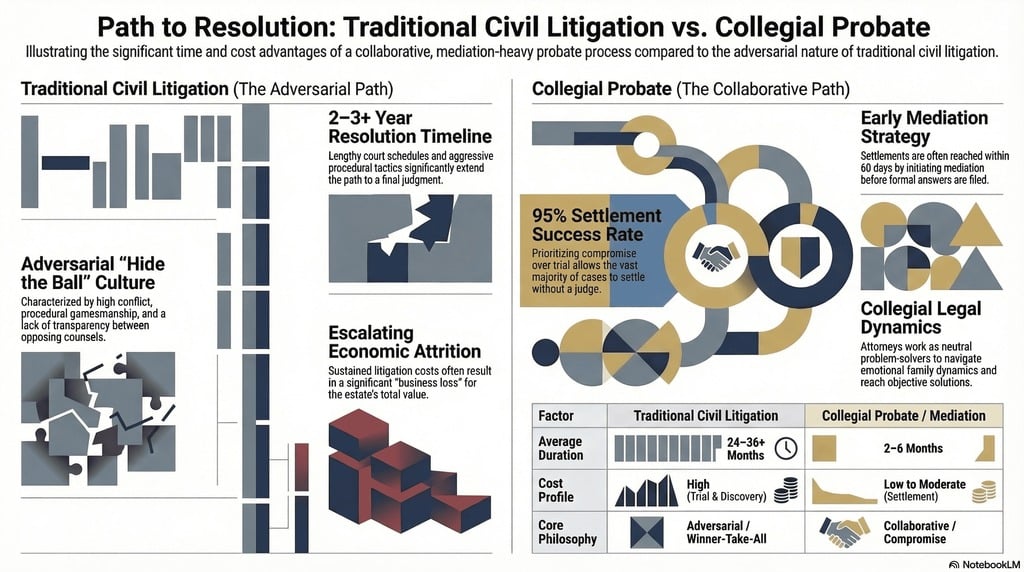
California sets the ordinary fee for the attorney who represents the personal representative by statute, as a percentage of the estate. The schedule is four percent of the first $100,000, three percent of the next $100,000, two percent of the next $800,000, one percent of the next $9 million and one half of one percent of the next $15 million, with anything above $25 million left to the court[1]. The detail that surprises people is the base. The value used is the appraised value of the property the representative accounts for, calculated without reference to encumbrances[1]. In plain terms, the mortgage does not reduce the fee.
So a house in Costa Mesa appraised at $1.5 million with $900,000 still owed on it is a $1.5 million estate for fee purposes, even though the family's real equity is $600,000.
| Gross estate value | Statutory ordinary attorney fee | What that looks like in Orange County |
|---|---|---|
| $1,000,000 | $23,000 | A modest condo in Irvine or a small house in Garden Grove |
| $1,500,000 | $28,000 | A typical single family home in Costa Mesa or Tustin |
| $2,500,000 | $38,000 | A family home in Laguna Niguel or the older parts of Newport Beach |
| $4,000,000 | $53,000 | Corona del Mar, Laguna Beach, Newport Coast |
Those figures are my own arithmetic from the statutory percentages[1], and they cover ordinary services only. They do not include extraordinary work, court costs, the appraisal, or what the estate spends keeping a vacant house insured and secure while the case moves through the Superior Court.
I do not think probate attorneys are overpaid for what they do. The work is real, and a good one earns the fee. My objection is to families paying it when one afternoon with an estate planning attorney ten years earlier would have kept the house out of court entirely.
Time is the cost nobody prices
The fee schedule is at least predictable. Time is not. While the case is open, someone has to pay property tax, insurance, utilities and the gardener on a house nobody lives in, and the market does not wait for the hearing calendar. I have written separately about how long a probate sale really takes in California; the short version is that the court sets the pace, not the family and not the buyer.
Why the Small Estate Limits Rarely Cover a House
California does let small estates skip formal probate. The trouble is the word small.
Under Probate Code section 13100, a successor can collect a decedent's personal property by declaration, without letters of administration, once 40 days have passed since the death, provided the estate stays under the statutory limit[3]. That limit is adjusted every three years. For deaths on or after April 1, 2025 it is $208,850, and the next adjustment is scheduled for April 1, 2028[2]. A separate affidavit procedure for real property of small value under section 13200 tops out at $69,625 for the same period[2].
Now compare those numbers with any house in Fountain Valley, Mission Viejo, Placentia or Yorba Linda.
There is no single family home in this county that fits under $69,625, and very few condos that fit under $208,850. In much of the country those thresholds keep an ordinary family's house out of court. Here, almost any parent who owns a home in their own name, and has done nothing else, is leaving their children a probate case. That is the part of the story most families miss. They hear that small estates are exempt and assume a modest home qualifies. In Orange County, modest is a seven figure word.
The quick test. Look at how the deed to the house is titled today. If it shows a parent's name alone, as a single person or as a surviving spouse, with no trust on title and no transfer on death deed or surviving joint tenant, assume the house will need a court process unless the family qualifies for one of the newer residence petitions described later in this guide.
What Assets Are Exempt From Probate in California?
The good news is buried in Probate Code section 13050, which lists property the court ignores when it decides whether an estate is small enough to skip formal probate[4]. Most of the planning tools that keep a family out of court work because they move an asset onto this list.
- Property the decedent held as a joint tenant, or in which the decedent had a life estate or another interest that ended at death[4]
- Property that passed to a surviving spouse under section 13500[4]
- Property in a trust the decedent could revoke during their lifetime, which is the ordinary revocable living trust[4]
- Multiple party accounts, to the extent the funds belong to a surviving party or a named P.O.D. payee or beneficiary after death[4]
- Registered vehicles and vessels, plus registered manufactured homes and mobilehomes[4]
- Amounts due for service in the Armed Forces, and unpaid wages up to an adjusted cap of $20,875 for deaths on or after April 1, 2025[4][2]
Work with Paula: Probate real estate services in Orange County
Read that list again with your own house in mind. The first and third items are where nearly all of the real estate planning happens. A brokerage account with a named beneficiary and a bank account with a P.O.D. designation usually take care of themselves. The house is the asset that gets stuck, because it is the one asset most people title once, at the closing table, and never think about again.
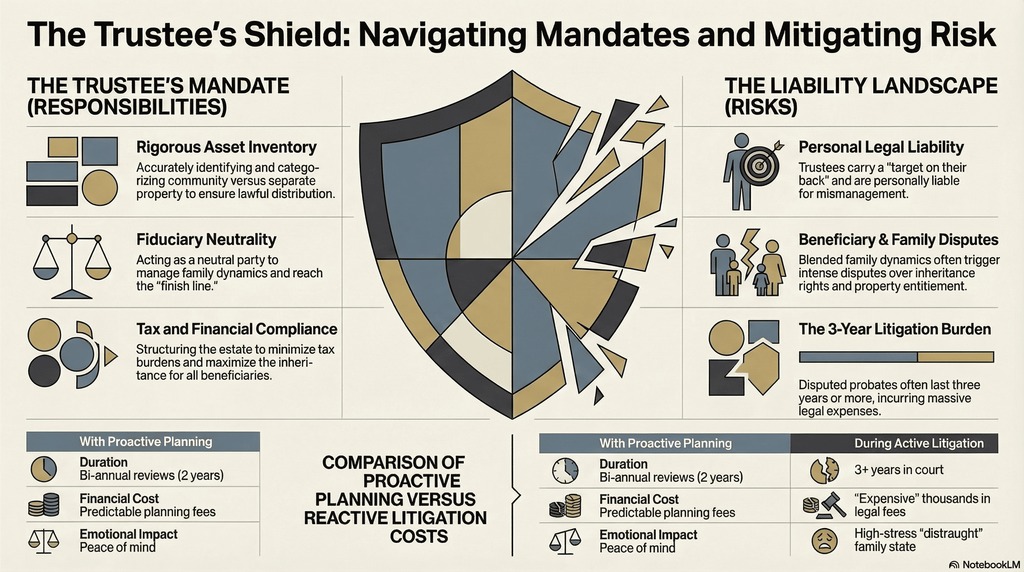
One caution. Excluded from the threshold is not the same as free of every other rule. Property that passes outside probate can still be reassessed for property tax. Someone still needs the authority to sign the escrow papers, and siblings who disagree about the house will disagree whether or not a judge is involved. Avoiding court solves one problem. It does not solve all of them.
The Funded Living Trust: The Most Reliable Way to Avoid Probate in California
If you ask me which single tool protects the most Orange County families, my answer is a revocable living trust that actually owns the house.
Property in a trust the decedent could revoke during life is excluded from the probate calculation[4], and when the trust holds title, the successor trustee steps in and manages or sells the property under the trust's terms instead of waiting for a judge to appoint anyone. I explain the mechanics in more depth in why a living trust can simplify real estate transfers.
The phrase that matters in that paragraph is actually owns.
A trust document sitting in a binder does nothing for a house that is still titled in the parents' individual names. The deed has to be signed and recorded into the trust. I see the unfunded trust more often than I would like: the parents paid for a full estate plan, signed everything in the lawyer's office, then refinanced a few years later, and the lender had them take the house out of the trust to close the loan. Nobody put it back. On paper the family planned. In the county recorder's office, they did not.
If you are not sure, the answer is a ten minute check of the most recent recorded deed, and I would do it before you do anything else on this list. If you have already lost a parent and found the house outside the trust, read what happens if a home was never transferred into a trust before you assume the plan has failed. California has procedures for that situation, and an estate attorney will know which one fits.
What the trust does not do
A living trust is a probate tool. It is not a tax shelter, and it does nothing on its own to stop a property tax reassessment when the children inherit[6]. Those questions are covered in the sections on Proposition 19 and basis below, and they need their own planning.
How to Avoid Probate Without a Trust: The Transfer on Death Deed
California's revocable transfer on death deed lets an owner name a beneficiary on the deed itself, so the house passes at death without a probate case, while the owner keeps full control and can revoke it during life. The governing part of the Probate Code applies to transferors who die on or after January 1, 2016[5].
It has two features worth knowing before you choose it.
The first is that the law has an expiration date. The statute says the part stays in effect only until January 1, 2032, and is repealed as of that date unless the Legislature extends or deletes the deadline first[5]. The same section protects deeds executed before that date, along with the owner's power to revoke one by recording a signed, notarized instrument[5]. The second is that the rules changed in 2022, and the revised provisions do not apply to a deed or revocation form signed before January 1, 2022[5], so an older deed should be reviewed against the version of the law that governs it.
| Question | Funded living trust | Transfer on death deed |
|---|---|---|
| Covers assets other than the house | Yes, anything titled in the trust | No, one deed per property |
| Handles incapacity during life | Yes, a successor trustee can act | No, it only operates at death |
| Cost to set up | Higher, attorney drafted plan | Lower, a single recorded deed |
| Statutory sunset | None | January 1, 2032 unless extended[5] |
| Who signs the sale later | Successor trustee | The beneficiary who received title |
My view: a transfer on death deed is a reasonable answer for a widowed parent in Laguna Woods with one condo and one child. For a family with several properties, or a parent whose memory is starting to slip, it is the wrong tool. A deed cannot manage anything while the owner is alive and unwell, and that is exactly the period when Orange County families most often need help selling.
Joint Tenancy and Spousal Transfers: Useful, With Traps
Joint tenancy is the oldest probate workaround in California. Property the decedent held as a joint tenant is excluded from the small estate calculation[4], because at the first death the survivor already owns it.
Between spouses this often works well, and property that passes to a surviving spouse under section 13500 is also excluded[4]. The problem is the second death. When the surviving spouse dies owning the house alone, the family is right back where it started, holding a house in one person's name with no plan attached.
Then there is the move I talk families out of most often: a parent adding an adult child to title as a joint tenant to keep the house out of probate.
It does avoid probate. It also hands the child a present ownership interest today, which puts the house within reach of that child's creditors or a divorce court. And it can change the income tax result when the house is finally sold. Inherited property generally takes a basis equal to its value at death, while a gift generally carries over the donor's adjusted basis[7], and putting a child on title while the parent is alive starts to look a lot more like a gift than an inheritance. Talk to a CPA before anyone signs a grant deed adding a name. I have seen this go fine, and I have seen it cost a family six figures in tax when they sold. The difference was never luck. It was whether someone ran the numbers first.
Planning ahead, or already holding the keys?
Paula is a Certified Probate Real Estate Specialist and works with trustees and executors on the real estate side of an estate, from a current valuation for the plan to the sale itself.
Schedule a Free ConsultationAvoiding Full Probate After a Death: The $750,000 Primary Residence Petition
Sometimes the planning simply never happened. A parent passes with the house in their own name and no trust or beneficiary deed in place. For many Orange County families, that used to mean a full probate case without exception.
Since 2025 there is a shorter path for the family home. Assembly Bill 2016 set a $750,000 limit for petitions under Probate Code section 13151 and its companion sections when the property is the decedent's primary residence in California, for deaths on or after April 1, 2025[2]. Like the other small estate procedures, it runs through a petition rather than a full administration, and the general small estate rule still requires that 40 days pass after the death before a successor uses it[3]. I covered the background in California's AB 2016 and what it means for families.
$750,000 helps in parts of Anaheim, Santa Ana, Stanton and Westminster, and for some older condos and mobilehome park homes elsewhere. It does not help much in Irvine or anywhere along the coast, where the primary residence alone will usually be above the line. I would not build a plan around it. It is a safety net for families who ran out of time, and a good one, but the threshold was set for the whole state and it shows.
The other procedures, side by side
| Procedure | Limit for deaths on or after April 1, 2025 | Typical use |
|---|---|---|
| Declaration under section 13100 | $208,850[2] | Collecting bank accounts and personal property without letters[3] |
| Real property of small value, section 13200 | $69,625[2] | Rarely a house in Orange County |
| Primary residence petition, section 13151 and following | $750,000[2] | A family home below the limit |
The adjusted amounts above apply until the next scheduled adjustment on April 1, 2028[2]. Any family relying on one of them should confirm the figure that applies to the date of death with their attorney, because the date of death, not the date of filing, decides which number governs.
Property Tax: The Proposition 19 Question That Avoiding Probate Does Not Answer
Here is a mistake I see families make in good faith: they keep the house out of probate, then lose its low property tax base anyway.
Under Proposition 19, which became operative February 16, 2021, the parent-child exclusion only covers a family home that was the transferor's principal residence and becomes the child's principal residence[6]. Rental homes do not qualify[6]. Even when the child moves in, the exclusion is capped: the limit is the factored base year value plus an adjusted $1 million, which is $1,044,586 for transfers from February 16, 2025 through February 15, 2027, and any market value above that limit is added to the taxable value[6]. The child has to file the claim and the homeowners' exemption with the county assessor within one year of the date of death or transfer, or the exclusion only applies going forward[6].
None of that depends on whether the house passed through a trust or through probate. Prop 19 cares about who lives in the house and what it is worth, not about the court.
In practice, that means a long held family home in Newport Beach that the children plan to rent out will usually be reassessed to something close to market value. For many families that changes the keep or sell math entirely, and it is one reason I ask heirs early whether anyone truly intends to live in the house. If the honest answer is no, the conversation is about when and how to sell it well, not how to hold it.
The Step-Up in Basis: The Part of the Legacy Already Protected
Not every piece of news in this guide is bad.
The IRS rule is that the basis of property inherited from a decedent is generally its fair market value on the date of death, or on the alternate valuation date if the personal representative elects it[7]. For an Orange County family that bought in the 1980s, that is often the single largest number in the whole estate. A house purchased for a few hundred thousand dollars and worth $2 million at death can often be sold by the heirs shortly afterwards with little or no capital gain, because the gain is measured from the date of death value rather than the original price.
Two practical points follow. First, get a proper date of death appraisal, even if the house is going straight into a trust administration with no court involved. That number becomes the heirs' basis, and recreating it two years later is harder and less convincing. Second, be careful with lifetime transfers made to avoid probate, for the reasons in the joint tenancy section above, because a gift does not carry the same basis rule as an inheritance[7].
I go through the inherited house tax questions in more detail in inheriting a house in California and capital gains tax. Your CPA should have the final word on any specific sale.
Checklist: How to Keep Your House Out of Probate
If you own a home in Orange County and want your children to inherit it without a court case, this is the order I would work in. It is not a substitute for an estate planning attorney. It is the list I would want a client to bring to that first meeting.
- Pull the current recorded deed. Confirm whose name is on title and how they hold it: individually, as joint tenants, as community property with a spouse, or as trustee of a trust.
- Compare the house value with the thresholds. If the home is worth more than $750,000, assume none of the small estate shortcuts will cover it[2].
- Pick a tool on purpose. For most families that is a funded living trust; a transfer on death deed can suit a simple single property estate. Have a careful conversation before adding any child to title.
- Fund the trust and check it again after every refinance. This is where good plans quietly fail.
- Name beneficiaries on accounts. P.O.D. and beneficiary designations keep those funds outside the probate calculation[4].
- Talk to the children about Prop 19. Who, if anyone, would actually live in the house, and what that means for the tax bill[6].
- Write down where everything is. The trust binder, the deed, the insurance policy, the alarm code. A successor trustee who cannot find the paperwork loses weeks.
Seven steps, and only the first two cost nothing but an hour.
Where a Probate and Trust Real Estate Specialist Fits
I am not an attorney, and I will not draft your trust. Where I come in is the real estate side, usually at one of two moments.
The first is before anyone passes, when a family wants to know what the house is realistically worth today so the estate plan is built on a real number rather than a guess from a website. The second is after, when a successor trustee or an executor has to sell. That is a different sale from an ordinary listing, with different paperwork and different people who need to sign off, and it is the work my CPRES designation is built around. Timing matters there too; I wrote about it in the 154-day window for Orange County fiduciaries.
If you are on the planning side of this, my honest advice is to call your estate attorney first. If you are on the selling side, call me early, before the house is cleaned out and before anyone has promised a relative they can buy it at a family price.
- Selling a house during probate
- How long it takes to sell a probate house
- What a probate real estate agent does
Further reading: Understanding Wills, Trusts, and Real Estate Inheritance, Kickstart Your Estate Planning in 2025 and 7 Tips to Make Your Family’s Wealth Last for Generations
Frequently Asked Questions
How do I avoid probate in California?
Make sure each asset passes outside the court process at death. For most homeowners that means a revocable living trust that actually holds title to the house, because property in a trust the decedent could revoke is excluded from the probate calculation[4]. The other common tools are a transfer on death deed[5], joint tenancy with a spouse and beneficiary designations on accounts, along with the newer primary residence petition when no plan was made[2].
Does having a will avoid probate in California?
No. A will says who should receive the property, but the California courts self help guide states that a person's estate may need to go through probate even if they had a will[8]. Property passes outside probate because of how it is held, in a living trust, by a transfer on death deed, in joint tenancy or with a named beneficiary, not because a will exists[9].
Can an estate be settled without probate in California?
Yes, when the property passes by how it is held or by a named beneficiary, or when the estate is small enough for a simplified procedure. For deaths on or after April 1, 2025, personal property can be transferred by affidavit when the estate is worth $208,850 or less and 40 days have passed since the death, and the decedent's main home in California can use a shorter petition up to $750,000[9]. A surviving spouse or domestic partner entitled to the property can file a spousal property petition, which the courts describe as faster and less complicated than opening probate[9].
What is the small estate limit in California in 2026?
For deaths on or after April 1, 2025, the declaration limit under Probate Code section 13100 is $208,850 and the primary residence petition limit is $750,000. The real property of small value affidavit is capped at $69,625. The next scheduled adjustment is April 1, 2028[2].
How much does probate cost on a $1.5 million house in California?
The statutory ordinary fee for the estate's attorney on a $1.5 million estate works out to $28,000 under Probate Code section 10810, calculated on the gross appraised value without subtracting the mortgage[1]. Court costs, appraisal, carrying costs and any extraordinary work are on top of that.
Does a living trust avoid probate in California?
Yes, for the property the trust actually owns. Property in a revocable trust is excluded from the probate calculation[4]. A house that was never deeded into the trust, or was taken out during a refinance and never put back, does not get that protection.
Is a transfer on death deed still valid in California?
Yes. The law applies to transferors who die on or after January 1, 2016, and it is currently scheduled to be repealed on January 1, 2032 unless the Legislature extends it. Deeds executed before that date remain protected[5].
Should I add my child to the deed to avoid probate?
Usually not without advice. It avoids probate, but it gives the child a present ownership interest that their creditors can reach, and lifetime gifts do not carry the same tax basis rule as inherited property[7]. Ask a CPA and an estate attorney before signing anything.
Will my children's property taxes go up when they inherit my house?
Often, yes. Under Proposition 19 the parent-child exclusion only applies if the home becomes the child's principal residence, and it is capped at the factored base year value plus $1,044,586 for transfers between February 16, 2025 and February 15, 2027. The claim must be filed within one year[6]. Avoiding probate does not change this.
What is the primary residence petition under AB 2016?
AB 2016 set a $750,000 limit for petitions under Probate Code section 13151 and its companion sections covering a decedent's primary residence in California, for deaths on or after April 1, 2025[2]. It gives families a shorter path than full probate when the family home falls under that value.
Do heirs pay capital gains tax when they sell an inherited house?
The basis of inherited property is generally its fair market value at the date of death, or the alternate valuation date if elected[7]. Gain is measured from that value, so a sale soon after death often produces little gain. A CPA should confirm the result for any specific sale.
Sources and How This Guide Was Written
Every statutory figure in this guide was read from the source listed below while it was being written in October 2026. California codes were read on law.justia.com and california.public.law because leginfo.legislature.ca.gov was not reachable from our research environment; the adjusted dollar amounts come from the Judicial Council's own table.
- California Probate Code section 10810, compensation of the attorney for the personal representative, read on california.public.law because leginfo is not reachable from our research environment. Read the statute
- Judicial Council of California, table of dollar amounts adjusted under Probate Code section 890 for deaths on or after April 1, 2025, including sections 13050, 13100, 13151 and 13200. Read the table
- California Probate Code section 13100, collection of personal property of a small estate by declaration without letters, as amended by AB 2016, read on law.justia.com. Read the statute
- California Probate Code section 13050, property excluded when determining whether an estate qualifies for the small estate procedures, read on california.public.law. Read the statute
- California Probate Code section 5600, scope and sunset date of the revocable transfer on death deed law, read on california.public.law. Read the statute
- California State Board of Equalization, Proposition 19 information page covering the parent-child exclusion, including the adjusted $1 million limit and the one-year filing deadline. Read the BOE guidance
- Internal Revenue Service Publication 551, Basis of Assets (December 2025), including the basis rules for inherited property. Read the publication
- Judicial Branch of California, Self Help Guide, Guide to property after someone dies, including the statement that an estate may need to go through probate even if the person had a will. Read on November 12, 2026. Read the guide
- Judicial Branch of California, Self Help Guide, Check if you can use a simple process to transfer property, including the amounts for deaths on or after April 1, 2025, the 40 day wait for an affidavit and the spousal property petition. Read on November 12, 2026. Read the guide
Probate thresholds are adjusted every three years and estate law changes, so confirm the figures that apply to a specific date of death with your estate attorney or CPA before relying on them.
Stay Connected
New posts every week on probate, trust and inherited property in Orange County. Subscribe to the blog or listen to the podcast on Spotify. You can also find Paula on Instagram and YouTube.
Paula Aragone
Aragone & Associates
949-415-4784 | [email protected]
Paula Aragone, CA DRE #01364746
Aragone & Associates | First Team Real Estate, CA DRE #01008773
4 Corporate Plaza Dr #100, Newport Beach, CA 92660
This article is general information about probate and estate planning for real estate and is not legal, tax or financial advice. We are not attorneys or tax advisers, so please review your situation with a qualified estate planning attorney and CPA, and if you do not have one, we can connect you with one of our trusted attorneys.
This article is general information and is not legal or tax advice. We are real estate professionals, not attorneys or tax advisors, so please confirm your own situation with a qualified California attorney or CPA before you act.
Tags: avoid probate Orange County, California probate fees, living trust California, transfer on death deed California, small estate affidavit California, AB 2016 primary residence, Proposition 19 parent-child exclusion, inherited house Orange County

Paula Aragone
Aragone & Associates | First Team Real Estate
Paula has spent 23 years in Orange County real estate, with more than 900 transactions and over $900 million in sales behind her. She holds the CPRES, SRES, Certified Luxury and Certified Relocation Specialist designations, is a member of Luxury Portfolio International, and went to law school before building her practice around probate, trust, divorce and luxury property.
Want to know where your Orange County home stands before it is ever a court case?
Tell Paula how the house is titled today. She will give you a realistic current value and the questions to bring to your estate attorney.
Call (949) 415-4784Schedule a ConsultationCheck out this article next