Often, yes. An as is probate sale is the right call less often than most executors are told. Before you accept it, get two numbers in writing: what the house sells for today in its current condition, and what it sells for after a short, targeted round of paint, flooring, lighting, cleanout and staging. California law gives executors and trustees the power to make repairs and improvements[2][3], and a trustee is held to a prudent person standard[1]. If the gap between the two numbers, minus cost and carrying time, is real money for the beneficiaries, prepare the house.
- Should an Executor Make Repairs or Sell As Is?
- What an Executor or Trustee Actually Owes the Beneficiaries
- Busting the Tear-Down Myth: The $2.1 Million Newport Beach Trust Sale
- Which Repairs Are Worth Making: Removing Buyer Friction Instead of Remodeling
- Probate Realities: From Fontana to Luxury Listings
- Can an Executor or Trustee Pay for Repairs Before a Probate Sale?
- Full Authority, Limited Authority and Court Confirmation
- What As-Is Really Means in a California Probate or Trust Sale
- The Two Numbers Rule for Choosing a Probate Agent
- Document, Document, Document: How Fiduciaries Protect Themselves
- When Selling a Probate Property As-Is Is the Right Move
- Strategy Over Luck
- Frequently Asked Questions
- Sources and How This Guide Was Written
Imagine standing in the doorway of a house that has stayed virtually untouched for three decades. If you are the executor of a probate estate or the trustee of a family trust, you are carrying two loads at once: the grief, and the physical weight of a property full of accumulated belongings and decades of deferred maintenance. That is exactly the moment an as-is probate sale starts to sound like a lifeline.
It is also the moment the most money gets left on the table.
This guide walks through why the as-is pitch is so persuasive, what California law actually says a fiduciary owes the beneficiaries and is allowed to spend, how court confirmation and overbids change the pricing picture, and the two real sales (one a Newport Beach trust, one a Fontana probate) that shaped how I advise every executor who calls our office. I will also tell you when as-is is the correct answer, because sometimes it is.
Should an Executor Make Repairs or Sell As Is?
When an agent walks through a tired estate property and calls it a tear-down, the advice usually arrives in a reassuring package. Sell it for land value. Let an investor deal with the mess. Close in thirty days and move on with your life.
For someone who has just spent weekends sorting a parent's closets, that promise of closure is very hard to resist. I understand why people sign. Exhaustion makes decisions that a rested person would question.
The problem is who benefits from speed. An as-is listing on a house that clearly needs work draws a narrow buyer pool made up mostly of investors and builders, and every one of them prices in a renovation budget and a profit margin. Every one of those line items comes out of the beneficiaries' share. A fiduciary who takes the path of least resistance can end up handing hundreds of thousands of dollars, and in some cases millions, to a buyer who simply showed up with a contractor.
The question to ask yourself first. Is the as-is recommendation based on a written comparison of two prices, or on how tired everyone is? If nobody has put the improved value on paper, nobody has actually evaluated the as-is option yet.
In the higher priced coastal markets of Newport Beach and Corona del Mar, a land value only opinion on a house with good bones is often a sign that the agent did not look past the carpet. I say that bluntly because I have watched it happen to families who trusted the first opinion they got.
If the home is not in probate, should you sell an inherited house as is or fix it up covers the same choice for heirs, and how to sell a hoarder house in California covers a house that needs a full cleanout first.
What an Executor or Trustee Actually Owes the Beneficiaries
A California trustee does not get to pick the easy path because it is easy. The Probate Code requires a trustee to administer the trust with reasonable care and caution under the circumstances then prevailing, the way a prudent person acting in a like capacity would[1]. The trust document can expand or narrow that standard, and a trustee who relies in good faith on those express terms is protected for doing so[1]. Read your trust before you assume anything.
Executors work under a different part of the code, but the expectation in practice is the same: you are managing someone else's inheritance, and you should be able to explain every decision to the people who are receiving it.
Quick doesn't mean best. Quick often means discounted. When you are acting as a fiduciary, your job is to act prudently and to pursue a strong outcome for the estate, not accept the easiest option and the quickest way.
Paula Aragone
Prudence cuts both ways. It does not mean spending money on every house. It means making the decision with numbers in front of you. A trustee who sells a $5 million property as-is without ever asking what it would bring after a modest cleanup has a hard time explaining that choice to a sibling who later sees the investor's listing photos. A trustee who spends heavily on a house that had no upside has the opposite problem. The defensible position is the one you can show your work on.
If you are a trustee worried about liability, our article on whether a trustee can be sued over a property sale goes deeper into the disputes that come up after a sale closes.
Busting the Tear-Down Myth: The $2.1 Million Newport Beach Trust Sale
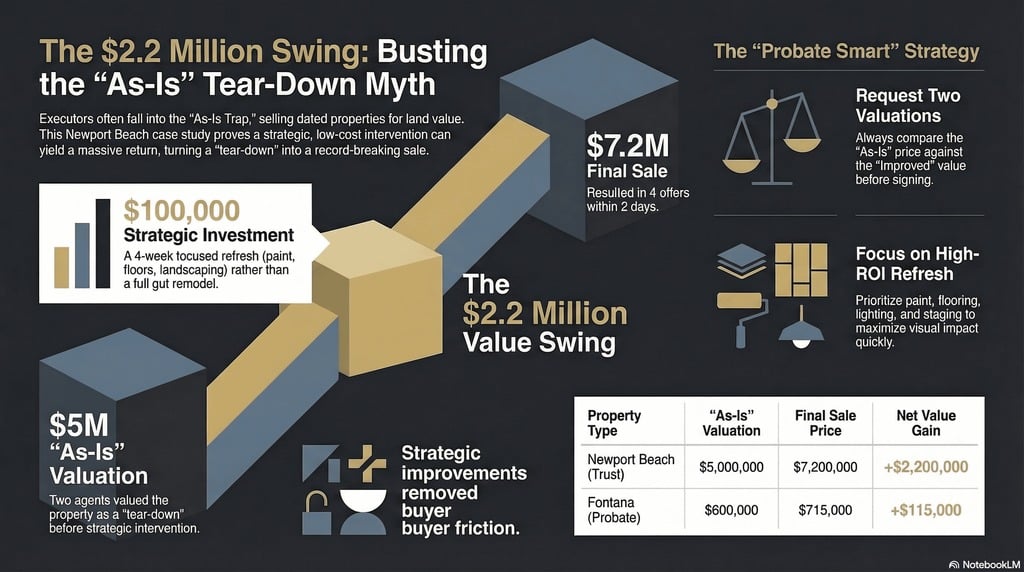
Consider 1436 West Bay Avenue in Newport Beach. This waterfront property sat on a premier location but suffered from a tired, antiquated presentation.
Two separate agents assessed the home as a complete demolition project. Their valuations topped out at $5 million to $5.2 million, and both urged the family to skip the hassle of repairs and sell immediately as-is.
Before the family signed, their estate planning attorney, Cheryl Barrett at Ferruzzo & Ferruzzo, stepped in. She recognized that a second opinion would protect the estate and suggested the family consult with me. Where the earlier agents saw a wrecking ball, I saw a functional floor plan and a world-class view hidden behind decades of neglect.
What happened when the house went on the market
The estate invested $100,000 in strategic improvements, completed on a condensed three to four week timeline. Within forty-eight hours of hitting the market, the estate received four high-quality offers, and the property closed at $7.2 million.
In other words, a $100,000 preparation took a home valued at $5.0 million as is to a $7.2 million sale, $2,100,000 more net to the seller. That money would have gone to an investor if the trustee had followed the as-is advice.
| Newport Beach trust sale | As-is advice | What actually happened |
|---|---|---|
| Valuation | $5 million to $5.2 million as a tear-down | Closed at $7.2 million |
| Money spent before listing | None | $100,000 in targeted improvements |
| Prep time | None | Three to four weeks |
| Market response | Investor or builder pricing | Four offers within forty-eight hours |
One detail I want executors to notice: the person who changed the outcome was the attorney, not an agent. A good estate attorney knows that a second opinion on value costs the estate nothing, and a missing one can cost it everything above the investor's price.
Which Repairs Are Worth Making: Removing Buyer Friction Instead of Remodeling
The answer is almost never a gut remodel. A full renovation inside an estate burns months of carrying cost while the fiduciary makes design decisions for buyers nobody has met yet. I advise against it in nearly every case.
What works is a focused, high-impact plan aimed at one thing: buyer friction. Friction is what happens when a buyer cannot see past dated finishes or a list of small repairs. In a luxury market, buyers pay a premium for turn-key. Remove the friction and the buyer pool changes shape, from a handful of investors running spreadsheets to a much larger group of end users who are buying a home and are willing to pay for one.
Where the money goes
- A neutral palette. Fresh, quality paint that maximizes natural light and gives buyers a clean canvas.
- Contemporary flooring. Replacing worn or dated carpet with modern finishes that flow from room to room.
- Lighting. Updated fixtures that brighten the rooms that go dim by late afternoon.
- A full cleanout. Removing decades of accumulated personal property and garage clutter so the space reads as space again.
- Curb appeal. Front yard cleanup and planting so the first impression happens before the front door opens.
- Professional staging. Furniture with the right scale so buyers can mentally move in.
Work with Paula: Probate real estate services in Orange County
Notice what is not on the list: no moved walls, no new bathrooms. Each item above is something a buyer sees in the first ninety seconds of a showing, and each one is something an investor would otherwise use as a reason to discount the offer.
In the Newport Beach sale, our team managed every contractor, so the trustee could stay focused on the legal side of the administration instead of returning calls from painters. That part matters more than people expect. An executor who has to coordinate the work personally often decides, quite reasonably, that as-is is easier, and that is how the cycle starts.
We wrote about the same decision from a trustee's point of view in Should You Sell a Trust Property As-Is or Prepare It for the Market?
Probate Realities: From Fontana to Luxury Listings
The Newport Beach sale was a trust administration. The same principle works in a court-supervised probate, and it works far below the luxury price points.
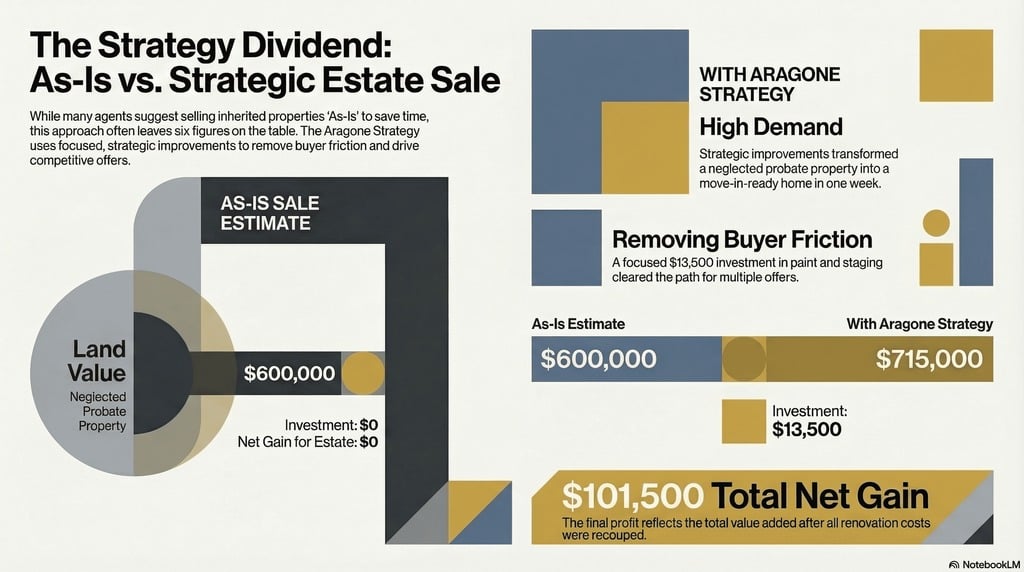
Consider 7537 Red Bluff Lane in Fontana, out in the Inland Empire. This probate property had been neglected and was sitting vacant, which for an executor means stress and liability every week it stays that way.
The estate invested a modest $13,500 in focused improvements. The house sold within a week for $115,000 more than its as-is value.
Run that ratio. Every dollar spent came back roughly eight times over. You do not need a waterfront lot for this to work; you need a house whose problems are cosmetic and a buyer pool that is larger than the investor list.
Vacancy is its own argument for moving quickly once you decide. An empty house is a house where a slow leak can run for weeks before anyone notices. I would rather spend three weeks preparing a house with a crew on site than leave it dark for three months waiting for the perfect offer.
Can an Executor or Trustee Pay for Repairs Before a Probate Sale?
Yes. This is one of the most common worries I hear, and the Probate Code is clearer on it than most executors expect.
Under the Independent Administration of Estates Act, a personal representative has the power to make repairs and improvements to the estate's real and personal property[2]. That power sits in the article of powers a personal representative can use without first giving notice of proposed action[2]. A trustee has the power to make repairs and improvements to trust property, ordinary or extraordinary, and even to demolish improvements[3], subject always to the prudent person standard[1] and to whatever the trust instrument says.
| Question | Executor under independent administration | Successor trustee |
|---|---|---|
| Power to repair and improve | Yes, Probate Code section 10562[2] | Yes, Probate Code section 16229[3] |
| Standard the decision is judged by | Your duty to the estate; ask your attorney how it applies | The care and caution of a prudent person[1] |
| What controls first | The court's order and your letters | The trust instrument[1] |
| What I recommend either way | Written bids and receipts shared with counsel | Written bids and receipts shared with beneficiaries |
Where the money comes from
Estates fund improvements in different ways, from cash already in the estate to an advance from a beneficiary who wants the higher number. Which one is available to you is a question for your attorney, because it depends on the estate's accounts and on what the heirs agree to. What I can tell you is that the source of funds is rarely the real obstacle. The obstacle is usually that nobody has shown the family a number worth spending for.
For the broader picture of an executor's job, start with What Every Executor Needs to Know Before Selling Estate Property in California.
Want both numbers on your estate property?
Paula will walk the house, give you an as-is value and an improved value in writing, and show you the scope and budget behind the second one, before you commit to anything.
Schedule a Free ConsultationFull Authority, Limited Authority and Court Confirmation
Executors often ask whether the level of authority they received changes the as-is decision. It changes the process. It should not change the goal.
Limited authority under the Probate Code includes every independent administration power except the power to sell real property, exchange it, grant an option to buy it, or borrow against it[4]. So an executor with limited authority who needs to sell the house goes through court confirmation. An executor with full authority can generally sell without a confirmation hearing, after giving notice of proposed action to the people entitled to it.
How court confirmation sets the floor
In a court-confirmed private sale of real property, the offer must be at least 90 percent of the appraised value, and the appraisal must be dated within one year before the confirmation hearing[5]. At the hearing, the court must accept a written overbid from a responsible person that meets the statutory minimum and complies with the law[6].
A correction to the original version of this article. We previously described court confirmation as a 10% overbid process. The statute is more specific. The first overbid must exceed the original bid by at least 10 percent of the first $10,000 plus 5 percent of the amount above $10,000[6], which works out to a little over 5 percent on a typical Orange County house.
| Accepted offer | 10% of first $10,000 | 5% of the rest | Minimum first overbid |
|---|---|---|---|
| $800,000 | $1,000 | $39,500 | $840,500 |
| $1,200,000 | $1,000 | $59,500 | $1,260,500 |
| $2,000,000 | $1,000 | $99,500 | $2,100,500 |
Those figures are arithmetic from the statute's formula[6], not a prediction of what happens in any courtroom.
Here is why this matters for the as-is decision. In a confirmation sale, the accepted offer is the starting line. An improved house brings a stronger opening offer from an end user, and everything that happens in the courtroom is built on top of that number. Start from an investor's discounted price and the overbid only stretches a low floor. Start from an improved-value offer and the court is looking at a higher return for the heirs before anyone raises a hand.
What As-Is Really Means in a California Probate or Trust Sale
Part of the reason the as-is pitch is so common is that probate and trust sales already look as-is on paper.
California's Transfer Disclosure Statement requirement has exemptions. One covers sales under court order, including sales ordered by a probate court in the administration of an estate[7]. Another covers sales by a fiduciary in the course of administering a trust, a decedent's estate, a guardianship or a conservatorship[7]. That fiduciary exemption has a limit: it does not apply when the trustee is a natural person serving as trustee of a revocable trust who is a former owner of the property or lived in it within the preceding year[7].
So in many estate sales, the seller does not hand the buyer that particular form. That is a paperwork rule. It says nothing about price.
Buyers know the exemption exists, and they price the uncertainty. A buyer who cannot get a seller's history of the house assumes the worst about the roof and the sewer line, and writes the offer accordingly. That is exactly the friction a pre-listing cleanup and a set of inspections can take off the table. My own practice is to share what we know about a property in writing, because a buyer who trusts the information pays more for it, and because surprises in escrow are what kill estate sales. Ask your attorney which disclosures make sense in your specific case.
As-is in the contract is not the same as as-is in the marketing
You can prepare a house beautifully and still negotiate a contract with no repair credits after inspections. Those are two separate decisions, and a buyer is far more willing to accept the second one when the house already looks cared for.
The Two Numbers Rule for Choosing a Probate Agent
When you interview agents for an estate or trust sale, look for technical proficiency over a charismatic pitch. The simplest test I know is what I call the Two Numbers Rule. Ask every agent you interview for both of these, in writing:
- The as-is value. The price the property would bring today, in its current condition, most likely from an investor or developer looking for a discount.
- The improved value. The projected sale price if a targeted plan of improvements is carried out, along with the scope and the budget behind it.
The red flag: if an agent cannot give you both numbers, supported by comps, or has no team to manage the improvements on your behalf, that agent is not equipped for an estate sale. An expert should be able to explain exactly how a specific investment turns into a higher net for the estate.
How to run the interview
- Send the same packet to each agent. Address, photos, the appraisal if you have one, and any known issues. Comparable inputs give you comparable answers.
- Ask for the as-is value with comps. Make them show which sales they used and why.
- Ask for the improved value with a line-item scope. Paint, flooring, lighting, cleanout, yard and staging, each with a budget and a timeline.
- Ask who manages the work. If the answer is you, factor your own time and stress into the math.
- Compare the net, not the gross. Subtract improvement cost and the extra weeks of carrying cost from the improved value before you compare it to the as-is number.
- Share both numbers with your attorney and the beneficiaries. Whatever you decide, decide it in the open.
An agent who only brings one number is telling you which path is easier for the agent. For more on pricing an estate correctly in the first place, see Is Your Trust Property Priced Right.
Document, Document, Document: How Fiduciaries Protect Themselves
Transparency is the best protection a fiduciary has against beneficiary disputes. Spending estate money feels risky precisely because someone might question it later. The fix is a paper trail good enough that the question answers itself.
At Aragone & Associates we keep every receipt along with full before and after photography of the work. That file goes to the estate's attorney and, where appropriate, to the beneficiaries. It shows that every dollar spent was a considered investment and what it returned, which is the best insulation I know against a later claim of mismanagement.
What belongs in the file
- Both written valuations from the Two Numbers interview, dated
- Contractor bids, including the ones you did not accept
- Signed scopes of work and change orders
- Invoices with proof of payment
- Before photos taken on the same day the work starts, and after photos from the same angles
- Copies of every offer received, with the final settlement statement
A trustee who can put that file on the table rarely ends up defending the decision in front of a judge. Without it, even a great result can look like a gamble that happened to work.
When Selling a Probate Property As-Is Is the Right Move
Strategic improvements usually produce the higher return. Usually is not always. A serious advisor has to recognize when as-is is the sound choice, and that decision should come from math presented to the beneficiaries, never from an agent's wish for a fast paycheck.
As-is is the right call when one of these is true:
- The structure is compromised. Foundation failure or extensive systemic mold, where remediation would cost more than the market upside.
- The return is negative. Carrying costs during the work period, such as property taxes and HOA dues, eat into the projected gain enough that the risk-adjusted return is unattractive.
- The spread has disappeared. In rare markets where demand for fixers is so strong that the as-is and improved values are nearly the same.
- The estate genuinely cannot fund or supervise the work. There is no cash and no willing beneficiary to advance it. In that case a well marketed as-is sale beats a half-finished project every time.
I will recommend as-is when the math says so. What I will not do is recommend it before both numbers are on the table. For another as-is probate story, this one from Anaheim Hills, read Why Your As-Is Probate Sale Is Costing You Thousands.
For the full sequence of an estate sale from letters to closing, our guide to selling probate property in Orange County lays out each stage.
Strategy Over Luck
The difference between a tear-down and a record estate sale is rarely luck. It is a rigorous plan backed by a team that can execute inside the rules of probate and trust administration. As a fiduciary, you are the steward of someone's legacy, and the representation you choose decides whether that legacy reaches the beneficiaries intact or gets quietly discounted on the way out.
Before the fatigue wins and you sign an as-is listing, ask yourself one question.
Am I choosing the easiest path for my own convenience, or the best path for the beneficiaries I am sworn to protect?
Frequently Asked Questions
Should an executor make repairs before selling a house?
In my experience, a short round of cosmetic work beats an as-is sale on most estate properties whose problems are cosmetic. In the Fontana probate, $13,500 in improvements produced a sale $115,000 above the as-is value within a week. As-is wins when the structure is compromised or when the estate cannot fund or supervise the work. Get both numbers in writing before deciding.
Can an executor make repairs to a house in probate in California?
Yes. Under the Independent Administration of Estates Act, a personal representative has the power to make repairs and improvements to estate property, and that power appears among the powers usable without first giving notice of proposed action[2]. Keep every bid and receipt, and loop in your attorney before spending significant sums.
Can a successor trustee renovate a trust property before selling it?
A California trustee has the power to make repairs and improvements to trust property, ordinary or extraordinary[3]. The decision is judged by the prudent person standard of reasonable care[1], and the trust instrument can expand or restrict that standard. Read the trust first, then document the reasoning.
How much is the overbid in a California probate court confirmation?
The first overbid must exceed the original accepted bid by at least 10 percent of the first $10,000 plus 5 percent of the amount above $10,000[6]. On a $1,200,000 accepted offer, that is $1,000 plus $59,500, so the minimum overbid is $1,260,500.
Does a probate sale have to be at least 90 percent of the appraised value?
For a court-confirmed private sale of real property, yes. The offer must be at least 90 percent of the appraised value, and the appraisal must be within one year before the confirmation hearing[5]. A new appraisal can be obtained if the old one is stale or the court finds it too high or too low.
What does limited authority mean in a California probate?
Limited authority gives the personal representative every independent administration power except selling real property, exchanging it, granting an option to buy it, and borrowing against it[4]. An executor with limited authority who needs to sell the house goes through court confirmation.
Do probate and trust sellers have to give buyers a Transfer Disclosure Statement?
Sales ordered by a probate court and sales by a fiduciary administering an estate or trust are exempt from that requirement, with one exception: the trust exemption does not apply when a natural person serving as trustee of a revocable trust is a former owner or lived in the property within the past year[7]. The exemption covers a form, not the price buyers will pay for uncertainty.
How much should an estate spend on improvements before selling?
Spend only what the improved value clearly pays back after carrying costs. The Newport Beach trust spent $100,000 over three to four weeks and closed at $7.2 million against a $5 million tear-down valuation. The Fontana probate spent $13,500. Neither involved a remodel; both were paint, flooring, lighting, cleanout, yard and staging.
How do I protect myself from beneficiaries questioning repair costs?
Build the file before you spend, from both written valuations and competing bids to receipts and before and after photos, and share it with the estate attorney and the beneficiaries. A fiduciary who can show the reasoning and the return rarely has to defend the decision later.
Sources and How This Guide Was Written
The case figures in this guide come from Paula Aragone's own transactions as described in the original March 2026 version of this article. Every legal point was read from the California Probate Code and Civil Code in October 2026 using the california.public.law copies listed below, because the official leginfo.legislature.ca.gov site could not be opened from our research environment.
- California Probate Code section 16040, the trustee's prudent person standard of care and the settlor's ability to expand or restrict that standard. Read the statute
- California Probate Code section 10562, the personal representative's power under independent administration to make repairs and improvements to estate property. Read the statute
- California Probate Code section 16229, the trustee's power to repair and improve trust property, ordinary or extraordinary, or to demolish improvements. Read the statute
- California Probate Code section 10403, the definition of limited authority under independent administration and the four real property powers it excludes. Read the statute
- California Probate Code section 10309, the one-year appraisal requirement and the 90 percent of appraised value minimum for court-confirmed private sales of real property. Read the statute
- California Probate Code section 10311, overbids at the confirmation hearing and the minimum overbid formula. Read the statute
- California Civil Code section 1102.2, the exemptions from the Transfer Disclosure Statement requirement for court-ordered sales and for transfers by fiduciaries. Read the statute
Statutes and court practice change, and your trust or court order may set different rules, so confirm each point with your estate attorney before you spend estate funds or sign a listing agreement.
Stay Connected
New posts every week on probate and trust sales in Orange County. Subscribe to the blog or listen to the podcast on Spotify. You can also find Paula on Instagram and YouTube.
Paula Aragone
Aragone & Associates
949-415-4784 | [email protected]
Paula Aragone, CA DRE #01364746
Aragone & Associates | First Team Real Estate, CA DRE #01008773
4 Corporate Plaza Dr #100, Newport Beach, CA 92660
This article is general information about preparing and selling probate and trust property and is not legal or tax advice. Paula Aragone is not an attorney; talk with qualified counsel about your specific estate, and if you do not have one, our office can connect you with a trusted estate attorney.
Tags: as-is probate sale, probate sale California, selling probate property as-is, trust property sale, executor repairs, probate overbid, court confirmation, Orange County probate real estate, Newport Beach estate sale

Paula Aragone
Aragone & Associates | First Team Real Estate
Paula has spent 23 years in Orange County real estate, with more than 900 transactions and over $900 million in sales behind her. She holds the CPRES, SRES, Certified Luxury and Certified Relocation Specialist designations, is a member of Luxury Portfolio International, and went to law school before building her practice around probate, trust, divorce and luxury property.
Is an as-is offer sitting on your table right now?
Before you sign it, Paula will give you the improved value in writing and show you what it would take to get there, so the decision you make is one you can explain to every beneficiary.
Call (949) 415-4784Schedule a ConsultationCheck out this article next