
Probate takes so long in California partly because California law tells courts to give criminal cases precedence over civil matters, and a probate petition is a civil matter.[1] Your estate cannot change that queue. What you can control is everything around it: getting the probate referee appraisal done early, and sending a clean Notice of Proposed Action at least 15 days before closing.[3] Families who plan for a long wait and work the deadlines they control usually finish sooner than families who expect a quick case.
- Why Does Probate Take So Long in California?
- Why Criminal Cases Get Priority Over Your Probate Case
- How Long Does Probate Take? A Realistic Orange County Timeline
- Why Probate Errors Send an Estate to the Back of the Line
- Case Study: 22 Heirs Abroad and One Complex Estate
- Protecting the Asset: From Hazmat to Highest Sale Price
- The Probate Referee: The Appraisal You Cannot Skip
- Notice of Proposed Action: Why We Count 17 Days, Not 15
- The "Wait and Hurry Up" Checklist for Success
- Can You Sell Before the Probate Case Ends?
- How to Talk to Your Family About Probate Timelines
- Strategy Over Patience
- Frequently Asked Questions
- Sources and How This Guide Was Written
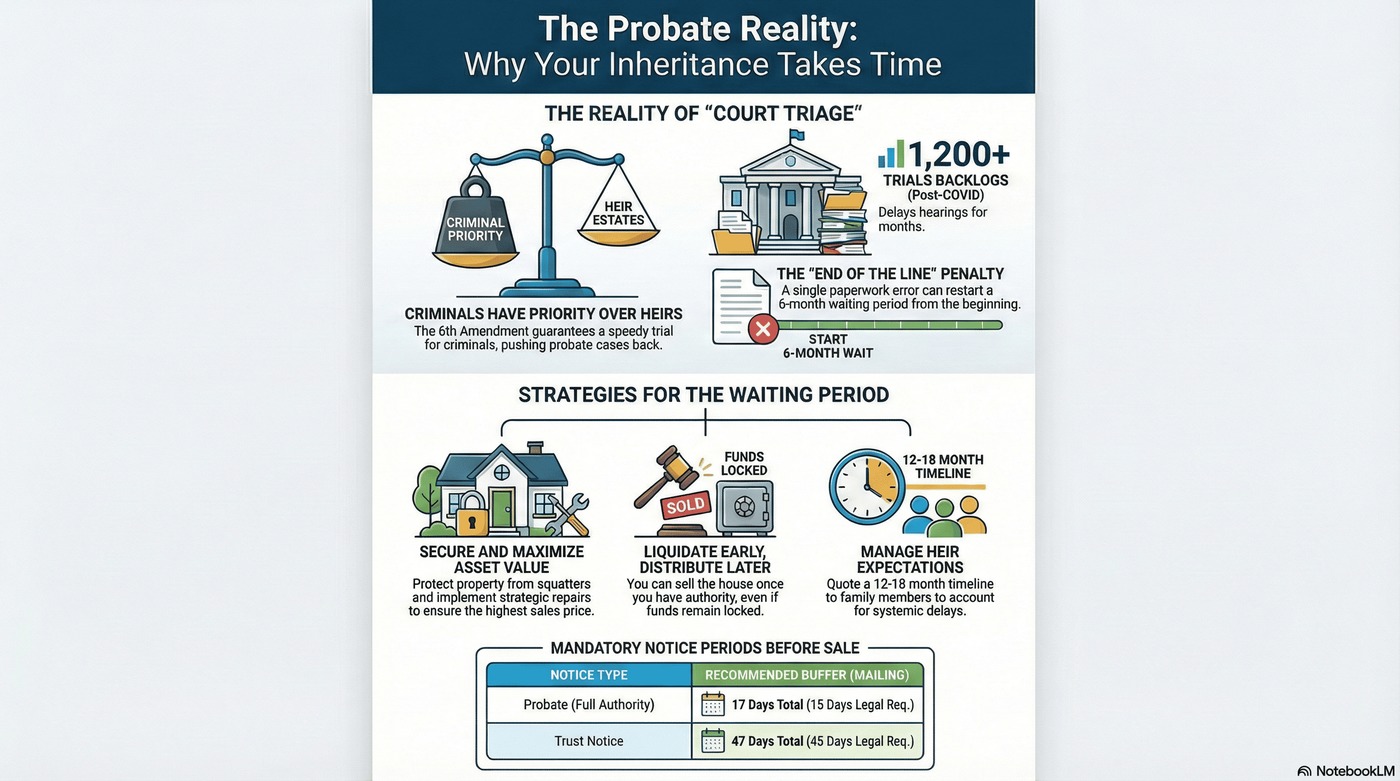
Probate timelines are the first thing every family asks me about, and the answer they least want to hear is that the court is not ignoring them. It is busy with something the law ranks higher. California tells its courts that criminal cases get set and heard ahead of civil matters, without regard to whatever else is pending.[1] Your mother's house in Fullerton is a civil matter.
That sounds unfair when you are paying a mortgage and insurance on a vacant property you did not choose to own. It is also the single most useful fact for planning a probate sale, because once you accept that the calendar is out of your hands, you can spend your energy on the parts that are not.
This guide walks through why the wait happens, what the statutes actually require, a real case with 22 heirs living abroad, and the checklist we use so that when the court finally gets to your file, nothing in it sends you back to the end of the line.
Why Does Probate Take So Long in California?
Most heirs walk into probate expecting something like a real estate escrow: a defined number of days, a closing date, a check. What they get is a court process where the first hearing date is assigned to them. Continued hearings are common, and each step depends on the one before it.
The house does not wait politely in the meantime. Property taxes come due. The homeowner's policy may need to be rewritten as a vacant dwelling policy. A pipe under the kitchen sink starts to weep, or a neighbor calls because someone has been sleeping in the side yard. Every month on the probate calendar is a month of carrying costs paid by the estate, which means paid by the heirs.
The court triage
A courthouse works like an emergency room with a fixed number of doctors. The patient with the most urgent legal claim goes first, and the law has already decided who that is. A person accused of a crime is facing the loss of liberty and has a constitutional right to a speedy trial. A family waiting on an order to distribute a house is facing inconvenience and cost. Painful, yes. Not equal in the eyes of the law.
I do not say that to be harsh. I say it because the families who make peace with the triage early make better decisions. They stop treating each continuance as a personal insult and start using the dead time to get the property and the paperwork ready.
Why Criminal Cases Get Priority Over Your Probate Case
The Sixth Amendment opens with a promise: "In all criminal prosecutions, the accused shall enjoy the right to a speedy and public trial."[2] There is no matching constitutional promise that an heir will get a quick order confirming the sale of a three bedroom ranch house in Garden Grove.
California backs the federal guarantee with a statute aimed squarely at court calendars. Penal Code section 1050 directs that criminal cases be given precedence over, and be set for trial and heard without regard to the pendency of, any civil matters or proceedings.[1] The same subdivision tells courts and counsel to move criminal proceedings along as quickly as justice allows.[1]
Put those two together and you have the structural reason probate timelines stretch. Judges and courtrooms are finite. When criminal matters must move first by law, the civil side of the building absorbs the delay, and probate lives on that side.
What this means for you. Nobody can call the court and get your hearing moved up because the house is costing money. The lever you have is preparation: a file so complete that the first hearing you get is the only one you need.
I have heard attorneys and families talk about this as if it were a scandal. I see it differently. The rule exists for a good reason, and fighting it is wasted energy. Planning around it is where the money is.
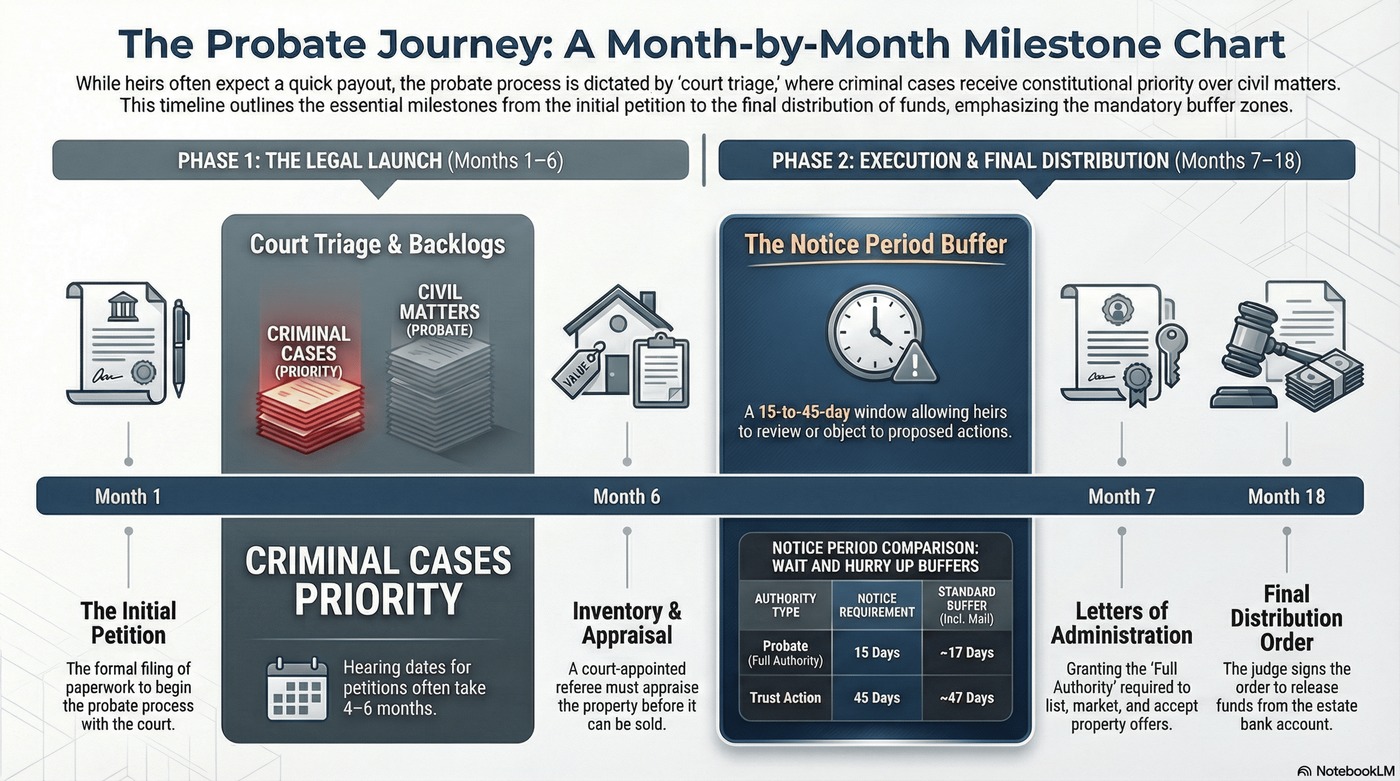
How Long Does Probate Take? A Realistic Orange County Timeline
Some parts of the probate timeline are fixed by statute. Others depend on the court calendar and on the family. Here is how the pieces fit, with the deadlines the code actually sets.
| Milestone | What the law says | What controls the real timing |
|---|---|---|
| Letters issued to the executor or administrator | Starts most of the statutory clocks below | The court's hearing calendar for the initial petition |
| Inventory and appraisal filed | No later than four months after letters are issued[7] | How fast the executor lists assets and gets the file to the referee |
| Probate referee completes appraisal | Within 60 days of receiving the inventory, or the referee must report the delay[7] | Referee workload and the completeness of what you send |
| Sale of the house | Notice of Proposed Action at least 15 days before acting with full authority[3]; court confirmation sales need a recent appraisal and an offer of at least 90 percent of it[5] | Property condition and whether anyone objects |
| Petition for final distribution or status report | Within one year after letters, or 18 months if a federal estate tax return is required[6] | Creditor issues, tax returns, family disputes |
Notice what the table does not contain: a date for the first hearing, a date for any continued hearing, or a promise about when the judge will sign the final order. Those belong to the court.
For the sale itself, our longer breakdown of how long a probate sale takes in California goes step by step from listing through confirmation.
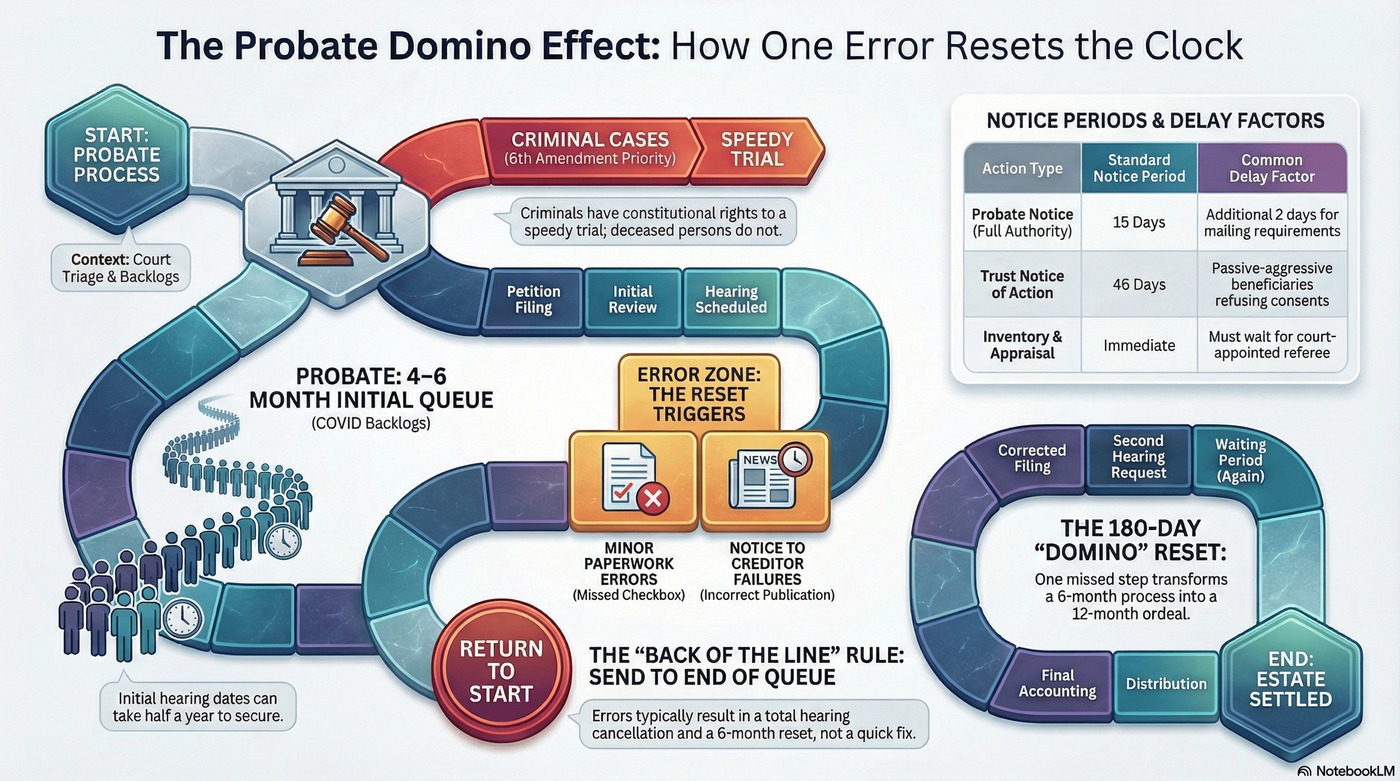
Why Probate Errors Send an Estate to the Back of the Line
Here is the part of probate timelines that families can actually change, and the part most of them underestimate.
When a petition or a notice has a defect, the hearing usually does not end with a quick fix at the counter. It ends with a continuance. A new date is set, and that date is wherever the next opening falls on a calendar already crowded by the cases the law puts first. A missing signature or an heir who never got notice can cost you a slot you waited months for.
That is why I would rather spend an extra week getting a notice right than save a week and lose a hearing.
Where files go wrong most often
- An heir's current mailing address was never confirmed, so proof of notice is incomplete.
- The notice period was counted to the exact day with no margin.
- The inventory was filed without the property that matters most because the deed was still being located.
- Family members heard about a proposed sale from a neighbor before they heard it from the executor, and they objected out of surprise rather than substance.
Work with Paula: Probate real estate services in Orange County
The last one is not a legal defect at all. It is a communication failure, and it produces the same result: delay. We cover the human side of this in more depth in common challenges in probate sales and how to overcome them.
Case Study: 22 Heirs Abroad and One Complex Estate
Some estates are simple: one house, one executor, two siblings who get along. This one was not.
The property was in Anaheim Hills. The heirs were not. There were 22 of them, living in a foreign country, and the law did not care that coordinating them was hard. The work came down to these realities:
- Every one of the 22 heirs in a foreign country had to be formally notified.
- We had to work within the rigid "15-day vs. 45-day" notice requirements.
- The entire process lived in the shadow of a single "No", one objection from any of the 22 heirs would have frozen the estate for years.
- Every document had to be right the first time, because a redo meant another round of international mail and another wait on the court calendar.
The statute is blunt about delivery. A Notice of Proposed Action goes out under the Probate Code's general notice rules to each person entitled to it, and it must be delivered no less than 15 days before the date of the proposed action.[3] When those people live overseas, "delivered" becomes a logistics problem: you need verified addresses and a calendar that assumes international mail is slow.
The approach I recommend in an estate like this is to treat 22 people as 22 people: each one gets the same information at the same time, and each one has someone to call. Silence from an heir overseas is not consent and it is not opposition. Usually it is confusion, and confusion is cheaper to fix before a deadline than after it.
If your family looks anything like this one, with heirs spread out and nobody quite in charge, read what happens when siblings cannot agree on selling an inherited house before the first notice goes out.
Protecting the Asset: From Hazmat to Highest Sale Price
While the estate in that case study waited on notice periods, the house itself needed help, and it could not wait. Our approach had three parts, and they are the template I still use on any probate property that has been sitting.
- Hazmat and Security: We immediately secured the perimeter and brought in professional hazmat teams to remediate the interior.
- Strategic Valuation: We performed an "As-Is vs. Repaired" analysis to show the heirs exactly how a targeted investment would yield a higher return.
- The Luxury Transformation: We treated the renovation as if it were a premier luxury listing.
The order matters. Securing the property comes first because a vacant estate home is an invitation, and liability for whatever happens there runs to the estate. The valuation comes second because heirs who live overseas cannot walk the house; they need a side by side comparison of what it sells for as it stands and what it sells for after specific, priced improvements. Only after the heirs see that math does the renovation make sense.
I have a clear opinion here. Selling a probate house as is, to the first cash buyer, is often the most expensive choice an estate makes, and it is usually made because the family is tired of waiting, not because the numbers favor it. Long probate timelines are exactly what make a targeted renovation possible: the months you are going to wait anyway become the months the work gets done. The fuller Anaheim Hills story is in why your as is probate sale is costing you thousands.
In fairness, as is is sometimes right. When the estate has no cash for repairs, or the house needs structural work that will not pay back, a clean as is sale can be the better call. The analysis tells you which case you are in.
Facing a long probate timeline in Orange County?
Paula can review the referee and notice deadlines in your estate, and whether the house should be repaired or sold as is while you wait.
Schedule a Free ConsultationThe Probate Referee: The Appraisal You Cannot Skip
You cannot sell until the house is appraised by a court-appointed Probate Referee. You don't get to choose them, so you must request their appointment the moment you have standing.
Probate referees are appointed by the State Controller from a pool of applicants who have passed an examination, and each serves a county.[7] In a probate case the court designates the referee for your estate, usually by impartial rotation.[7] The referee appraises the estate's non-cash assets, which for most Orange County estates means the house, and charges a statutory fee of one tenth of one percent of the assets they appraise, with a $75 minimum in probate matters, plus expenses.[7]
Timing matters in two directions. The inventory and appraisal has to be filed within four months after letters are issued, and once the referee receives the inventory, the appraisal is due within 60 days or the referee must explain the delay.[7] On the back end, if the sale goes through court confirmation, the appraisal must be within one year of the confirmation hearing and the offer has to be at least 90 percent of the appraised value.[5]
Watch the one year window. On a slow case, the appraisal can go stale before the sale is confirmed. If the market has moved, the court can also allow a new appraisal when it is satisfied the latest one is too high or too low.[5] Ask your attorney early whether a reappraisal is likely, because it adds time.
My advice is simple. Get the inventory to the referee as soon as letters issue, along with everything the referee needs to get inside and understand the house. A referee who has to chase information is a referee whose appraisal comes back late.
Notice of Proposed Action: Why We Count 17 Days, Not 15
The notice periods are where probate timelines and trust timelines split, and where a lot of families get confused because they hear both numbers from different people.
| Probate estate (executor with full authority) | Trust (trustee) | |
|---|---|---|
| Statute | Probate Code section 10586[3] | Probate Code section 16502[4] |
| Minimum notice | Delivered no less than 15 days before the date of the proposed action[3] | Objection period of at least 45 days from delivery or receipt of the notice[4] |
| What it must say | The proposed action and the date on or after which it will be taken | The trustee's contact details, a contact person, the action and its reasons, the objection deadline, and the date the action may be taken[4] |
| Our working margin | 17 days | We plan from 45 days and add margin for mail |
The 17 day habit
With "full authority," you must give a Notice of Proposed Action 15 days before closing. One detail that matters: Always add two days for mailing. We count 17 days to ensure no heir can claim they weren't notified. If you're dealing with a trust, that notice period jumps to 45 days. Be proactive, difficult heirs often stay silent just to force you to wait the full duration.
To be precise about it, the two extra days are our own margin, not a statutory requirement. The code sets the 15 day minimum and says the notice is delivered under the Probate Code's general notice rules.[3] Counting 17 costs two days. Counting 15 and being wrong can cost the hearing, and on this calendar a lost hearing is measured in months.
The quiet heir problem is real. An heir who objects in writing is at least telling you where things stand. An heir who says nothing and waits out every day of every notice period is using the clock, and the only defense is to start the clock early.
The "Wait and Hurry Up" Checklist for Success
Probate has a strange rhythm. Long stretches where nothing seems to happen, then a notice period or a hearing date where everything has to happen at once. We call it wait and hurry up, and the families who do well are the ones who use the waiting to prepare for the hurry.
- Request the probate referee appointment the moment you have standing, and send the inventory as soon as letters issue.
- Confirm every heir's address in writing before the first notice goes out, including anyone overseas.
- Secure and insure the property right away, and tell the carrier the house is vacant.
- Run an as is versus repaired analysis so the family decides on numbers instead of fatigue.
- Count 17 days, not 15, on a probate Notice of Proposed Action, and plan from 45 on a trust.
- Put the one year deadline on the calendar for the petition for final distribution or the status report.[6]
- Blame the system, not yourself. Set expectations with the family using the court's reality, not your hopes.
None of that speeds up the judge. All of it keeps you from losing your place once the judge gets to you.
If you are the executor and this is your first week, start with the first 48 hours of probate, which covers the steps that protect the house before any of these deadlines begin.
Can You Sell Before the Probate Case Ends?
Yes, and in most Orange County estates I work on, the house sells well before the case closes. The sale happens during administration, once the executor has authority and the appraisal is in hand. Distribution of the proceeds is what waits for the end.
How the sale proceeds depends on the authority the court granted.
With full authority
The executor can sell by giving a Notice of Proposed Action to the people entitled to it at least 15 days before the action.[3] If nobody objects, the sale moves forward without a court confirmation hearing. This is usually the faster path, and it is the one where the 17 day habit pays off.
Through court confirmation
When the sale needs the court's approval, the appraisal must be within a year of the confirmation hearing and the accepted offer has to be at least 90 percent of the appraised value.[5] Now the hearing calendar is back in play, so the same triage that slowed the start of the case can slow the sale as well.
The money waits even when the house does not. Selling early stops the carrying costs and turns a deteriorating asset into cash in an estate account. It does not mean the heirs are paid that week. Final distribution follows its own timeline under the court's supervision.
For executors weighing these choices for the first time, our guide on what every executor needs to know before selling estate property in California covers the authority question in more depth.
How to Talk to Your Family About Probate Timelines
Executors get blamed for the court. It happens in almost every family, and it happens most to the sibling who lives closest to the house and ends up doing the work.
Blame the System: Don't take the heat for the court’s failures. My script for executors is short, and I give it to them word for word:
The attorney and the Aragone team have confirmed that the Orange County backlog is 12 to 18 months. If you finish in nine months, you’re a hero. If you promise six and it takes twelve, you’re the villain.
Paula Aragone
That range is our working estimate from the cases we handle, not a figure the court publishes. The point of saying it out loud is to anchor the family to a realistic number before anyone anchors them to a hopeful one.
Two more habits help. Send the whole family the same written update at the same time. And when a hearing gets continued, say why in one sentence and give the new date.
And when an heir asks why the court is so slow, tell them the truth from the top of this article. The law puts criminal cases first.[1] That answer lands better than "the attorney is working on it," because it is specific and it does not make anyone the villain.
Strategy Over Patience
Patience is what most people tell grieving families to have. I think that advice is incomplete. Patience with the court is necessary. Patience with everything else is expensive.
The estates that take longest in my experience are rarely the ones with the most complicated law. They are the ones where nobody requested the referee, the house sat unsecured for months, an heir in another country never got a proper notice, and the family argued about price without a valuation in front of them. Each of those is a self inflicted delay layered on top of a calendar that was already long.
The estates that finish well look different. The work that can be done early is done early, with notices sent out with margin, and the house gets protected and, when the math supports it, improved while the court catches up. By the time the judge reaches the file, there is nothing left in it to fix.
You cannot jump the line. You can make sure that when your turn comes, you only need one.
Frequently Asked Questions
Why does probate take so long in California?
Probate takes so long partly because California law tells courts to give criminal cases precedence over civil matters, and a probate petition is a civil matter. The estate cannot change that queue. What the executor can control is everything around it: getting the probate referee appraisal done early, and sending a clean Notice of Proposed Action at least 15 days before closing.
Why do criminal cases get priority over probate in California courts?
California Penal Code section 1050 directs that criminal cases be given precedence over, and be heard without regard to the pendency of, any civil matters or proceedings.[1] It sits on top of the Sixth Amendment right of an accused person to a speedy trial.[2] Probate is a civil proceeding, so it yields.
How long does probate take in Orange County?
There is no fixed number. Our working estimate for families is 12 to 18 months, based on the cases we handle, and the statute expects the executor to petition for final distribution or file a status report within one year after letters, or 18 months when a federal estate tax return is required.[6] Disputes and continued hearings push it longer.
Can I sell a house in probate before the case is closed?
Yes. The house is usually sold during administration, once the executor has authority and the referee's appraisal is done. With full authority the executor gives a Notice of Proposed Action at least 15 days ahead.[3] The heirs are paid at distribution, which comes later.
What does a probate referee do?
A probate referee is appointed by the State Controller and designated by the court, usually by rotation, to appraise the estate's non-cash assets such as real estate.[7] The fee is one tenth of one percent of the assets appraised, with a $75 minimum in probate matters, plus expenses.[7]
Can I choose my own probate referee?
Generally no. In probate cases the court designates the referee, usually by impartial rotation.[7] That is why we tell executors to request the appointment as soon as they have standing rather than wait.
How many days of notice does an executor have to give before selling?
Under Probate Code section 10586, a Notice of Proposed Action must be delivered no less than 15 days before the date of the proposed action.[3] We count 17 days as a working margin, which is our own practice rather than a legal requirement.
Is the notice period different for a trust?
Yes. A trustee's notice of proposed action under Probate Code section 16502 must give beneficiaries at least 45 days from delivery or receipt to object.[4]
What is the minimum price for a court confirmed probate sale?
For a private sale that goes to court confirmation, the offer must be at least 90 percent of the appraised value, and the appraisal must fall within one year before the confirmation hearing.[5]
What happens if one heir objects to the sale?
An objection to a Notice of Proposed Action can force the sale into court supervision, which puts it back on the hearing calendar. In the 22 heir estate we describe above, one objection from any heir would have frozen the estate for years, which is why clear, early communication with every heir matters as much as the paperwork.
Sources and How This Guide Was Written
Every statute and deadline in this guide was read from the source listed below while this article was being updated. California code sections were read on California Public Law copies because the official legislature site was not reachable from our research environment; the probate referee details come from the referee guide published on the State Controller's website.
- California Penal Code section 1050, which gives criminal cases precedence over civil matters and proceedings on court calendars (California Public Law copy). Read the statute
- The Bill of Rights transcript at the National Archives, including the Sixth Amendment right of the accused to a speedy and public trial. Read the amendment
- California Probate Code section 10586, setting the 15 day minimum for delivering a Notice of Proposed Action under independent administration (California Public Law copy). Read the statute
- California Probate Code section 16502, governing a trustee's notice of proposed action and its 45 day objection period (California Public Law copy). Read the statute
- California Probate Code section 10309, requiring an appraisal within one year of the confirmation hearing and an offer of at least 90 percent of appraised value for a confirmed private sale (California Public Law copy). Read the statute
- California Probate Code section 12200, requiring a petition for final distribution or a status report within one year after letters, or 18 months when a federal estate tax return is required (California Public Law copy). Read the statute
- The California Probate Referees' Association guide hosted by the California State Controller's Office (Rev. 04/2020), covering referee appointment, designation, fees and appraisal timing. Read the guide
Statutes and court practices change, so confirm the current rules and your own deadlines with your probate attorney before acting.
Stay Connected
New posts every week on probate and trust real estate in Orange County. Subscribe to the blog or listen to the podcast on Spotify. You can also find Paula on Instagram and YouTube.
Paula Aragone
Aragone & Associates
949-415-4784 | [email protected]
Paula Aragone, CA DRE #01364746
Aragone & Associates | First Team Real Estate, CA DRE #01008773
4 Corporate Plaza Dr #100, Newport Beach, CA 92660
This article is general information about probate timelines and probate real estate sales in California and is not legal advice. We are not attorneys, so review your situation with qualified counsel, and if you do not have an attorney we can connect you with one we trust.
Tags: probate timelines, how long does probate take in California, Orange County probate, probate referee, notice of proposed action, sell house during probate, probate court delays, probate sale Anaheim Hills

Paula Aragone
Aragone & Associates | First Team Real Estate
Paula has spent 23 years in Orange County real estate, with more than 900 transactions and over $900 million in sales behind her. She holds the CPRES, SRES, Certified Luxury and Certified Relocation Specialist designations, is a member of Luxury Portfolio International, and went to law school before building her practice around probate, trust, divorce and luxury property.
Is your family stuck waiting on probate?
Paula will map out the deadlines you control and keep the house protected and ready to sell while the court works through its calendar.
Call (949) 415-4784Schedule a ConsultationCheck out this article next
