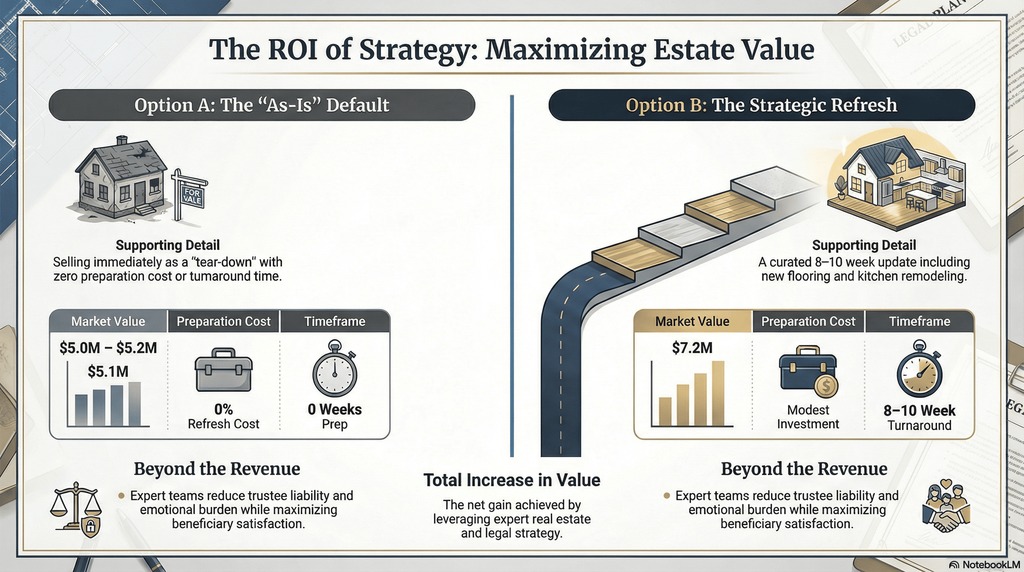
In estate real estate, an expert team means an estate attorney handling the legal side and a specialized real estate advisor handling the market, with a CPA on the tax questions, all in constant contact. In one Orange County trust sale, agents called the house a tear-down worth $5 million to $5.2 million as is; a budget-conscious refresh led to a $7.2 million sale in under three months. The team also keeps the statutory clocks straight, such as the 45 day objection window on a trustee's notice of proposed action.[1]
- The $2.2 Million Difference in One Orange County Estate Sale
- The Tear-Down Trap: Why As Is Is the Default Advice
- What a Strategic Refresh Covers and What It Leaves Alone
- Who Belongs on an Estate Real Estate Expert Team
- Trust Sale vs. Probate Sale: The Notice Periods
- Keeping Beneficiaries Informed So Nobody Waits Out the Clock
- How Long Does an Estate Sale Take When the Team Is Aligned
- Prop 19 and the Inherited Property Tax Base
- The Federal Estate Tax Exemption Has Moved
- Stale Powers of Attorney and Probate for the Living
- Choosing a Trustee When Family Dynamics Are Complicated
- How Our Team Works With Your Attorney and CPA
- Frequently Asked Questions
- Sources and How This Guide Was Written
Stepping into the role of trustee or executor comes with a heavy paradox. You are asked to make cold, high stakes financial decisions about estate real estate while you are still grieving, and in the luxury markets of Orange County the fiduciary weight is enormous. One wrong move can cause family friction, and it can also cost the beneficiaries a fortune.
This guide starts with a real case where the difference between the first advice and the final result was $2.2 million. Then it walks through why an expert team protects estate value, and the California notice periods and Prop 19 rules that shape every estate sale. I have updated the facts from the original post against primary sources, and where a figure has changed since March 2026, I say so.
The $2.2 Million Difference in One Orange County Estate Sale
The family had already heard the verdict from more than one local agent. Sell the trust property as is, they said, somewhere between $5 million and $5.2 million, and spare yourself the hassle. The house was a tear-down. Nobody was going to pay for the structure, only for the dirt under it.
The client asked for a second opinion. That single phone call is the reason this article exists.
Instead of listing at the as is number, the trust put a modest, budget-conscious amount into a refresh that a specialized real estate advisor scoped and managed, working alongside the trust's attorney. The property sold for $7.2 million. The difference between the as is advice and the actual result was $2.2 million, and it went to the beneficiaries, which is where an estate's money is supposed to go.
The whole sequence, from the start of the refresh through the close of escrow, took less than three months. I mention the timeline because speed is the usual argument against doing anything to an estate property, and in this case the argument simply did not hold.
As it was put in the podcast episode behind this post: "By putting a little bit of money... this trust was able to maximize the sale and get 2 million 2.2 million more than they would have got by not doing anything."
What changed the outcome. The house did not change much. The team did. The attorney handled the legal side of the trust, the real estate advisor handled the market side, and the two talked to each other constantly instead of meeting for the first time at closing.
I am not telling this story to suggest every estate property is hiding two million dollars. Most are not. I am telling it because the gap between a lazy recommendation and a researched one is real money, and the trustee is the person who answers for that gap.
The Tear-Down Trap: Why As Is Is the Default Advice
Plenty of agents recommend selling estate property as is. Some of the time they are right. A lot of the time it is simply the path with the least work for the agent.
Think about the incentives. An as is listing goes up in a week and closes on an investor offer without anyone having to chase a painter who shows up late. Labeling the house a tear-down ends the conversation before it starts. And the agent's commission on $5 million versus $7.2 million is a difference the agent can live without far more easily than the beneficiaries can.
My position is blunt: for an older house in a high value Orange County neighborhood, the words "tear-down" should trigger a second opinion every single time. Buyers in places like Newport Beach, Newport Coast, Corona del Mar or the hills above Laguna Beach will pay for land, yes. But a large share of them will also pay a meaningful premium for a house they can move into this year instead of spending two years in permits and construction. When the house is livable with some work, selling it as dirt leaves that second group of buyers out of the room.
When as is really is the right call
I have seen it work both ways, and there are estates where I tell the trustee to sell as is and not spend a dollar:
- The structure has serious foundation or slope problems that a cosmetic refresh would only hide.
- The beneficiaries cannot agree to fund any work, and the trust has no liquid cash to do it.
- The land value so far exceeds the house that buyers are certain to scrape it regardless of condition.
- The court timeline or a creditor issue makes waiting a few extra weeks more expensive than the likely gain.
Outside those situations, the burden of proof should sit on the person recommending you do nothing. Ask them to show you the comparable sales that support the as is price and the comparable sales of refreshed homes nearby. If they only bring the first set, you have learned something about the recommendation. We wrote more about this exact decision in selling trust property as is or preparing it first, and about the as is mistake in a probate setting in the $2.2 million misconception.
What a Strategic Refresh Covers and What It Leaves Alone
A refresh is not a renovation. That distinction is the whole point.
A renovation moves walls and runs for months on permits. A strategic refresh spends a controlled budget on the handful of things buyers react to in the first ninety seconds of a showing and in the listing photos, then stops. In the $7.2 million sale, the focus was on high impact items such as new flooring, an updated kitchen and fresh paint.
| Usually worth doing | Usually worth skipping |
|---|---|
| Stained or mismatched flooring | Moving interior walls or changing the floor plan |
| Paint throughout, in a neutral palette that photographs well | Custom finishes chosen to someone's personal taste |
| Kitchen counters and lighting | A full kitchen gut with new cabinet layout |
| Landscaping cleanup and curb appeal | Additions or anything requiring plan check |
| Repairs an inspector will flag anyway | Upgrades a buyer will rip out regardless |
The discipline is in the second column. Executors and trustees who have just lost a parent sometimes want to restore the house to how it felt when the family was young. That is a lovely instinct and an expensive one. The goal of a refresh is to match what the buyer pool in that specific neighborhood is paying up for, and nothing more.
Who pays for the refresh
The money usually comes from the trust or estate itself, which means the trustee has to be comfortable explaining the spend to beneficiaries. That conversation is much easier with a written budget and a pricing analysis showing the expected net with and without the work. I would never ask a trustee to approve a refresh on a hunch. The numbers should be on paper before a single painter is hired.
Who Belongs on an Estate Real Estate Expert Team
We are in an age of specialization. An estate attorney protects you on the legal side, including the fiduciary exposure that comes with being a trustee or executor. A specialized real estate advisor handles the market execution. Attorneys are not Realtors, and Realtors are not legal counsel. A successful probate or trust sale needs both, and in most estates it also needs a tax professional.
| Team member | What they own | What they should not be asked to do |
|---|---|---|
| Estate or trust attorney | Trust interpretation, court filings, notices, fiduciary liability | Price the property or pick a listing strategy |
| CPA or tax adviser | Basis calculations and tax returns | Decide whether to refresh the house |
| Specialized real estate advisor | Valuation, preparation, marketing, buyer negotiation, escrow coordination | Give legal or tax advice |
| Professional fiduciary (when used) | Neutral administration of the trust when family members cannot serve | Replace the attorney's role |
| Escrow and title | Clearing title, recording, payoff of liens | Resolve disputes between beneficiaries |
Attorney Cheryl Barrett of Ferruzzo & Ferruzzo emphasized that transparency between these experts is what makes the team work. Often a client will mention a goal to their agent that they have never shared with their lawyer. Maybe one sibling wants to keep a particular piece of furniture, or the trustee is worried about a brother who has been living in the house. When the team communicates constantly, those goals get handled properly and every "T" is crossed.
Look for continuity in the firms you hire
High net worth families should also look at succession inside the professional firms they use. A firm that pairs veteran attorneys with younger associates is planning to be around for the decades your estate plan has to last. A solo practitioner near retirement may be brilliant today and unavailable when your trust becomes irrevocable.
A practical test: ask each advisor whether they are willing to be on a shared email thread with the others. The good ones say yes immediately.
Trust Sale vs. Probate Sale: The Notice Periods
One of the biggest stressors for a new trustee or executor is the red tape. You cannot list an estate property on Monday and close on Friday. California builds in notice periods to protect beneficiaries and heirs, and those periods shape the calendar of every sale.
The original version of this post described a 45 day period for trust transactions and a 15 day period for probate transactions. Both numbers are real, and I have checked them against the Probate Code for this update. It is worth being precise about what each one actually is.
| Situation | Rule | Minimum time |
|---|---|---|
| Trustee gives a notice of proposed action (for example, a proposed sale) | Probate Code section 16502 | At least 45 days for beneficiaries to object[1] |
| Personal representative acting under independent administration gives a notice of proposed action | Probate Code section 10586 | Delivered not less than 15 days before the proposed action date[2] |
| Revocable trust becomes irrevocable at the settlor's death | Probate Code section 16061.7 | Trustee notification due within 60 days; 120 day window to contest after service[3] |
The trust side
Under section 16502, a trustee's notice of proposed action has to describe the action and the reasons for it, and it must give beneficiaries at least 45 days from delivery or receipt to object[1]. It is a tool, not a requirement for every trust sale, but it is one many attorneys use for a significant transaction because it puts beneficiaries on notice and gives them a fair chance to speak before the house is sold.
Separately, when a revocable trust becomes irrevocable because a settlor has died, the trustee must notify beneficiaries and heirs within 60 days, and the notice carries a warning that a contest generally cannot be brought more than 120 days after the notification is served[3]. Your attorney sets that clock. Your real estate advisor should know where it stands.
The probate side
In a probate with independent administration authority, the personal representative gives a notice of proposed action that must be delivered not less than 15 days before the date on or after which the action will be taken[2]. If you want the fuller comparison, including court confirmation, see our guide on selling a house in probate versus a trust sale. For families in the hills of north Orange County, our probate real estate page for Anaheim Hills covers the local side.
Keeping Beneficiaries Informed So Nobody Waits Out the Clock
The 45 day trust window can feel long when there is a buyer waiting and a property tax bill coming.
Here is what experience shows. When beneficiaries are kept well informed and can see a clear path to their inheritance, they rarely sit on their objection period out of suspicion. In practice they tend to cooperate early, and many attorneys can document that cooperation in writing. Transparency is the most effective answer I know to the human dynamic of family friction.
Insider insight. Most objections I have seen in trust sales are not about the price. They are about a beneficiary who felt left out of the decision. Send the pricing analysis and the refresh budget to every beneficiary before the house goes live, and a large share of those objections never materialize.
What does well informed look like week to week? A short written update after each milestone. The comparable sales the price is based on. The offers received, in summary form, with the reasoning for the counter. Those updates take an hour to write and can save a month of conflict.
When siblings simply cannot agree, the dynamics change and the attorney's role grows. We wrote about that situation in detail in what happens when siblings cannot agree to sell an inherited house.
Was your estate property called a tear-down?
Paula is a CPRES certified probate and trust specialist. She will prepare a pricing analysis both ways, as is and after a refresh, and share it with your attorney.
Schedule a Free ConsultationHow Long Does an Estate Sale Take When the Team Is Aligned
The case study above closed in under three months, refresh included. That is fast for a property of that size, and it was possible because the legal work and the market work were running in parallel instead of in sequence. Here is the order I aim for on a trust sale where the trustee has authority and the beneficiaries are informed.
- Week one: gather the documents. The trust, the death certificate, the most recent property tax bill, any loan statements and the attorney's read on the trustee's authority to sell.
- Weeks one and two: valuation and scope. A pricing analysis as is and after a refresh, with a written budget for the work and a projected net under both scenarios.
- Weeks two and three: beneficiary communication. The attorney decides whether a notice of proposed action is advisable, and the trustee shares the plan with every beneficiary.
- Weeks three through seven: the refresh. Flooring, paint, kitchen surfaces and landscaping, managed against the budget, while photography and marketing are prepared.
- Weeks seven through twelve: list and close. Listing, offers, inspection negotiation and escrow, with the attorney and CPA copied on the milestones that touch them.
Every estate has its own complications, and I would rather give you an honest range than a promise. A trust with cooperative beneficiaries and a clean title can move like this. A probate with court confirmation or a relative living in the house will not, and the fix there is patience plus a good attorney rather than a faster agent.
Prop 19 and the Inherited Property Tax Base
An estate plan is not a static document, and Prop 19 is the clearest recent example of why. For transfers from parents to children on or after February 16, 2021, the old rules under Propositions 58 and 193 no longer apply[4].
Under the current rule, a child can keep a parent's low property tax base on the family home only if the home was the parent's principal residence and becomes the child's principal residence[4]. The child has to file for the homeowners' exemption within one year of the death or transfer to get the full benefit, and the separate exclusion claim is due within three years or before the property is transferred to a third party, whichever comes first[4].
There is also a value cap. The exclusion covers the factored base year value plus an adjusted amount, which the Board of Equalization lists at $1,044,586 for transfers from February 16, 2025 through February 15, 2027[4]. Any market value above that sum gets added to the assessed value. Rental homes do not qualify for the parent-child exclusion at all[4].
The sibling problem Prop 19 creates
Here is where it gets hard in real families. Say three siblings inherit a house in Irvine. Only one of them can move in and keep the tax base, which usually means buying out the others. That buyout needs a defensible valuation and real money behind it. It also needs an attorney to document it, so nobody later claims the price was unfair.
My opinion: if the plan is for one child to keep the family home, the parents should have that conversation with their attorney while they are alive, not leave it for the siblings to work out in the weeks after a funeral. If it has been more than four or five years since your plan was reviewed, and it predates February 2021, it was written for rules that no longer exist.
The Federal Estate Tax Exemption Has Moved
The original version of this post said the federal estate tax exemption was near $13 million. That figure is out of date, and this is what changed.
According to the IRS, the basic exclusion amount was $13,990,000 for estates of people who died in 2025, and it is $15,000,000 for 2026, after legislation signed on July 4, 2025 (Public Law 119-21) amended the statute to set that 2026 amount[5]. The annual gift exclusion for 2026 is $19,000 per recipient[5].
For most Orange County families, that number means federal estate tax is not the issue. For a family with a Newport Coast estate plus a commercial building, it can be. And even below the threshold, the structure of an older plan still matters.
Why older A/B trusts deserve a second look
Many couples signed A/B trusts years ago, when the exemption was a fraction of today's figure and splitting the estate at the first death was the standard way to use both spouses' exemptions. With a much higher exemption, that split can create its own problems, including a locked up trust share that the surviving spouse cannot manage freely. I am not a tax adviser, and this is exactly the question to bring to your estate attorney and CPA together. What I can tell you is that I regularly see trust documents in escrow that clearly were drafted for a different era, and the families did not know.
A simple rule of thumb. Treat your estate plan like a roof. Have it inspected every four or five years, and immediately after a death, a divorce, a large sale or a change in the law.
Stale Powers of Attorney and Probate for the Living
Estate risk is not limited to what happens after someone dies. Incapacity can freeze a family's real estate just as completely.
Many people assume a power of attorney is a permanent shield. In the podcast conversation behind this post, the point was made that banks and title companies often balk at documents that are more than about five years old. That is a practice observation from the people who handle these transactions, not a rule written into the Probate Code, but I have seen the hesitation myself, and it is reason enough to refresh old documents.
When a power of attorney cannot be used, the family may have to ask a court for a conservatorship. California treats that as a last resort: the court must find that a conservatorship is the least restrictive alternative needed to protect the person, and it has to consider options such as powers of attorney, health care surrogate designations, advance health care directives and supported decisionmaking agreements first[6].
The cost is time. As it was said on the episode: "A conservatorship is a probate for the living... if we ask for a court date today, we're not going to get a hearing till Christmas." In the meantime, the property cannot be sold and the money inside it cannot pay for care.
If a conservatorship is already in place and the home has to be sold, there is a specific process for it. We explain it in selling a home under a conservatorship in California.
- Locate the current power of attorney and note the date it was signed.
- Ask your attorney whether it is durable and broad enough to cover a real estate sale.
- Confirm the named agent is still willing and able to act, and name a backup.
- Make sure the agent has authority over trust assets as well as assets held in your own name.
Choosing a Trustee When Family Dynamics Are Complicated
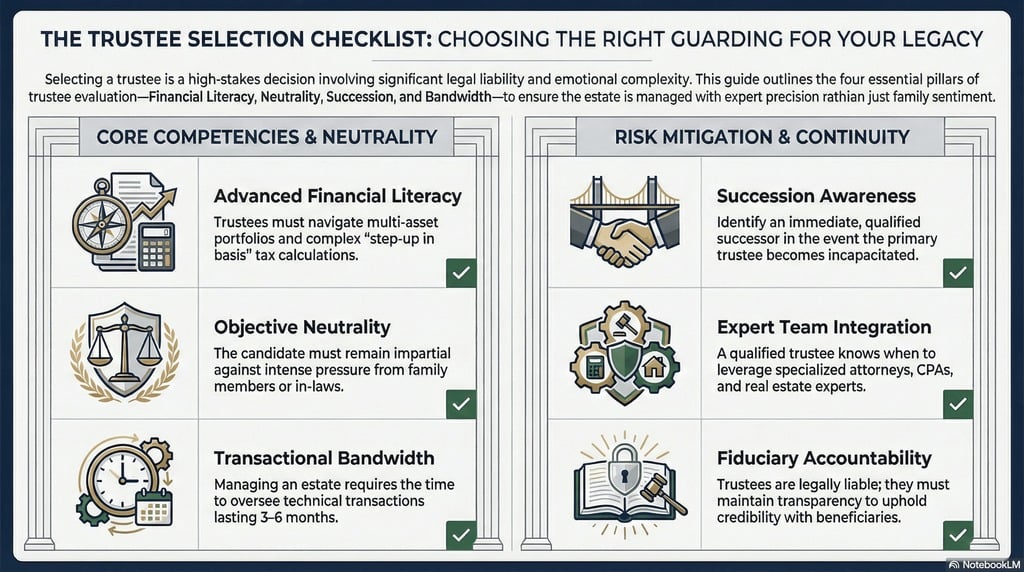
Choosing a trustee is as much about psychology as it is about finance. The "mom liked you best" dynamic tends to resurface during trust administration. A domineering in-law can make it very hard for a sibling who is serving as trustee to act neutrally, even when that sibling is doing everything right.
In many high net worth families, a professional fiduciary or a corporate trustee is the better choice. They carry none of the emotional history, so their decisions are much harder to frame as favoritism. In California, non-family professional fiduciaries are licensed by the Professional Fiduciaries Bureau, which is part of the Department of Consumer Affairs, and you can verify a license on the Bureau's site[7].
A professional costs money, of course. I think it is money well spent when there is a blended family or a beneficiary who is likely to challenge everything. We cover the role in more depth in what a professional fiduciary is in California.
Trustee selection checklist
- Does the candidate have the time to manage a property sale and the beneficiary communication around it for a year or more?
- Can every beneficiary accept this person's decisions without assuming bias?
- Is there a spouse or in-law likely to influence the candidate's choices?
- Will the candidate hire professionals and actually listen to them?
- Does the candidate live close enough to deal with an Orange County property in person?
- Has a successor trustee been named in case the first choice cannot serve?
If the honest answer to more than one of those is no, talk with your attorney about a professional.
How Our Team Works With Your Attorney and CPA
My role on an estate team is the market side. I am not your lawyer and I will not act like one, even with a law school background. What I bring is a pricing analysis built on real comparable sales, a refresh scope with a budget, a contractor network that can work on an estate timeline, and the habit of copying your attorney on the decisions that touch the trust.
The goal of the whole team is to take a large share of the stress off the trustee and reach the finish line with the highest return the property can support. When the estate is treated as an asset to manage rather than a burden to unload, the beneficiaries feel the difference, sometimes in seven figures.
Does your plan account for the 2021 Prop 19 changes and the current federal exemption? If it has been more than five years since your last review, you may be holding a stale plan that invites conflict or unnecessary tax.
Frequently Asked Questions
Should I sell an inherited or trust property as is?
Sometimes. If the house has serious structural problems or buyers are certain to scrape it, selling as is is reasonable. Otherwise, ask for pricing both ways. In one Orange County trust sale, agents advised an as is price of $5 million to $5.2 million, and a budget-conscious refresh led to a $7.2 million sale in under three months.
What is a strategic refresh?
A limited, budget-controlled set of improvements, such as flooring, paint, kitchen surfaces and landscaping, aimed at what buyers in that neighborhood pay a premium for. It avoids layout changes and anything that needs a permit.
How long is the trust notice of proposed action period in California?
Under Probate Code section 16502, the notice must give beneficiaries at least 45 days from delivery or receipt to object to the proposed action.[1]
How long is the notice period for a probate sale under independent administration?
Probate Code section 10586 requires the notice of proposed action to be delivered not less than 15 days before the date on or after which the action will be taken.[2]
When must a trustee notify beneficiaries after a death?
When a revocable trust becomes irrevocable because a settlor died, the trustee must serve notification within 60 days, and the notice warns that a contest generally cannot be brought more than 120 days after it is served.[3]
Can I keep my parents' property tax base under Prop 19?
Only for a family home (or family farm) that was the parent's principal residence and becomes yours, with a homeowners' exemption filed within one year. The exclusion is capped at the factored base year value plus $1,044,586 for transfers from February 16, 2025 through February 15, 2027. Rentals do not qualify.[4]
What is the federal estate tax exemption in 2026?
The IRS lists a basic exclusion amount of $15,000,000 for 2026, up from $13,990,000 for 2025.[5]
Why is a conservatorship called probate for the living?
Because it puts a living person's finances under court supervision, with hearings and delays similar to probate. California courts must first find it is the least restrictive alternative and consider options like powers of attorney.[6]
Should a family member or a professional serve as trustee?
A family member is fine when beneficiaries trust each other and the person has time. When there is conflict or an influential in-law, a licensed professional fiduciary or corporate trustee is often the safer choice. Licenses can be verified with the Professional Fiduciaries Bureau.[7]
Who should be on an estate real estate team?
At minimum an estate attorney and a specialized real estate advisor who talk to each other. Most estates also need a CPA for basis and tax questions, and some need a professional fiduciary when family members cannot serve neutrally.
Sources and How This Guide Was Written
Every legal and tax figure in this guide was read from a primary or official source while it was being updated. California Probate Code sections were read on Justia and California Public Law copies because the official legislature site was not reachable from our research environment; the Prop 19 and estate tax figures come directly from the Board of Equalization and the IRS.
- California Probate Code section 16502, contents of a trustee's notice of proposed action, including the minimum 45 day objection period (Justia copy of the 2023 California Code). Read the statute
- California Probate Code section 10586, delivery of a personal representative's notice of proposed action not less than 15 days before the proposed action date (California Public Law copy). Read the statute
- California Probate Code section 16061.7, trustee notification within 60 days when a trust becomes irrevocable and the 120 day contest warning (California Public Law copy). Read the statute
- California State Board of Equalization, Proposition 19 overview, covering the parent-child exclusion and its adjusted value limit. Visit the BOE page
- Internal Revenue Service, What's new: estate and gift tax, listing the basic exclusion amount for 2025 and 2026 and the 2026 annual gift exclusion. Visit the IRS page
- California Probate Code section 1800.3, requiring a finding that a conservatorship is the least restrictive alternative and consideration of alternatives such as powers of attorney (California Public Law copy). Read the statute
- California Department of Consumer Affairs, Professional Fiduciaries Bureau, which licenses non-family professional fiduciaries and offers license verification. Visit the Bureau
Statutes and exemption amounts change over time, so confirm the current rules with your estate attorney and CPA before acting.
Stay Connected
New posts every week on probate and trust real estate in Orange County. Subscribe to the blog or listen to the podcast on Spotify. You can also find Paula on Instagram and YouTube.
Paula Aragone
Aragone & Associates
949-415-4784 | [email protected]
Paula Aragone, CA DRE #01364746
Aragone & Associates | First Team Real Estate, CA DRE #01008773
4 Corporate Plaza Dr #100, Newport Beach, CA 92660
This article is general information about selling estate and trust real estate in California and is not legal or tax advice. We are not attorneys or tax advisers, so review your situation with qualified counsel, and if you do not have an attorney we can connect you with one we trust.
Tags: estate real estate, trust property sale Orange County, probate sale California, expert team estate sale, notice of proposed action, Prop 19 inherited property, estate tax exemption 2026, sell inherited house as is, professional fiduciary California

Paula Aragone
Aragone & Associates | First Team Real Estate
Paula has spent 23 years in Orange County real estate, with more than 900 transactions and over $900 million in sales behind her. She holds the CPRES, SRES, Certified Luxury and Certified Relocation Specialist designations, is a member of Luxury Portfolio International, and went to law school before building her practice around probate, trust, divorce and luxury property.
Were you told your family's home should be sold as is?
Send Paula the address. She will run the numbers both ways and walk you and your attorney through what a strategic refresh could change.
Call (949) 415-4784Schedule a ConsultationCheck out this article next