ARAGONE & ADVISORS
1. Introduction: A Conversation on Wealth, Strategy, and Trust
The transition from "grit to gold" is a hallmark of the American dream, yet for many high-net-worth individuals, the skills required to amass a fortune are starkly different from those required to preserve it.
While wealth creation is driven by aggressive marketing and financial acumen, wealth preservation demands a bespoke strategic framework rooted in technical precision and foresight.
In a recent episode of the Aragone & Advisors podcast, host Paula Aragone sat down with Blaine J. Burch of BHR Law Group to pull back the curtain on the high-stakes world of estate planning and business succession.
This wasn't merely a discussion on tax forms; it was a masterclass in navigating the intersection of family dynamics and sophisticated asset protection.
As an expert in helping families with closely held businesses, Burch highlights a critical reality: while many focus on the "now," the most successful legacies are built by those meticulously planning for the "what’s next."
2. The "Silence" Trap: Why Communication is the Ultimate Asset Protection Tool
The greatest threat to a multi-generational legacy isn't a market downturn or a predatory creditor it is the element of surprise. Blaine Burch identifies "the silence trap" as the primary catalyst for estate litigation. When a business owner operates in a silo, keeping succession plans or inheritance structures under wraps, they inadvertently create a vacuum that is inevitably filled by resentment and legal challenges.
To mitigate this, sophisticated planners advocate for a "tribe" mentality, bringing Gen 1 (the founders), Gen 2 (the successors), and Gen 3 together to align expectations. Litigation rarely stems from a lack of funds; it stems from unmet expectations and the emotional shock of a "clumsy execution" of the founder’s wishes. Even a child who is intentionally disinherited can find peace with the decision if it is communicated with clarity and love during the founder’s lifetime.
"There’s litigation when there’s a surprise. You can have a kid that’s entirely disinherited; they won’t care if they knew about it... but if it’s a surprise, if there’s something in there that’s just different than what everybody thought was going to happen, that’s when the litigation starts."
— Blaine J. Burch
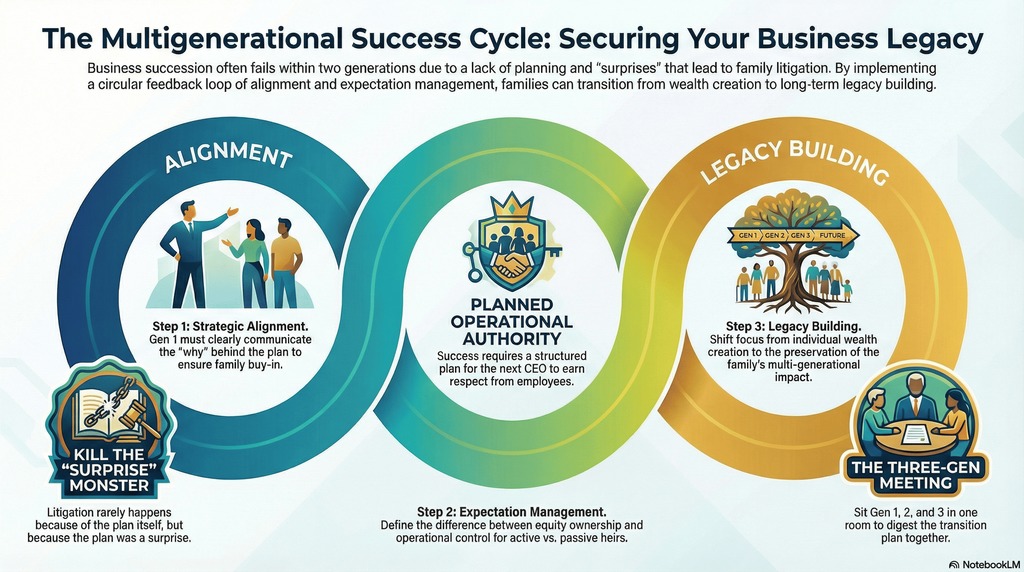
"The Communication Flow: From Gen 1 to Gen 3" involving a circular feedback loop of Alignment, Expectation Management, and Legacy Building.
3. Equity vs. Control: Solving the "Brat Son" Dilemma
Succession planning in family-held businesses often founders on a fundamental misunderstanding: the distinction between the equity of the business and the operational control of the entity. Burch draws from personal experience, having grown up in his family’s onion ring business (the legendary supplier for Carl's Jr.). Despite his background, he recognized the "brat son" stigma, the inherent skepticism employees feel toward a successor who hasn't yet proven their mettle.
The antidote to this perception is not just hard work, but the implementation of rigorous systems and procedures.
A sophisticated estate plan solves the "brat son" dilemma by separating the right to the business’s value from the right to sit in the CEO’s chair. For a family with multiple heirs, a common strategy is to grant the successor child operational control (often through non-voting shares or specific governance roles), while the other children receive equitable value through other means.
In the competitive landscape of Southern California, this might involve balancing the portfolio with a high-yield luxury listing or a specific trust or estate property that provides passive income. By diversifying the inheritance, the business is protected from "too many cooks in the kitchen," ensuring its survival into the next generation.
4. The 40% Surprise: Navigating the Estate Tax Cliff
Many business owners are "asset-rich and cash-poor," with their wealth tied up in the very enterprises they spent decades building. This lack of liquidity creates a massive vulnerability regarding the federal estate tax. While the current exemption is historically high—approximately $14 million per individual—anything exceeding that threshold is subject to a 40% tax.
The "9-month rule" is the most brutal aspect of this cliff: the IRS demands payment in cash within nine months of death. Without a proactive strategy, families are often forced into a "fire sale" or a rushed probate sale of a core asset.
Paula notes a recent case in San Juan Capistrano where the IRS unilaterally determined the property value, leading to a grueling dispute. Relying on a traditional buy/sell in Orange County and surrounding areas without considering the tax implications can leave heirs with a massive liability and a fractured legacy.
The Planning Paradox: Basis vs. Exemption

5. Sophisticated Shielding: Moving Beyond the Basic LLC
For high-liability professionals, doctors, attorneys, and developers, a standard LLC is often a paper-thin shield. Because professional liability often follows the individual, high-net-worth clients must move beyond basic structures toward advanced jurisdictional and statutory tools.
Burch emphasizes a three-layered pyramid of protection:
1. The Corporate Entity: Separation of personal and business assets.
2. Specialized Insurance: Tailored to the unique risks of the industry.
3. Statutory Protections: Using the Private Retirement Plan (PRP).
The PRP is an "insider" tool based on the California Code of Civil Procedure. Unlike a 401(k) or an ERISA plan, which have strict annual contribution caps, a PRP has no funding limits.
This makes it a game-changer for shielding sudden windfalls or the proceeds from a business sale.
As long as the assets can be proven necessary for retirement support, they are protected from creditors by California statute, a level of "sophisticated shielding" that traditional retirement accounts cannot match.
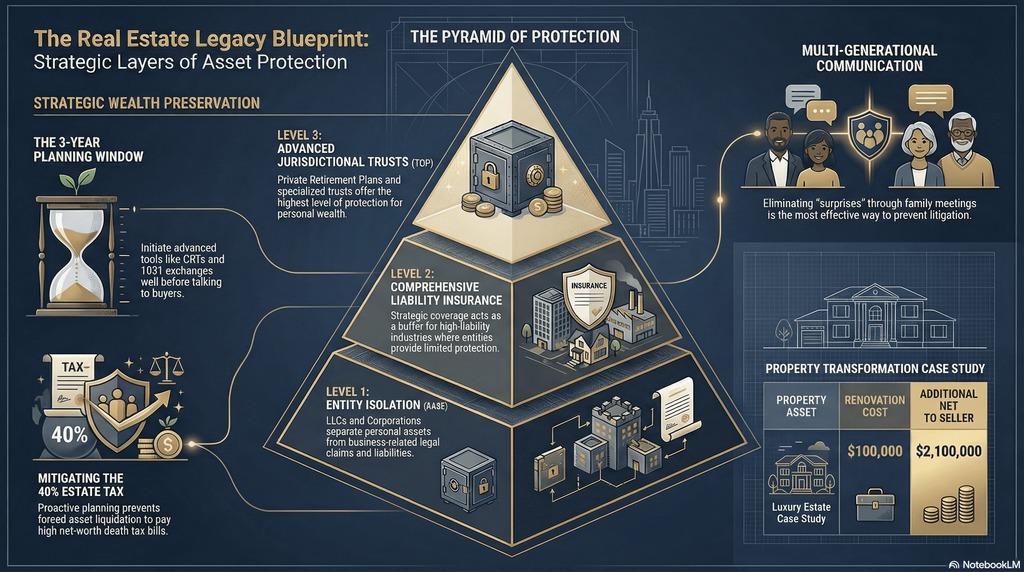
"Layers of Protection" pyramid graphic.
6. Charitable Remainder Trusts (CRT): Turning "Involuntary Taxes" into a Legacy
Blaine Burch frames charitable planning as a choice between "voluntary" and "involuntary" charity. You can either write a check to the IRS (involuntary) or direct that wealth toward a cause that reflects your values (voluntary). A Charitable Remainder Trust (CRT) is the premier vehicle for this, providing an immediate tax deduction, a lifetime annuity for the family, and the avoidance of immediate capital gains.
Burch shares a compelling case study of a family who used a CRT to fund a research hub at a local hospital.
This wasn't just philanthropy; it was strategic wealth creation. By funding the hospital, the community became a magnet for high-level employees and residents. Because the family had proactively purchased the surrounding real estate, the value of their holdings skyrocketed, far exceeding the initial donation.
This level of synergy is common in complex property transfers, including those involving a conservatorship transaction, where legal oversight and tax efficiency must coexist perfectly.
7. Conclusion: From Reactive to Proactive
The core philosophy of the BHR Law Group and Aragone & Associates is distilled into a single mantra: "We Build Trust."
A bespoke strategic framework is not a stack of documents to be signed and forgotten; it is a living, breathing strategy that evolves alongside your family and the law.
The most successful individuals are those who view their professional advisors not as "transactional vendors" to be nickel-and-dimed, but as a "tribe" of trusted partners. If your current planning is reactive, waiting for a crisis to occur, you are leaving your legacy to chance. True wealth protection requires moving from the handshake to the blueprint.
If you were removed from your business tomorrow, would your family be protected, or would they be surprised?
8. Call-to-Action (CTA)
Ready to protect your inheritance and maximize your estate’s value?
- Watch: See the full Anaheim Hills story and more expert tips on the [Aragone & Associates YouTube Channel].
- Subscribe: Visit our Blog Main page to sign up for our newsletter and receive in your inbox our latest blogs articles.
- Listen: Catch the latest episodes of the Aragone & Advisors podcast on Spotify for deep dives into Orange County real estate strategy.
- Connect: Follow us for daily insights and probate advice on [Instagram], [Facebook], and [LinkedIn].
Let Aragone & Associates guide you through the process, helping to make the transition seamless. Call us at 949-415-4784 or email us at [email protected].
Disclaimer: We are not real estate attorneys, and the information provided should not be considered legal advice. We strongly recommend consulting with qualified legal counsel regarding your specific situation. If you do not currently have legal representation, feel free to reach out to us, and we can connect you with one of our trusted attorneys.
Check out this article next