Being an executor is a thankless job because you carry personal liability for an estate you do not own, on behalf of heirs who can sue you. Under California Probate Code section 9601, a court can make you repay any loss your breach of duty caused, with interest[2]. To protect yourself as executor, keep estate money in a separate estate account, keep a record of every transaction, keep the beneficiaries informed in writing, and sell real estate with full authority and a 15 day notice of proposed action where you can, so the sale does not end up in a courtroom overbid.
- Why Being an Executor Feels Like a Thankless Job
- Executor Liability in California: How Your Personal Bank Account Gets Involved
- How an Executor Gets Removed by the Court
- The Executor Duties That Trip People Up First
- Commingling: The Mistake That Turns a Helper Into a Defendant
- Full Authority vs Limited Authority: The Procedural Trap That Costs Estates Money
- The 15 Day Notice of Proposed Action, Explained
- Court Confirmation and the Overbid: What Really Happens in the Courtroom
- What an Executor Is Actually Paid in California
- Red Flags: When Your Agent Becomes a Liability to the Executor
- Transparency: How to Protect Yourself as Executor From the Heirs
- The Executor's Shield: Rules for Protecting Yourself
- Are You Prepared to Defend Your Decisions?
- Frequently Asked Questions
- Sources and How This Guide Was Written
Most people agree to be an executor at a kitchen table, years before anyone dies, as a favor to a parent. Nobody explains at that table that the job carries personal liability, or that the heirs will read every decision you make as a decision about their money. That is the reason so many executors describe it as a thankless job: you do the work and carry the risk, and if everything goes well, nobody complains.
I have spent more than two decades selling estate property across Orange County, much of it probate real estate in places like Anaheim Hills, Fullerton, Costa Mesa and Mission Viejo, and the pattern repeats. The executors who get hurt are rarely dishonest. They are tired, grieving, short on time, and working with advisers who treat a probate house like any other listing.
This guide covers what California law actually says about executor liability, the procedural choice that decides whether your sale closes cleanly or ends in a courtroom bidding war, and the habits that keep your own bank account out of the estate's problems.
Why Being an Executor Feels Like a Thankless Job
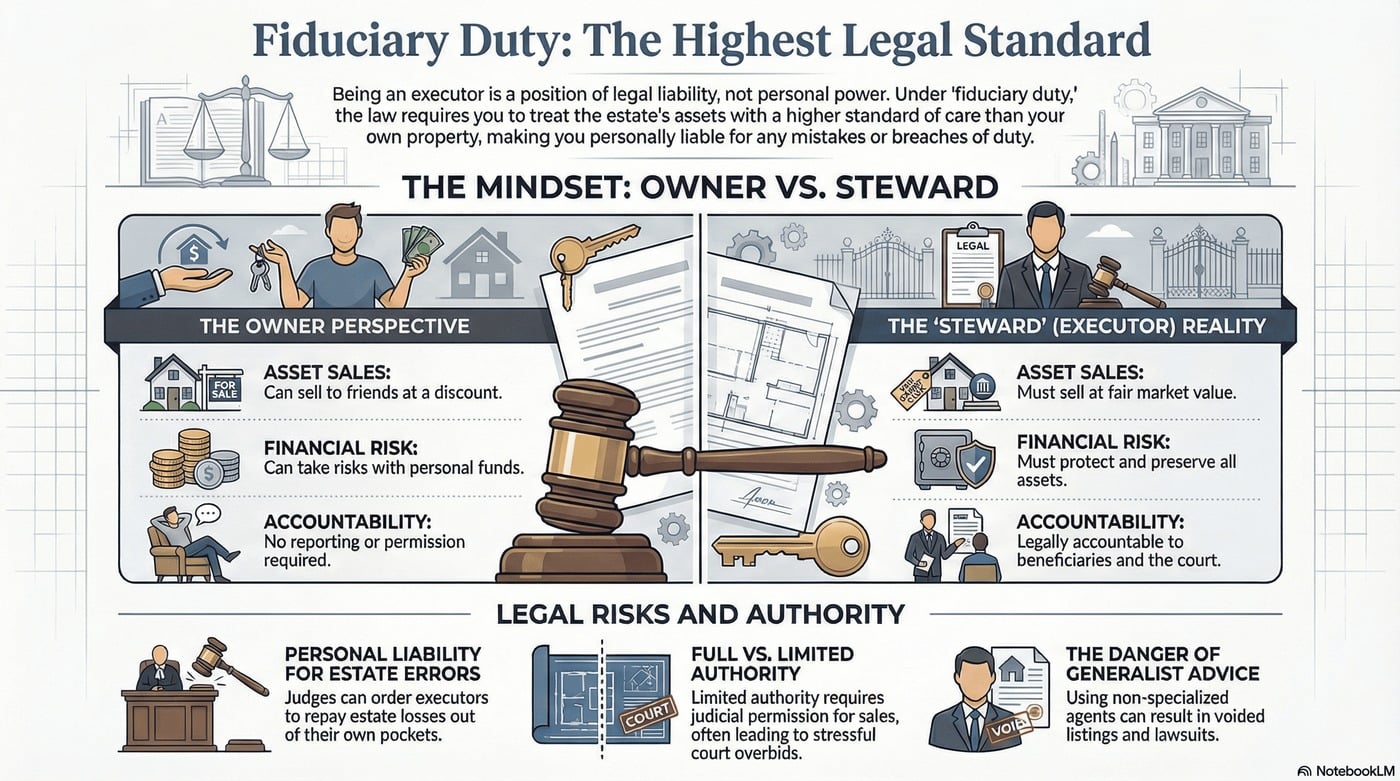
An executor (the law calls you a personal representative) steps into the shoes of someone who has died and manages everything they left behind until it is paid out. You collect the assets, protect them, pay the debts and the expenses, and eventually hand what is left to the beneficiaries. On paper it is an administrative role. In practice it is a fiduciary role, which means the law holds you to a standard of loyalty and care that is far higher than the standard you hold yourself to with your own money.
The thankless part comes from several places at once, and they stack.
First, the work is front loaded and invisible. The house in Placentia has to be secured, insured, kept up, and eventually emptied, often by the executor personally on weekends, while the heirs see nothing happening for months.
Second, every choice you make has a winner and a loser among people you love. Selling quickly protects the estate from carrying costs and frustrates the sibling who wanted to keep the house. Holding out for a better price satisfies that sibling and frustrates the one who needs the money now.
Third, the downside lands on you personally. If the estate loses value because you did something a careful fiduciary would not have done, a court can make you pay it back out of your own pocket[2]. Nobody hands you a bonus when the sale goes well.
Fourth, the pay is fixed by statute and is modest for the hours involved, which we work through in the fee section below.
That is the deal. Once you understand it, you can protect yourself, and most of the protection is surprisingly unglamorous.
Executor Liability in California: How Your Personal Bank Account Gets Involved
California Probate Code section 9601 spells out what a court can hold an executor liable for after a breach of fiduciary duty. There are three measures, and a court can apply whichever fit the facts[2]:
| What the court can charge you | What it looks like in an estate house sale |
|---|---|
| Any loss or drop in value of the estate caused by the breach, with interest | The house sold well below what a properly marketed sale would have brought, or sat vacant and uninsured and was damaged |
| Any profit the executor personally made through the breach, with interest | The executor lived in the house rent free, or steered the sale to a friend |
| Any profit the estate would have earned without the breach | Estate cash left sitting where it earned nothing, or a rental left empty for a year |
The phrase that matters is "with interest". A mistake that costs the estate money in year one can come back larger in year three, when the accounting is finally filed and a beneficiary objects to it.
There is one provision in your favor. Under subdivision (b), if you acted reasonably and in good faith under the circumstances as you knew them, the court may excuse you in whole or in part if that would be fair[2]. Read that sentence carefully. "May", not "must". The executors who get excused are the ones who can show their reasoning on paper: the appraisal they relied on, the comps behind the price, the attorney's advice they followed, the written notice they sent to the heirs before they acted.
The good faith defense is built in advance. You cannot reconstruct a reasonable decision after someone sues you. Every significant decision about the house, from the price reduction to the choice of buyer, should have a dated paper trail that shows why you made it.
Federal litigator Nikki Milliban put the common failure this way: "Most family probate disputes happen because executors forget this duty. They make emotional decisions or, even worse, they start acting like they personally own the assets." I agree with her entirely. The estate is not yours, even when you are also one of the heirs, and the moment you start treating it as yours is usually the moment the trouble begins.
How an Executor Gets Removed by the Court
Liability is about money. Removal is about control, and for many executors it is the more painful outcome, because a stranger or a sibling takes over the job in the middle of it.
Probate Code section 8502 lets the court remove a personal representative on these grounds[3]:
- The executor has wasted, embezzled, mismanaged or committed a fraud on the estate, or is about to.
- The executor is incapable of properly carrying out the duties, or is not qualified for the appointment.
- The executor has wrongfully neglected the estate, or has long neglected to do something the job requires.
- Removal is otherwise necessary to protect the estate or the interested persons.
- Any other cause provided by statute.
Notice how broad the fourth one is. A court does not need to find theft to remove you. An executor who lets the house sit empty for a year with no insurance and no plan can be removed for neglect, even though nobody took a dollar.
The Judicial Council's own summary of your duties, form DE-147, is blunt about the same point. If you skip a required court approval, you may be removed, made to repay the estate from your own funds, or both, and missed duties or deadlines can also mean reduced compensation[1]. Most executors sign that form at the start of the case and never read it again. Read it again.
The Executor Duties That Trip People Up First
The first months of an administration decide most of what follows. These are the duties from form DE-147 that I see executors miss most often, along with the practical version of each[1].
- Separate estate account. The form says never to deposit estate funds in your personal account or mix them with anyone else's property, and estate accounts must show they belong to the estate.
- Insurance from day one. You are expected to confirm adequate insurance on the estate's assets and keep it in force for the whole administration. A vacant house is the asset I worry about most. Call the carrier the week you get your Letters, tell them the owner has died and whether anyone is living there, and get their answer about coverage in writing.
- Complete records. Every dollar in and every dollar out, with the date. Keep the receipts, because the court may ask for them.
- Inventory and appraisal. Due within four months after Letters are first issued.
- Notice to creditors. Mailed to each known creditor within four months of your appointment.
- Change of ownership filing. Required with the county recorder or assessor for California real property the decedent owned.
- No self payment without an order. Paying yourself or your attorney requires a court order first.
None of these is difficult on its own. The danger is that they all arrive at once, during the worst weeks of someone's year, and the house is usually the largest and most demanding asset on the list.
Commingling: The Mistake That Turns a Helper Into a Defendant
If I could put one rule on the refrigerator of every executor in Orange County, it would be this one. Never mix estate money with your own.
It sounds obvious. Here is how it actually happens. The gas and electric bill for Mom's house in Garden Grove arrives, the estate account is not open yet, so you pay it from your checking account. The handyman wants a deposit, so you use your own card. Three months later the house has sold and you reimburse yourself in one lump transfer from the new estate account. You have done nothing dishonest. You have also created a record in which your money and the estate's money moved back and forth with no court order, and any heir who is already suspicious now has something to point at.
Form DE-147 does not soften this: estate funds never go into your personal account[1]. And the removal statute names mismanagement as a ground for removal[3].
The practical fix is boring and it works. Open the estate account the day you receive Letters. Pay estate expenses only from it. If you truly must advance your own money before the account exists, write down what you paid and why, keep the receipt, and ask your attorney how to be repaid properly instead of quietly paying yourself back.
Full Authority vs Limited Authority: The Procedural Trap That Costs Estates Money
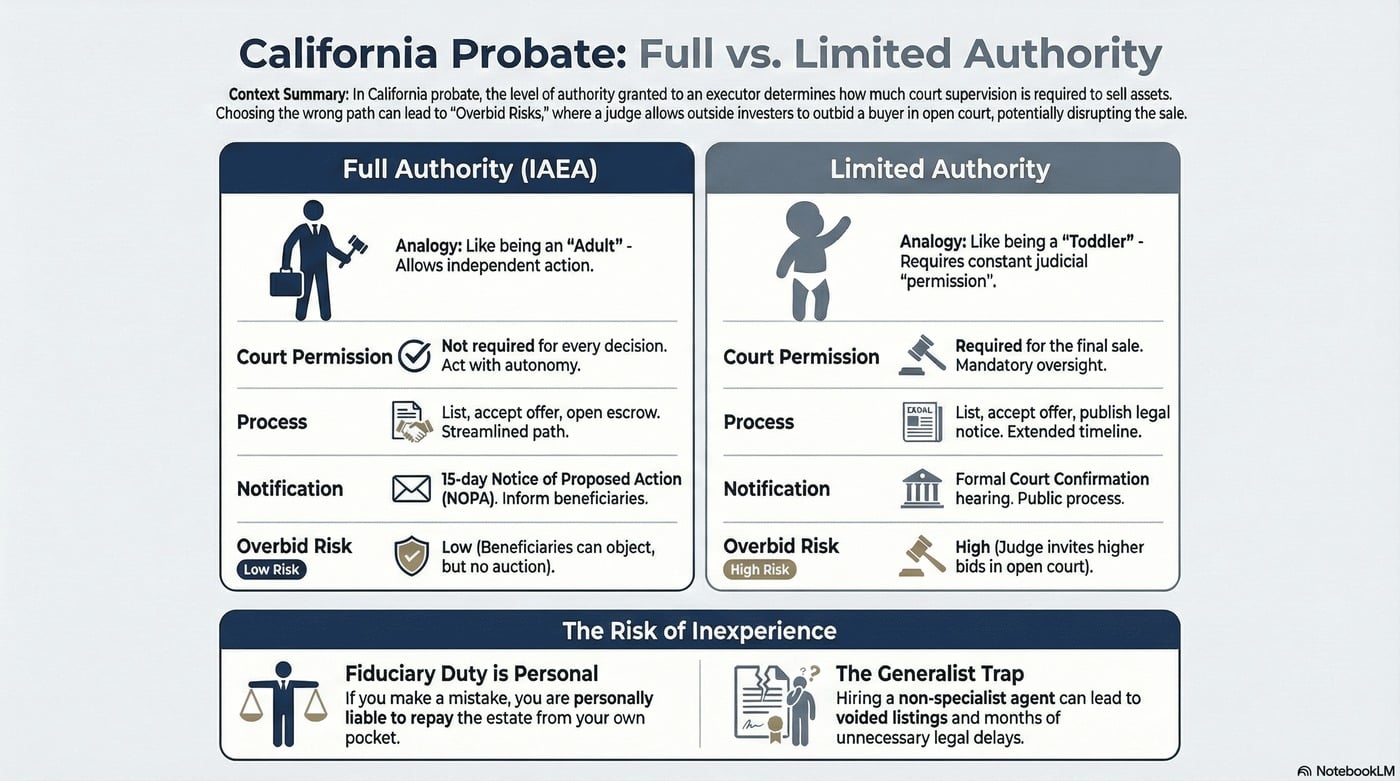
The success of a probate real estate sale often hinges on a technicality most families ignore until it is too late: the level of authority the court granted the executor under the Independent Administration of Estates Act. It is printed on your Letters. Look at it before you call any agent.
With full authority, an executor can generally sell the house without a court confirmation hearing, by giving the heirs a notice of proposed action instead. With limited authority, the sale of real property is one of the actions that must go through court supervision[4]. The same subdivision reaches other real property moves too, such as an exchange or a loan secured by the house[4].
| Full authority | Limited authority | |
|---|---|---|
| How the house sale is approved | Notice of proposed action to the heirs, no hearing unless someone objects | Court confirmation hearing |
| Can the buyer be outbid in court? | Not under a notice of proposed action sale | Yes, any qualified bidder can overbid at the hearing |
| Who the listing tends to attract | Ordinary buyers, including families with conventional financing | A heavier share of investors who are used to court sales |
| Typical friction for the executor | Paperwork and a 15 day notice period | Waiting for a hearing date, then uncertainty at the hearing itself |
Limited authority is a functional headache for executors. A buyer can have an offer accepted, wait for a hearing, and then lose the house in the courtroom to someone who bids more. That uncertainty drives away the traditional buyers, the families looking for a home in Tustin or Huntington Beach who cannot plan a move around a hearing. What it attracts instead are investors who specialize in court confirmed properties and expect a discount because they know much of the competition has stepped aside.
In my experience that lack of competition tends to mean a lower final price for the heirs. There are exceptions. A very desirable house in Corona del Mar can draw a crowded courtroom, and an overbid can push the price well above the accepted offer. Those are the exceptions, though, and I would not plan a sale around them.
One more thing to know. Some transactions need court supervision whatever level of authority you hold, including transactions between the estate and the executor personally[4]. If you, as executor, want to buy the house yourself, talk to your attorney before anyone writes an offer.
For the timing side of this choice, see how long a probate sale really takes in California.
Executor of an Orange County estate with a house to sell?
Paula is a Certified Probate Real Estate Specialist and works alongside your probate attorney, so the sale is planned around the authority you hold and the notices you will have to give.
Schedule a Free ConsultationThe 15 Day Notice of Proposed Action, Explained
The notice of proposed action, which everybody in probate calls a NOPA, is the tool that makes a full authority sale work. You describe the sale you intend to make, the price and the terms, and deliver the notice to each person entitled to receive it. It must go out at least 15 days before the date stated in the notice, and you cannot complete the action before that period runs out[5].
Here is how I sequence a NOPA sale with the executor and the probate attorney:
- Confirm the authority. The attorney reads the Letters and confirms full authority before the house is listed.
- Price from evidence. We price the house from current comps in that neighborhood, and I give the executor a written net sheet so the heirs can see what the estate actually receives.
- Market it properly. Full exposure on the MLS with real photography and open houses, plus enough time on the market, so no heir can later say the house was given away.
- Accept an offer subject to the NOPA period. The purchase contract tells the buyer plainly that the sale depends on the notice period passing.
- Serve the NOPA. The attorney prepares and delivers the notice with the accepted terms, and we count the 15 days from there.
- Close. If the period passes cleanly, escrow closes like an ordinary sale.
A NOPA does not make the heirs agree with you. What it does is give them a fair chance to object before you act, and a beneficiary who received a proper notice and stayed silent has a much weaker complaint later. Your attorney will explain what happens if someone does object. Plan for that possibility when there is a difficult sibling, which is the subject of our piece on siblings who cannot agree on selling an inherited house.
Court Confirmation and the Overbid: What Really Happens in the Courtroom
When a sale has to be confirmed by the court, the hearing is open to other bidders. Probate Code section 10311 says that if a written offer at the hearing beats the accepted price by at least 10 percent of the first $10,000 plus 5 percent of everything above $10,000, the court shall accept it and confirm the sale to that bidder, provided the bidder is a responsible person and the offer complies with the law[6]. If several bidders qualify, the court takes the highest[6].
The original version of this article said a buyer could lose the house to someone who bids "a few dollars more". That was too loose. The first overbid has to clear a real minimum, and it is easy to calculate.
| Accepted offer | 10% of first $10,000 | 5% of the rest | Minimum first overbid |
|---|---|---|---|
| $900,000 | $1,000 | $44,500 | $945,500 |
| $1,200,000 | $1,000 | $59,500 | $1,260,500 |
| $2,000,000 | $1,000 | $99,500 | $2,100,500 |
So the risk for the original buyer is real, but it has a price tag of roughly 5 percent. For the estate, the overbid is not a bad thing in itself; it can raise the price. The cost is everything that happens before the hearing. A buyer with a family and a lease ending is less likely to wait weeks for a hearing they might lose, and the offers you collect on a confirmation sale often reflect that.
Commissions are left out when the court compares bids[6]. If you want the whole sequence, from listing to the courtroom, it is laid out step by step in our guide to selling probate property in Orange County.
What an Executor Is Actually Paid in California
Part of the reason the job feels thankless is that the compensation is fixed by statute and is modest relative to the work. Probate Code section 10800 sets the executor's fee for ordinary services as a percentage of the estate accounted for[7]:
| Portion of the estate | Statutory rate |
|---|---|
| First $100,000 | 4% |
| Next $100,000 | 3% |
| Next $800,000 | 2% |
| Next $9,000,000 | 1% |
| Next $15,000,000 | 0.5% |
| Above $25,000,000 | A reasonable amount set by the court |
Run that on an estate of $1,500,000, which in much of Orange County is simply one house and a small account. The fee works out to $4,000, plus $3,000, plus $16,000 on the next $800,000, plus $5,000 on the last $500,000. A total of $28,000, for a role that can last a year or more and exposes you personally to everything described above.
And you cannot simply take it. Form DE-147 says you need a court order before paying yourself[1]. Many family executors waive the fee altogether, which is a reasonable choice, but make it on purpose with your attorney rather than by default.
Red Flags: When Your Agent Becomes a Liability to the Executor
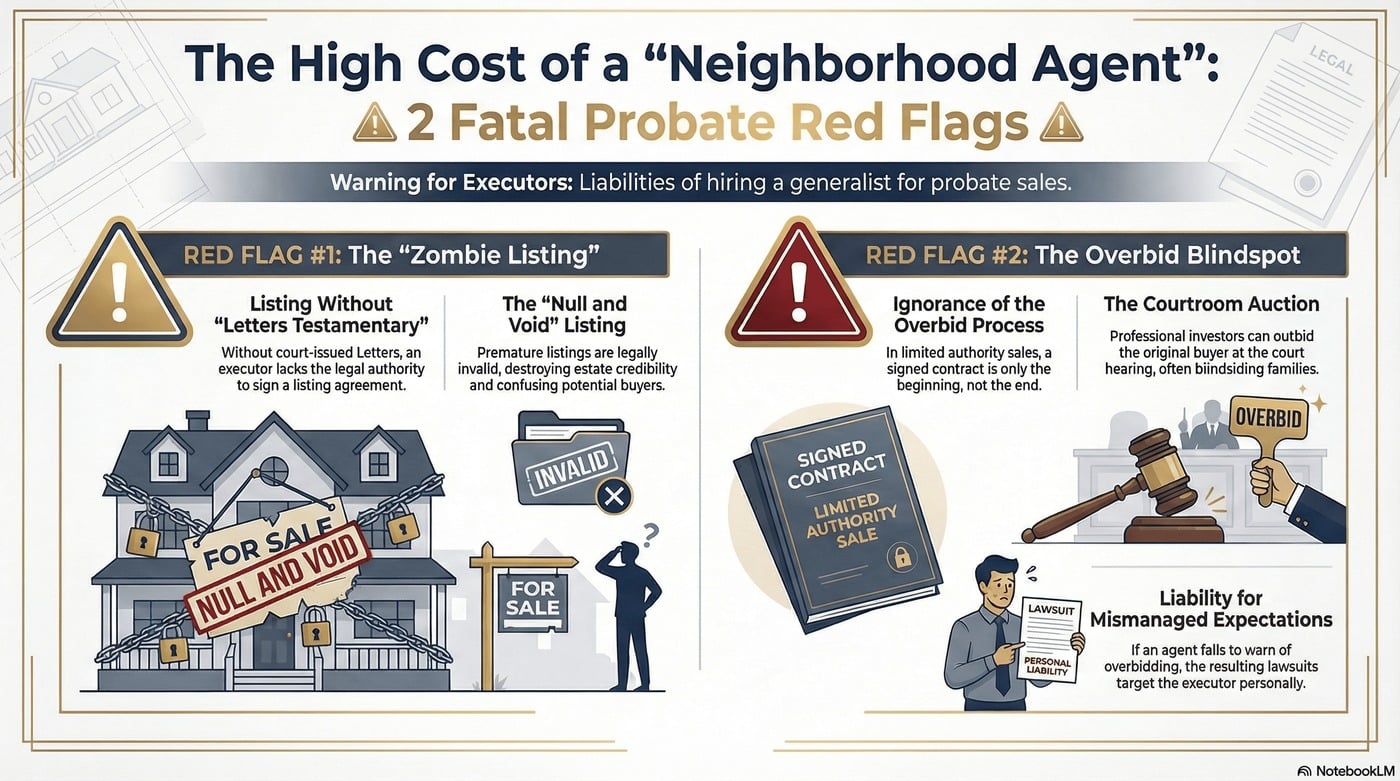
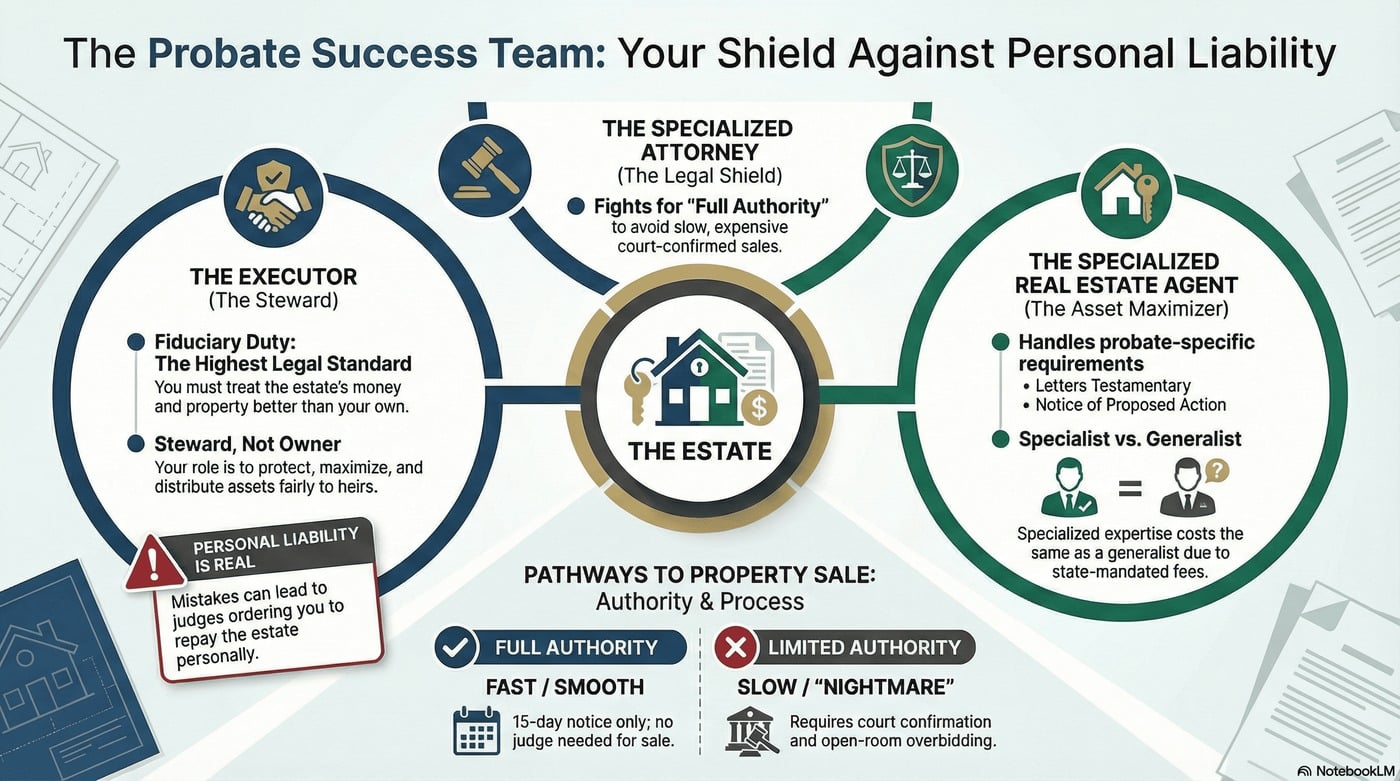
Hiring a neighborhood agent who mostly sells standard residential homes can expose an executor to real risk, because the agent's mistakes become the executor's mistakes in the eyes of the heirs and the court. The agent is not the fiduciary. You are.
These are the warning signs I would act on:
- The agent wants to list before anyone has read your Letters to see whether you hold full or limited authority.
- The agent cannot explain the difference between a 15 day NOPA sale and a court confirmation hearing without looking it up.
- The agent suggests a quick off market sale to an investor contact as the easy option, without showing you what open market exposure would bring.
- The listing agreement and purchase contract contain nothing about the NOPA period or court confirmation, as though this were an ordinary sale.
- The agent talks to one sibling and ignores the others, so the executor ends up defending decisions nobody else was told about.
If your agent shows the first two, I would replace them. An agent or attorney who cannot explain that difference is more than inexperienced; they are a risk to your personal financial safety, because the procedure they get wrong is the one you will be asked to defend.
Specialized training exists for this exact work. If you want to know what to look for, here is what the CPRES designation actually covers.
Transparency: How to Protect Yourself as Executor From the Heirs
Estate attorney Cheryl Barrett has a line I repeat to executors constantly: "Beneficiaries smell money." They will notice the house was sold, they will notice when the money did not arrive as quickly as they hoped, and they will fill any silence with their own theory.
Beneficiaries are far more likely to cooperate when they feel informed. They are far more likely to sue when they feel ignored.
So over communicate, in writing. A short email to every beneficiary at each milestone costs you ten minutes and is worth more than any argument you could make in court later:
- When you receive Letters, with a copy and a plain explanation of your authority.
- When the appraisal comes back, with the number.
- When you list the house, with the price and the reasoning behind it.
- When you accept an offer, with the net sheet.
- When the NOPA goes out, so nobody is surprised by it.
- When escrow closes, with the closing statement.
This also feeds directly into the good faith protection in section 9601[2]. A record of honest, timely communication is the clearest evidence you have that you acted reasonably.
I will add one honest caveat. Some families are going to fight no matter how well you communicate, usually over things that happened decades before anyone died. Good records will not fix that. They will make sure the fight is about the family history and not about your conduct as executor.
The Executor's Shield: Rules for Protecting Yourself
To protect your personal assets and fulfill your fiduciary duty, these are the principles from the original version of this article, sharpened with what the statutes say.
Practice absolute transparency
Never hide information. Send notices early, in writing, to everyone entitled to them. It is the single cheapest protection you have.
Never commingle funds
Never, under any circumstances, mix estate money with your personal accounts[1]. Mismanagement is a listed ground for removal[3], and a breach that costs the estate money is something you can be made to repay with interest[2].
Reject generalists
If an agent or attorney cannot explain the specific difference between a 15 day NOPA and a court confirmation hearing, they are the wrong adviser for an estate sale.
Document every decision
The appraisal, the comps, the price reductions, the offers you turned down and why. If you ever need the good faith defense, this file is the defense.
Ask before you spend or pay yourself
The court order comes first, then the payment[1]. Reversing that order is one of the easiest ways to end up repaying the estate from your own funds.
For a broader view of what comes before the sale itself, read what every executor needs to know before selling estate property.
Are You Prepared to Defend Your Decisions?
As you move forward, ask yourself a hard question: are you prepared to defend your decisions in front of a judge and a room full of heirs who "smell money"?
If the honest answer is not yet, that is fine. Very few people are at the start. The answer becomes yes through preparation: a probate attorney who knows the Orange County court, an agent who knows probate procedure, an estate account opened on day one, and a file that shows your reasoning for every significant decision about the house.
Probate takes time, and much of that time is outside your control, as we explain in why probate calendars move so slowly. What you control is how you behave while you wait. That is where executors either protect themselves or expose themselves, and it is almost never decided in the courtroom.

Frequently Asked Questions
Can an executor be held personally liable in California?
Yes. Under Probate Code section 9601, a court can make an executor who breached a fiduciary duty repay any loss to the estate with interest. It can also take away profit the executor made through the breach or charge profit the estate lost because of it. The court may excuse an executor who acted reasonably and in good faith, but that is discretionary, not automatic.[2]
Why is being an executor called a thankless job?
Because the executor carries the work and the personal risk while the benefit goes to the beneficiaries. The fee is fixed by statute, every decision disappoints someone in the family, and a mistake can be charged back to the executor personally. The best outcome is usually that nobody complains.
Can an executor be removed by the court?
Yes. Probate Code section 8502 lists the grounds, which include wasting, embezzling, mismanaging or committing fraud on the estate and wrongful or long neglect of it. A court can also remove an executor whenever that is necessary to protect the estate or the people interested in it.[3]
What is the difference between full authority and limited authority for an executor?
With full authority under the Independent Administration of Estates Act, an executor can usually sell real estate by giving a notice of proposed action instead of going to a confirmation hearing. With limited authority, the sale of real property must go through court supervision.[4]
How long is the notice of proposed action period in California?
The notice must be delivered at least 15 days before the date stated in it, and the executor cannot take the proposed action before that period ends.[5]
How much more does an overbid have to be at a probate confirmation hearing?
The first overbid must exceed the accepted offer by at least 10 percent of the first $10,000 plus 5 percent of the amount above $10,000. On a $1,200,000 accepted offer, that means at least $1,260,500.[6]
Can an executor use their own money to pay estate bills?
Avoid it. Form DE-147 tells executors never to deposit estate funds in a personal account or mix them with anyone else's property. If you must advance money before the estate account is open, keep the receipts and ask your attorney how to be repaid properly.[1]
How much does an executor get paid in California?
The statutory fee is 4 percent of the first $100,000, 3 percent of the next $100,000, 2 percent of the next $800,000, 1 percent of the next $9 million and 0.5 percent of the next $15 million, with a court set amount above $25 million. On a $1,500,000 estate that is $28,000. A court order is needed before the executor pays it.[7][1]
Can the executor buy the estate house?
Possibly, but transactions between the estate and the executor personally require court supervision under section 10501 regardless of the level of authority, with limited exceptions. Speak with your probate attorney before any offer is written.[4]
Sources and How This Guide Was Written
Every legal rule in this guide was read from the statute or the Judicial Council form while the article was being written. The official legislature site is not reachable from our research environment, so the Probate Code sections were read on california.public.law, which reproduces the official text and links back to it.
- California Judicial Council form DE-147, the summary of duties every personal representative must acknowledge, covering separate estate accounts, insurance, record keeping, the inventory deadline and sanctions. Read the form
- California Probate Code section 9601, the measure of a personal representative's liability for breach of fiduciary duty and the court's power to excuse a representative who acted reasonably and in good faith. Read the statute
- California Probate Code section 8502, the grounds on which a court may remove a personal representative. Read the statute
- California Probate Code section 10501, the actions that require court supervision under independent administration, including the sale of real property by a representative with limited authority. Read the statute
- California Probate Code section 10586, the 15 day delivery requirement for a notice of proposed action. Read the statute
- California Probate Code section 10311, the minimum increase required for a higher offer at a court confirmation hearing and the court's duty to confirm to the highest qualifying bidder. Read the statute
- California Probate Code section 10800, the statutory compensation schedule for a personal representative's ordinary services. Read the statute
Probate rules and local court practice change, so confirm the current text and your own situation with your probate attorney before you act on anything here.
Stay Connected
New posts every week on probate and trust real estate in Orange County. Subscribe to the blog or listen to the podcast on Spotify. You can also find Paula on Instagram and YouTube.
Paula Aragone
Aragone & Associates
949-415-4784 | [email protected]
Paula Aragone, CA DRE #01364746
Aragone & Associates | First Team Real Estate, CA DRE #01008773
4 Corporate Plaza Dr #100, Newport Beach, CA 92660
This article is general information about serving as an executor and selling estate real estate in California and is not legal, tax or financial advice. We are not attorneys, so review your situation with qualified probate counsel, and if you do not have one we can connect you with an attorney we trust.
This article is general information and is not legal or tax advice. We are real estate professionals, not attorneys or tax advisors, so please confirm your own situation with a qualified California attorney or CPA before you act.
Tags: executor liability California, being an executor, executor duties, probate real estate Orange County, full authority vs limited authority, notice of proposed action, probate overbid, executor fees California, protect yourself as executor

Paula Aragone
Aragone & Associates | First Team Real Estate
Paula has spent 23 years in Orange County real estate, with more than 900 transactions and over $900 million in sales behind her. She holds the CPRES, SRES, Certified Luxury and Certified Relocation Specialist designations, is a member of Luxury Portfolio International, and went to law school before building her practice around probate, trust, divorce and luxury property.
Are you the executor of an Orange County estate and unsure what you are allowed to do with the house?
Call Paula before you sign a listing agreement. She will read your Letters and your level of authority with you and your attorney, then tell you plainly what the sale will involve.
Call (949) 415-4784Schedule a ConsultationCheck out this article next