
Takeaway 2: The "Treasure Hunt" Hotspots You’re Likely Overlooking
Hidden value is rarely seated on a kitchen counter. In our 23 years of experience, we have found that hidden assets are the result of a "habit of security" by the deceased.
People hide things where they think no one will look, which is exactly why a professional "final sweep" is mandatory even when a family thinks they are "done."
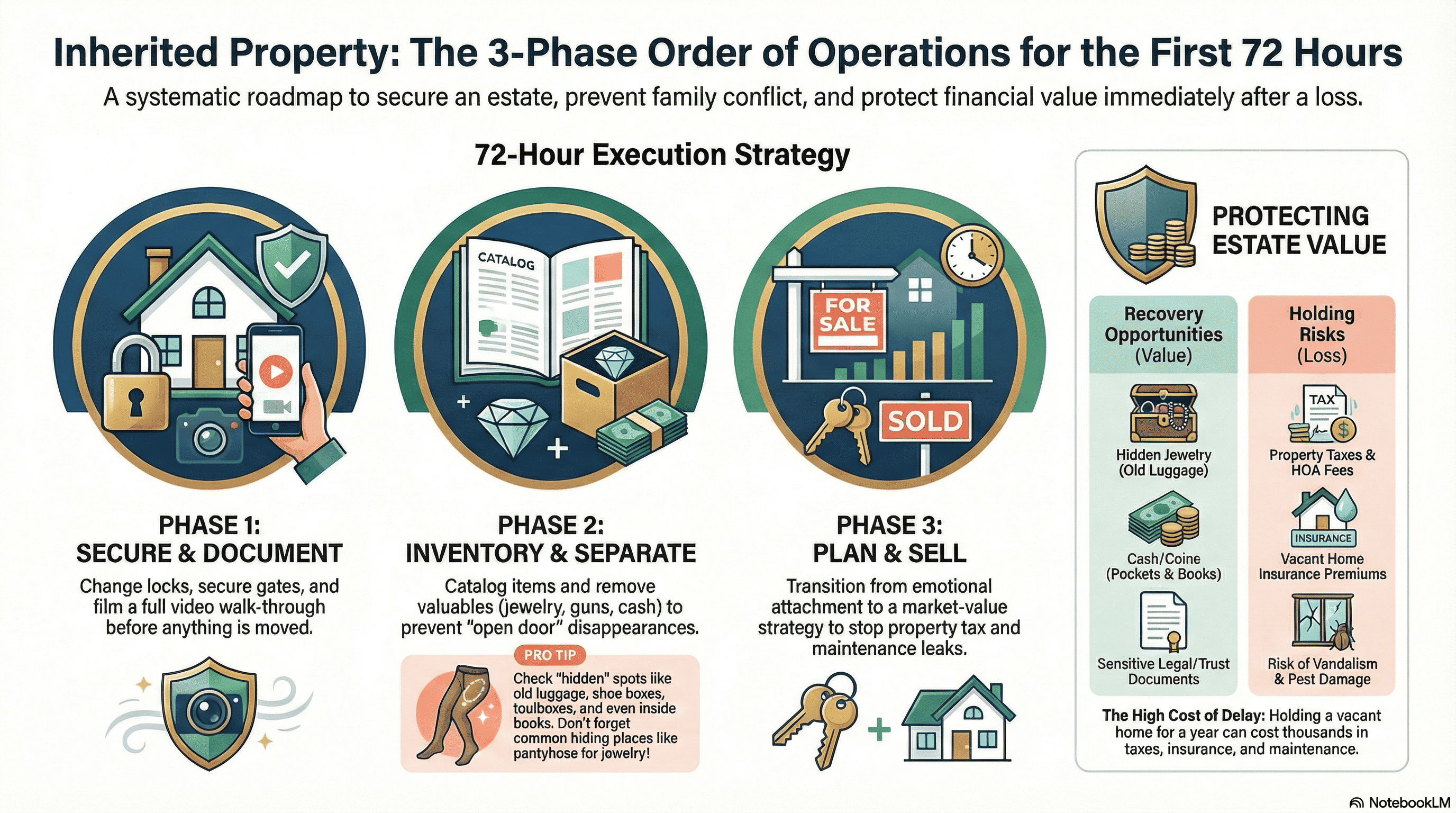
- Our team is systematic in checking the "Treasure Hunt Hotspots":
- Old Luggage and Garment Bags: As demonstrated in the Anaheim Hills case, these are classic hiding spots.
- Shoe Boxes and Hidden Closet Corners: Deep shelves often hide envelopes of cash or small jewelry boxes.
- Kitchen Tins and Junk Drawers: Value is frequently tucked into mundane canisters.
- Tool Boxes: Look past the wrenches; these are frequently used as makeshift safes.
- Behind Framed Artwork: We often find documents or cash taped to the back of frames or hidden inside the backing.
- Inside Books: This is the primary location for finding old bonds or high-denomination cash.
- By documenting everything, including sheds and attic access—before anything is moved, we ensure the process remains "calmer, clearer, and fair."
Takeaway 3: The Danger of the "Open Door" Policy
One of the most difficult realities of managing a probate sale is how quickly small valuables disappear. Dwight Brown of Home Helpers famously noted:
"Jewelry goes missing right after death."
When a home remains an "open door" without a clear inventory, items vanish through three primary channels: caregivers, well-meaning friends, or family members acting on "good intentions." We often hear the logic, "Mom would have wanted me to have this," or "I’m just taking this to keep it safe."
The problem arises months later when other beneficiaries ask where a specific heirloom went. Without a documented inventory, there is no clarity, only accusation.
This lack of transparency is the leading cause of litigation in estate transitions. Establishing a "no-entry" policy until the inventory is complete protects the family from itself.
Takeaway 4: The "Hoarder House" Reality and Safety First
Families are often blindsided by the condition of an inherited home. It is common for a deceased relative to have struggled with hoarding, a condition rooted in anxiety, trauma, and shame. Because of this shame, they often "control the image" for years, meeting family members at restaurants and never inviting them inside.
If you inherit a hoarder-condition property, you must realize that you haven't just inherited real estate; you have inherited a high-risk situation.
This is a professional challenge, not a DIY cleanup.
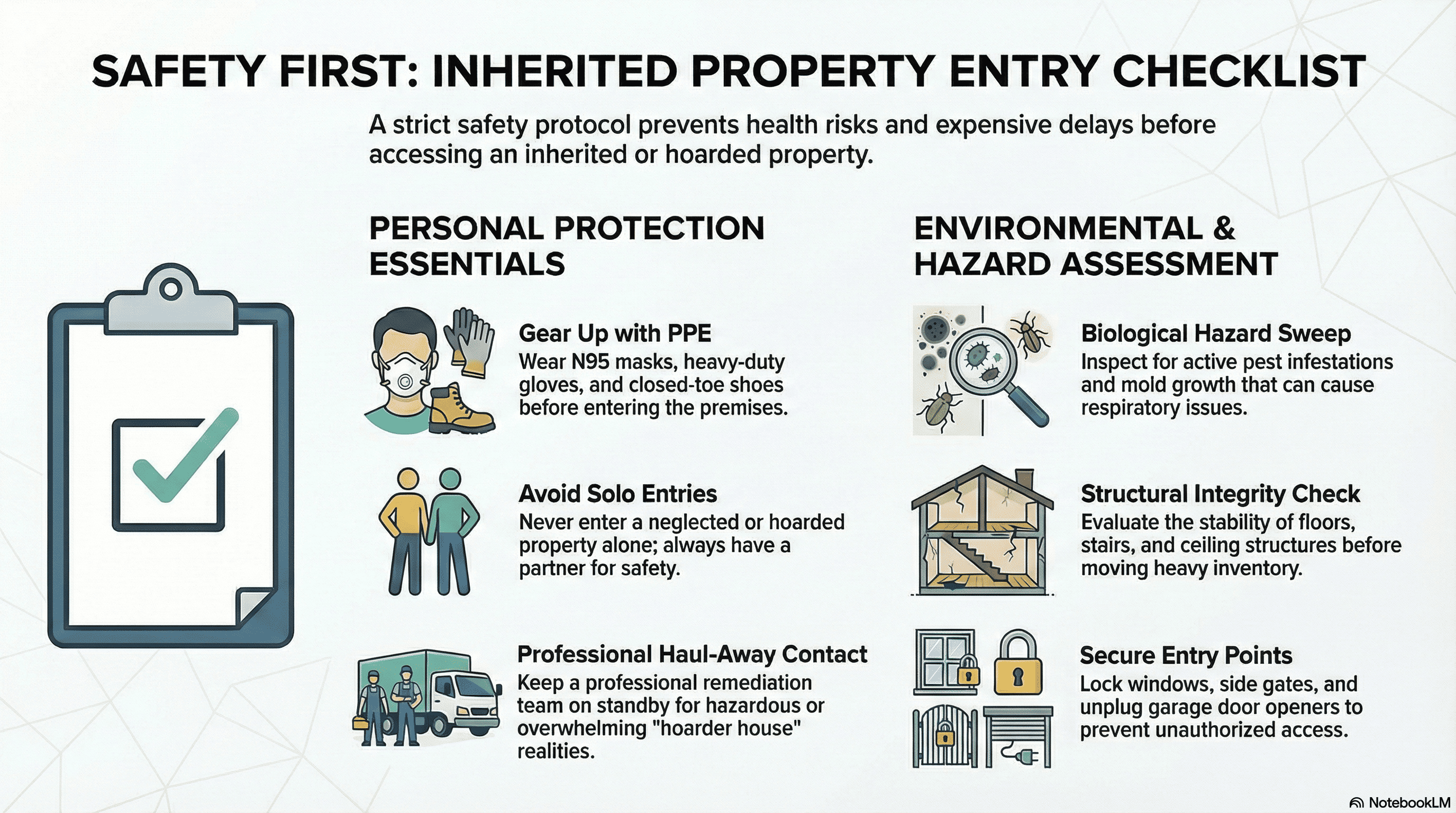
Safety Protocols for Initial Entry:
- PPE: Full-body protection, including heavy-duty gloves and N95 masks, is non-negotiable.
- Footwear: Closed-toe, puncture-resistant shoes are required.
- Environmental Hazards: Be alert for pests, mold, and structural hazards hidden under debris. A floor that looks solid may be compromised by years of weight or moisture.
Entering these environments without the right equipment can lead to respiratory issues, injury, and expensive delays in the sale process.
Takeaway 5: The "Silent Drain" of Delaying the Sale
A frequent mistake in a traditional buy/sell in Orange County is the "silent drain" caused by heirs who delay listing the home because they feel they must personally touch every item. While emotional value is real, it is not the same as market value.
Consider the case of an heir who refused to list a property for over a year while he conducted a solitary "scavenger hunt." After 12 months, his "big find" was $5,000 in change tucked into various pockets and books. While $5,000 is a significant sum, the math of his delay was devastating.
- The Mathematical Reality of Holding Costs:
- Property Taxes: These accrue daily and are often significant in Orange County.
- Insurance Premiums: Vacancy risks result in much higher premiums. If you fail to notify your insurer the home is empty and a pipe bursts, they may deny the claim entirely.
- Utilities and Maintenance: Landscaping and climate control costs offer zero return on an empty house.
- Risk of Damage: The longer a house sits, the higher the risk of vandalism, squatters, leaks, and pest infestations.
- Mortgage Interest: If the home isn't owned outright, the monthly interest payments alone can dwarf any "hidden treasure" found inside.
In conservatorship transactions, these delays can be even more damaging, as the court requires rigorous reporting of estate assets.
Every month the property sits off the market, the estate’s liquidity evaporates.
Conclusion: A System for Peace of Mind
Managing a trust or estate property transition is an overwhelming responsibility, but it does not have to be a chaotic one.
By adopting a systematic approach, securing the perimeter, documenting the interior, and hiring a team that knows exactly where the "suitcases" are hidden, you protect both the financial value of the estate and the emotional well-being of the beneficiaries.
The quality of your transition is determined by the team you choose. Ask yourself: Is your current team prepared to find the hidden suitcases in your estate, or are you leaving your legacy to chance?
Ready to protect your inheritance and maximize your estate’s value?
- Watch: See the full Anaheim Hills story and more expert tips on the [Aragone & Associates YouTube Channel].
- Subscribe: Visit our Blog Main page to sign up for our newsletter and receive in your inbox our latest blogs articles.
- Listen: Catch the latest episodes of the Aragone & Advisors podcast on Spotify for deep dives into Orange County real estate strategy.
- Connect: Follow us for daily insights and probate advice on [Instagram], [Facebook], and [LinkedIn].
Blog Article by Paula Aragone with Aragone & Associates
Check out this article next