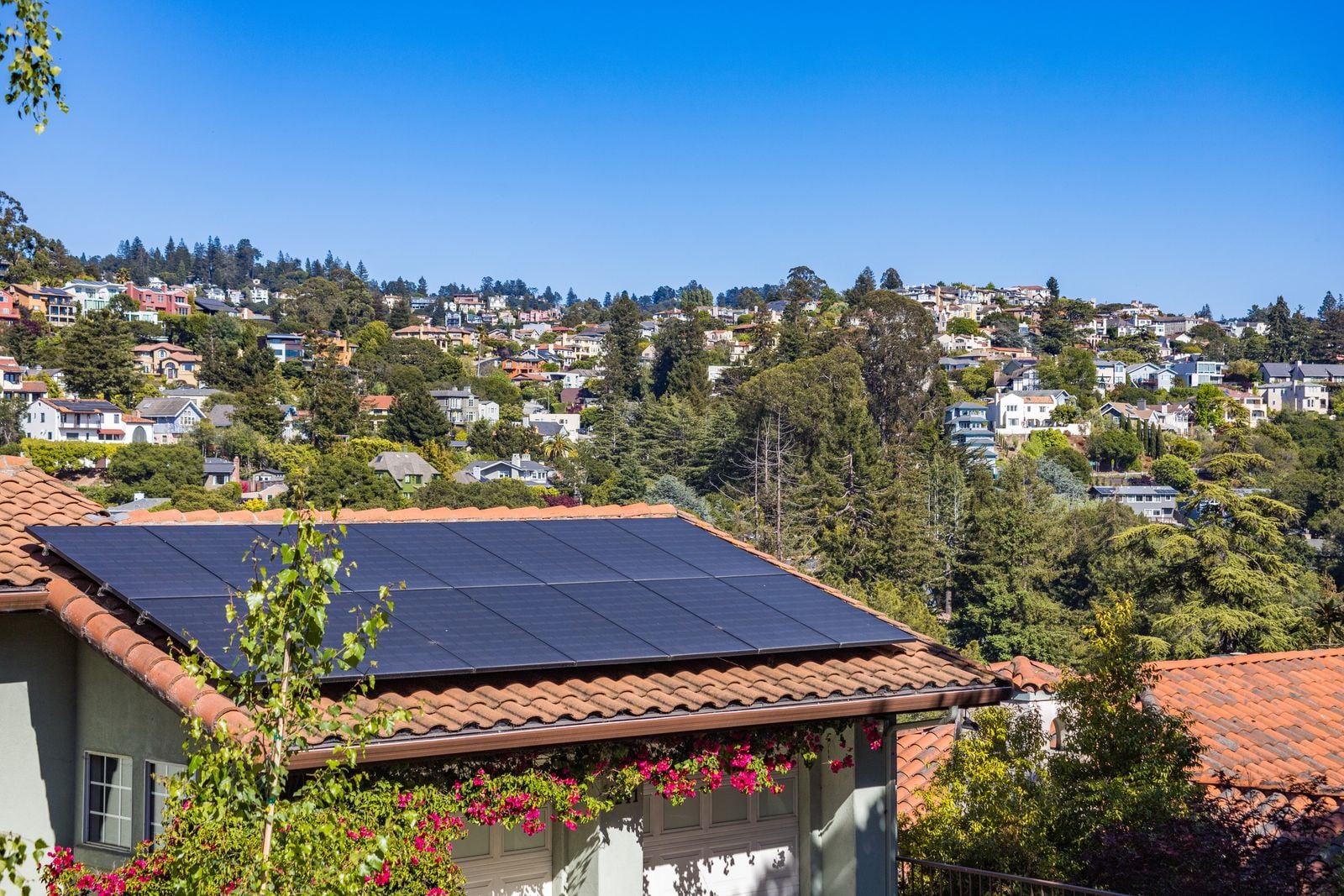
When you are selling a house with solar panels in California, the financing behind the system decides how escrow runs. Owned panels convey with the house. A solar loan may need a payoff and a release. A lease or power purchase agreement transfers only after the provider approves your buyer. A PACE assessment is a lien repaid through your property tax bill, and Fannie Mae will not buy a mortgage on a home with an outstanding PACE loan that has priority over the first mortgage[1], so it is usually paid off through escrow out of your proceeds. Find out which one you have before you list.
- Who Owns the Panels on Your Roof?
- Five Ways Solar Gets Financed, Five Different Closings
- Selling a House With Leased Solar Panels or a PPA
- Should You Buy Out the Lease to Save the Sale?
- The Roof Underneath the Array
- PACE and HERO Assessments: The Lien That Can Stop Your Buyer's Loan
- The PACE Disclosure California Requires From Sellers
- Solar Loans and the Filing on Your Title
- Net Metering: The Advantage Most Sellers Never Put in the Listing
- Does Net Metering Transfer When You Sell Your House?
- What to Do in the Two Weeks Before You List
- Do Solar Panels Add Value to an Orange County Home?
- Frequently Asked Questions
- Sources and How This Guide Was Written
Selling a house with solar panels in Orange County is rarely about the panels. They are almost never the problem. The paperwork behind them is, and it shows up at the worst possible moment, which is when the buyer's lender pulls the preliminary title report.
Solar came to Orange County in waves, and the paperwork came with it. A homeowner in Huntington Beach signed a 20-year lease in 2016 and has not opened the file since. A Yorba Linda owner put a system on the tax bill through a PACE program and thinks of it as part of the property taxes, because that is literally how it gets billed. A buyer in one of the newer Irvine tracts inherited an array that came with the house and has no idea who holds the paper on it. Each of those houses closes differently.
So before you put a sign in the yard, answer one question.
Who Owns the Panels on Your Roof?
Not what you remember signing. What the document says.
Pull the agreement out of the drawer, or call the provider and have them email a copy of the executed contract, the one with the signature page. The first two pages will tell you which of five situations you are in. You own the system outright. You lease it. You buy the power it produces under a power purchase agreement. You financed it with a loan in your own name. Or the cost was attached to your property tax bill through a PACE program. Those five paths do five different things to your escrow, and the disclosure package you hand a buyer depends on which one is yours.
Owned outright is the clean one. The panels are a fixture and they convey with the house. Your buyer will want the interconnection paperwork and whatever warranty documents you still have, and nothing else in the transaction changes.
Everything else has a process attached, and every process has a clock.
When the paperwork is gone
Sellers lose these files constantly, especially when the system went on the roof under a previous owner or the original installer has since been absorbed by another company. Two documents you already have will usually tell you where you stand. Your property tax bill shows a PACE assessment as its own line, because PACE contracts are repaid through increased assessments on the annual tax bill[3]. Your bank statements show whether you send a monthly payment to a solar company, and the memo line on that payment often says whether it is for equipment or for power. If you pay nobody and the tax bill shows nothing, you probably own the system. I still want to see a preliminary title report before I say that to a buyer.
If you bought the house with the panels already on it. You may have taken over a lease or a PPA in your own purchase, or the prior owner may have paid the system off before closing. Your escrow file from that purchase normally answers the question. Look for a transfer agreement signed during that escrow, and if you find one, you are about to repeat the same process from the other side of the table.
Five Ways Solar Gets Financed, Five Different Closings
This is the table I walk sellers through at the listing appointment, before we talk about price.
| How it was financed | Who owns the system | What escrow needs from you | Effect on your proceeds |
|---|---|---|---|
| Cash, owned outright | You | Interconnection approval, inverter and panel warranties | None. The value sits in your list price. |
| Lease | The solar provider | Transfer packet, the provider's approval of your buyer, provider sign-off before closing | None directly, unless you agree to buy the contract out |
| Power purchase agreement (PPA) | The solar provider | The same transfer process, plus the rate sheet and escalator terms for the buyer to review | None directly. A steep escalator can cost you in negotiation. |
| Solar loan (sometimes with a UCC-1 fixture filing) | You, subject to the lender's security interest | Payoff demand and, where a filing was recorded, a release of it | Payoff comes out of your proceeds at closing |
| PACE or HERO assessment | You, repaid through the property tax bill | Payoff through escrow in nearly every financed sale | Payoff comes out of your proceeds at closing |
Notice what the last two rows have in common. Both are liens that can surface on the preliminary title report, and both consume equity you may have already spent in your head.
The first row is the one everybody hopes for, and in my experience it is the minority in older neighborhoods, where so many systems went up during the years when leases were marketed door to door with no money down. The middle rows are paperwork. They take time, but they almost never kill a deal by themselves. The bottom row is the one that does, because it collides with the rules your buyer's lender has to follow. I come back to it below in detail.
Why the financing matters more than the equipment
A buyer's home inspector will look at the panels and the roof penetrations around them. Nobody on the buyer's side reads the solar contract unless you put it in front of them. That is backwards from how the risk actually runs. In the sales I have watched go sideways over solar, the hardware was working fine. The surprise was a lien nobody had mentioned, or an escalator clause the buyer saw for the first time in week three.
Selling a House With Leased Solar Panels or a PPA
A lease is transferable. That does not make it quick.
Leases and power purchase agreements are written with a sale in mind, and homes carrying them sell in Orange County all the time. The usual mechanism is a transfer: your buyer signs the provider's transfer agreement and takes over the remaining term. The provider then runs its own review of that buyer before it approves anything, and until it does, you do not have a closing date. You have a hope.
That approval is the part nobody schedules for. It is a separate decision, made by a company that has no stake in your closing date, applying its own standards rather than the ones your buyer's mortgage lender used. I have watched a file that was clean everywhere else sit for a week waiting on a solar company's transfer department. My rule is to start the request roughly 30 days before the target close and to hand the provider's written requirements to the escrow officer the day escrow opens.
What a buyer will ask to see
- The executed agreement, every page, including any amendments
- The remaining term in months, and what happens at the end of it
- The current monthly payment and the annual escalator, if there is one
- Twelve months of production history from the monitoring app
- Any transfer fee and who pays it
- Who is responsible for repairs, and who pays to remove and reinstall the array if the roof needs work
Put that packet together before the first showing. A buyer who receives it on day one evaluates the solar as part of the house. A buyer who receives it on day twenty evaluates it as a problem you were hiding.
The PPA escalator conversation
A PPA bills for the electricity the system produces, usually at a rate per kilowatt hour that rises each year by a fixed percentage written into the contract. A low escalator on a system signed years ago can look like a bargain next to current utility rates. A high one compounds, and buyers who run the numbers notice. I would rather disclose a steep escalator early and price the house with it in mind than defend it in the middle of the contingency period, when every concession costs more.
Should You Buy Out the Lease to Save the Sale?
Sometimes the buyer comes back and asks you to buy the lease out instead of transferring it.
My honest opinion, after a lot of these: that request usually deserves a no, at least as a first answer. Transferring is the normal path and, for the seller, the cheaper one. Get a written buyout quote with a good-through date anyway, because the quote and the remaining payment stream are rarely the same number, and you want to know the real figure before you concede anything. Negotiating without that number is negotiating blind, which is the same mistake I see sellers make on repair credits, and I wrote about the broader version of it in why negotiation beats staging.
There is one place I would reconsider.
If the buyer genuinely cannot pass the provider's review and you would otherwise lose a good offer, a partial buyout or a credit can cost less than thirty more days on market followed by a price reduction. Run both numbers side by side. Carrying costs on an Orange County house add up quickly once you include the mortgage, property taxes, insurance and utilities for a home you have often already mentally moved out of.
If your lease was prepaid. A lease paid upfront in a lump sum leaves the buyer little or nothing to pay each month, which makes it an easier conversation. Ask the provider whether a transfer step still applies rather than assuming the paperwork disappeared with the payments.
What I would not do is offer a buyout preemptively in the listing to make the house look cleaner. You give away money to solve a problem that most buyers would never have raised.
The Roof Underneath the Array
Roofs deserve their own section, because this is where solar sales in older parts of the county get expensive.
Huntington Beach is full of houses built in the 1970s and 80s that got panels bolted on decades later. By now, in many of them, the roof underneath is near the end of its life while the array on top still has a decade left on a lease. A buyer's roof inspector will see it in about ten minutes.
Ask the provider what removal and reinstallation costs before that inspector raises it, because that conversation is coming and you would rather have the number than the silence. Under a lease or PPA the provider owns the equipment, so the contract decides who is allowed to take it down and who pays. Under a loan or a PACE assessment you own it and the cost is yours. Either way, a roofer will not touch an array they did not install without someone signing off on it.
Two ways to handle a tired roof
You can replace the roof before listing, which means coordinating the removal and reinstallation with the provider and adding weeks to your timeline. Or you can disclose the age and condition with a written estimate attached, and let it become part of the price conversation. I lean toward the second for most sellers, unless the roof is actively leaking, in which case it stops being a pricing question. If there is permitting history to sort out on an older addition at the same time, the approach in selling a house with unpermitted work applies to the roof file too.
Not sure what is on your title report?
Paula Aragone has closed 900+ Orange County transactions and reads these documents every week. Bring your solar agreement and we will tell you exactly what escrow is going to ask for.
Schedule a Free ConsultationPACE and HERO Assessments: The Lien That Can Stop Your Buyer's Loan
This is the section to read twice if your panels went on the tax bill.
PACE financing, marketed in Orange County under names like HERO, is repaid through increased assessments on your annual property tax bill rather than as a conventional loan, and California's Department of Financial Protection and Innovation says plainly that a lien is placed on the home until the PACE contract is paid off[3]. The same agency warns that PACE assessments can make it more difficult to sell or refinance[3]. That is an understatement once you see the lender rules.
What Fannie Mae says
Fannie Mae's Selling Guide, Section B5-3.4-01, explains that PACE loans typically carry automatic first lien priority over previously recorded mortgages, and that Fannie Mae will not purchase a mortgage secured by a property with an outstanding PACE loan unless the program's terms do not give it priority over first mortgage liens[1]. The standard loan application even asks about it: on Form 1003 the borrower indicates whether the property will be subject to a priority PACE lien[1].
What FHA says
FHA closed the door in its own way. HUD Mortgagee Letter 2017-18, dated December 7, 2017, states that properties encumbered with PACE obligations are no longer eligible for FHA-insured forward mortgages, for case numbers assigned starting thirty days after the letter[2]. A purchase loan is a forward mortgage.
Read all of that as a practical rule. A buyer using ordinary conventional or FHA financing usually cannot close around your PACE assessment. It gets paid off through escrow, out of your proceeds, or the deal does not fund. The exceptions are a cash buyer, or a lender working outside those rules, and I treat either one as something to negotiate rather than something to plan around.
The panels are almost never the problem. The paperwork behind them is.
Paula Aragone
Put it on the net sheet on day one
The payoff is a line in your net sheet from the first conversation, sitting right next to the commission and closing cost lines I broke down in how much it costs to sell a house in Orange County. Sellers who discover a five figure assessment in week four lose more than the money. They lose the buyer, because by then the purchase price was negotiated on the assumption it was not there.
Order the preliminary title report early, and pull your latest tax bill the same afternoon.
The PACE Disclosure California Requires From Sellers
California does not leave PACE disclosure to good intentions. Civil Code section 1102.6b covers the sale of property subject to a continuing lien for a contractual assessment program authorized under Chapter 29 of the Streets and Highways Code, which is the statutory home of residential PACE[4].
Under that section, the seller must make a good faith effort to obtain a disclosure notice about the contractual assessment and deliver it to the prospective buyer, as long as the local agency makes the notice available[4]. If it does not, the statute lets the seller deliver a substantially equivalent notice from another source, and it names a copy of the most recent year's property tax bill or an itemization of current assessment amounts as acceptable[4].
In practice that means two things for an Orange County seller. First, the tax bill you were going to pull anyway does double duty as a disclosure document. Second, you cannot keep the assessment quiet and plan to pay it off without mentioning it, because the statute expects the buyer to see the notice whether or not the lien survives closing.
Leases and PPAs belong in the disclosure package too
Section 1102.6b is written for assessments, not for leases. I still put every solar agreement in the disclosure package, because a financing obligation attached to the roof is the kind of fact a buyer would want to know, and because the transfer cannot happen without the buyer signing it anyway. There is no version of a solar lease sale in which the buyer does not find out. The only question is whether they find out from you in week one.
A practical order of operations. Start with the paperwork you can get today. The tax bill and the preliminary title report together tell me in one meeting which row of the table above a seller is in. The executed solar agreement tells me how long escrow is going to take.
Solar Loans and the Filing on Your Title
A solar loan is the quiet one. You own the panels, you make a monthly payment to a lender, and it feels like any other installment debt.
Sometimes it is. Some solar lenders, though, protect themselves by recording a UCC-1 fixture filing against the property, a public notice that they hold a security interest in equipment attached to the house. When one has been recorded, a title officer will want it addressed before your buyer's lender insures its own loan. In the files I have worked, that means a payoff demand from the solar lender paid out of escrow, followed by a release or termination of the filing.
The trap is timing. Solar lenders are not always fast at issuing releases, and a title company may hold the closing until it has one. Call the lender as soon as you decide to sell and ask two specific questions: whether a fixture filing was recorded on your property, and how long it takes them to provide a payoff and a release once escrow requests it.
If there is no filing
If your solar loan is unsecured, it may not appear on title at all, and paying it off at closing becomes a choice rather than a requirement. Read the loan agreement for any clause about selling the home before you decide. Some sellers keep paying it from the proceeds of the sale on their own schedule. I would rather see it gone, because a buyer who later discovers a stranger's debt tied to the equipment on their roof calls the listing agent first.
Net Metering: The Advantage Most Sellers Never Put in the Listing
Here is the upside nobody markets, and for the right buyer it is real money.
If your system was switched on years ago, it may sit on a net metering tariff that no new installation in California can get. Southern California Edison states that on April 15, 2023, NEM 2.0 closed to new customers and its Solar Billing Plan went into effect, and that NEM 2.0 customers are grandfathered to their tariff for 20 years from their permission to operate date[6]. The California Public Utilities Commission describes the same rule: customer-generators may remain on the NEM 2.0 tariff for 20 years from the date they interconnected, a transition period set in Decision 14-03-041[5].
Why a buyer should care. Under the newer net billing tariff, exported energy is credited at a rate based on the CPUC's Avoided Cost Calculator values, which the Commission itself says are usually lower than the retail rate[5]. The legacy tariffs credit exports far more generously, which is the whole reason solar owners guard them.
| Permission to operate date (NEM 2.0 account) | Legacy period runs until | What to confirm with SCE |
|---|---|---|
| 2018 | 2038, unless the account loses eligibility first | The PTO date and the tariff on the account |
| 2020 | 2040, unless the account loses eligibility first | The PTO date and the tariff on the account |
| 2022 | 2042, unless the account loses eligibility first | The PTO date and the tariff on the account |
| April 15, 2023 or later | The account is on the Solar Billing Plan instead | Which version of the newer tariff applies |
A system that received permission to operate in 2018 carries roughly a dozen remaining years of the older tariff as of this writing. A brand new array cannot buy that at any price. In an Irvine tract where every third roof has panels, that difference is one of the few things that separates your solar from the neighbor's.
Correcting an earlier version of this article
An earlier version of this post said a 2018 system had eight or nine years of the old tariff left. Measured the way SCE measures it, twenty years from the permission to operate date[6], a 2018 system runs to 2038. The arithmetic above replaces that line.
Does Net Metering Transfer When You Sell Your House?
Now the part I will not pretend to be certain about.
SCE's own page says a NEM account keeps billing under its program until the 20-year period expires or until the account loses eligibility to remain on the program, whichever is earlier[6]. The page does not define what a sale does to eligibility. For newer systems on the net billing tariff, the CPUC describes the legacy period in terms of the original customer who caused the system to be interconnected, and again does not say what happens when the home changes hands[5].
What happened to AB 942
Sacramento has already taken one run at this. Assembly Bill 942, by Assemblymember Lisa Calderon, as introduced would have required a new customer who bought a property with an existing NEM system on or after January 1, 2026 to take service under the net billing tariff and pay the non-bypassable charges that apply to non-NEM customers[7]. The committee analysis lists the state Realtors association among the opponents, who argued it would undermine homeowners' expectations[7].
That provision did not survive. The Senate Energy, Utilities and Communications Committee analysis for the July 15, 2025 hearing records that the committee and the author agreed to remove the NEM provisions and refocus the bill on the California Climate Credit, specifically on residential customers whose bills total less than $300 a year[7]. I could not confirm the bill's final status from a primary source while writing this, so I would not treat the home sale question as permanently closed. Recheck it before you list.
What I tell sellers to do
My instruction is narrow and boring. Get SCE to confirm the tariff and the permission to operate date on your specific service account, in writing, and only then let your agent put the tariff in the listing remarks. Advertising a benefit that evaporates after closing is how a happy buyer becomes a letter from an attorney.
What to Do in the Two Weeks Before You List
None of this is complicated. It is sequencing, and it has to happen before the first showing rather than after the inspection.
- Request the complete solar agreement in writing. Not the sales brochure. The executed contract with the signature page and any amendments.
- Get a current payoff or buyout quote with a good-through date. Quotes expire, and an expired quote is worthless at the negotiating table.
- Order the preliminary title report early. Read it specifically for a fixture filing or a PACE assessment. Do not wait for escrow to open.
- Pull your latest property tax bill. A PACE assessment shows there, and the bill can serve as the substantially equivalent notice the Civil Code allows[4].
- Ask SCE for the permission to operate date and the tariff on your account. Get it in writing and keep the email.
- Have someone look at the roof under and around the array. If the roof has fewer years left than the solar contract does, price that in now.
- Ask the provider for its transfer requirements and realistic lead time. Give that document to your escrow officer on day one.
- Put all of it in the disclosure package before a buyer walks through. A financing obligation attached to the roof is the kind of fact buyers expect to be told.
If you are also buying your next home, the solar timeline has to fit inside that one. The transfer approval is one more third party with its own clock, and the order you do things in matters as much as it does in buying and selling a home at the same time.

Do Solar Panels Add Value to an Orange County Home?
I will take a position on this, because sellers ask and most answers dodge.
Owned panels help, though usually less through price than through speed. A buyer comparing two similar homes reads a paid-off system as one less bill, and in my experience that shortens days on market more reliably than it lifts the number. A leased system is closer to value neutral, because the buyer is assuming an obligation rather than receiving an asset. A PPA with an aggressive annual escalator can actively cost you. A system with a loan or PACE balance lands wherever it would as an owned system, minus the payoff that comes out of your proceeds.
Geography inside the county changes the answer more than people expect. In the newer Irvine tracts where practically every roof in the neighborhood carries an array, panels are table stakes and add nothing on their own. In an older Mission Viejo pocket where the house next door has none, they become a genuine talking point, though only if the array is not the first thing you see from the driveway. A west-facing roofline covered in panels visible from the street is a different listing photo than a clean elevation with the system tucked on a back slope.
I have seen it go both ways on nearly identical systems. The variable was rarely the equipment.
Should you add solar right before selling?
No. A new system installed months before a sale rarely earns back its cost in the price, and if you finance it, you have just created one of the bottom rows in the table above for your own buyer to deal with. Money spent before listing goes further on the things I cover in home upgrades that add value before you sell.
If you take one thing from this article, make it the title report. A fixture filing or a PACE line shows up there in black and white. Finding it in week one costs you a phone call. Finding it in week four costs you the buyer.
Frequently Asked Questions
Can you sell a house in California with leased solar panels?
Yes. Leases are written with a sale in mind, and the usual path is a transfer: the buyer signs the provider's transfer agreement and takes over the remaining term after the provider approves them. The part that surprises sellers is the lead time. The provider is a third party that neither escrow nor your agent controls, so start the transfer request about 30 days before your target closing date rather than in the final week.
Does a solar lease have to be paid off before closing?
No. Transferring it to the buyer is the normal path and usually the cheaper one for the seller. A buyout makes sense mainly when the buyer refuses the transfer or cannot pass the provider's review and you would otherwise lose the deal. Get a written buyout quote with a good-through date before you agree to anything, because the quote and the remaining payment stream are rarely the same number.
What happens to a PACE or HERO assessment when I sell my house?
In practice it gets paid off through escrow out of your proceeds. PACE loans typically carry first lien priority, and Fannie Mae will not purchase a mortgage on a property with an outstanding PACE loan that has priority over the first mortgage[1]. So a buyer using ordinary conventional financing usually cannot close around it. Budget the payoff into your net sheet from the first day.
Can a buyer use an FHA loan on a house with a PACE lien?
Generally no, not while the PACE obligation remains. HUD Mortgagee Letter 2017-18 states that properties encumbered with PACE obligations are no longer eligible for FHA-insured forward mortgages, which include purchase loans[2]. If your buyer is using FHA financing, plan on the assessment being paid off through escrow.
Does net metering transfer to the buyer in California?
SCE says a NEM account keeps billing under its program until the 20-year period expires or until the account loses eligibility, whichever comes first, but its page does not define what a sale does to eligibility[6]. A 2025 bill, AB 942, originally would have moved buyers of NEM homes onto the net billing tariff, and that provision was removed in the Senate committee in July 2025[7]. Ask SCE to confirm your specific account in writing before you advertise the tariff.
How long does NEM 2.0 last?
Twenty years. SCE grandfathers NEM 2.0 customers to their tariff for 20 years from the permission to operate date[6], and the CPUC describes the same 20-year period measured from the date the system interconnected[5]. A system that went live in 2018 keeps its legacy tariff until 2038 unless the account loses eligibility first.
Do I have to disclose a PACE assessment when selling in California?
Yes. Civil Code section 1102.6b requires the seller to make a good faith effort to obtain a disclosure notice about a contractual assessment and deliver it to the buyer, and it allows a copy of the most recent property tax bill or an itemization of current assessments as a substantially equivalent notice[4]. I also put every solar agreement and warranty in the disclosure package, whatever the financing.
Do solar panels increase a home's value in Orange County?
Owned panels tend to help, though usually more through speed than price, because a buyer comparing two similar homes reads a paid-off system as one less bill. A leased system is closer to value neutral, a power purchase agreement with a steep annual escalator can work against you, and a system with a loan or PACE balance is worth what an owned one is, less the payoff. Location inside the county matters too: in newer Irvine tracts where nearly every roof has an array, panels are expected and add little on their own.
What if my buyer cannot qualify for the solar lease transfer?
You have two realistic options: find a different buyer, or buy out all or part of the contract so the buyer is not taking it over. Get the written buyout quote first, then compare it with what thirty more days on market and a possible price reduction would cost you. Sometimes the buyout is the cheaper path, though not as often as buyers suggest.
Sources and How This Guide Was Written
The lender rules, statutes, utility tariff dates and legislative history in this guide were read from the primary source while it was being written, not quoted from memory. California code sections were read on law.justia.com because the official legislature site was not reachable from the research environment, and the status of AB 942 comes from the Senate committee's own analysis.
- Fannie Mae Selling Guide, Section B5-3.4-01, Property Assessed Clean Energy Loans, which sets the eligibility rule for mortgages on properties with an outstanding PACE loan and the Form 1003 disclosure. Read the guideline
- U.S. Department of Housing and Urban Development, Mortgagee Letter 2017-18 (December 7, 2017), which ended FHA insurance of forward mortgages on properties encumbered with PACE obligations. Read the mortgagee letter
- California Department of Financial Protection and Innovation, consumer page on Property Assessed Clean Energy financing, covering repayment through the property tax bill and the lien that remains until payoff. Read the DFPI page
- California Civil Code section 1102.6b, the seller's disclosure duty for property subject to special taxes and contractual assessments, read on law.justia.com. Read the statute
- California Public Utilities Commission, Net Energy Metering and Net Billing, covering the 20-year NEM 2.0 transition period under Decision 14-03-041 and export compensation under the net billing tariff. Read the CPUC page
- Southern California Edison, Net Energy Metering, which states the April 15, 2023 closing of NEM 2.0 and the 20-year grandfathering period measured from the permission to operate date. Read the SCE page
- California Senate Committee on Energy, Utilities and Communications, bill analysis of AB 942 (Calderon) for the July 15, 2025 hearing, describing the original home sale provision and its removal. Read the analysis
Utility tariffs and lender guidelines change, so confirm your own account and title report with SCE, your solar provider, your attorney and your CPA before you rely on any of this.
Stay Connected
New posts every week on selling a home in Orange County. Subscribe to the blog or listen to the podcast on Spotify. You can also find Paula on Instagram and YouTube.
Paula Aragone
Aragone & Associates
949-415-4784 | [email protected]
Paula Aragone, CA DRE #01364746
Aragone & Associates | First Team Real Estate, CA DRE #01008773
4 Corporate Plaza Dr #100, Newport Beach, CA 92660
This article is general information about selling a house with solar panels and is not legal or tax advice. We are not real estate attorneys or tax advisers, so review your solar agreement and title report with your own attorney, CPA, utility and solar provider before you list.
Tags: selling a house with solar panels, leased solar panels home sale, PACE lien payoff, HERO assessment, solar loan UCC-1, NEM 2.0 transfer, Orange County home selling, Huntington Beach, Irvine

Paula Aragone
Aragone & Associates | First Team Real Estate
Paula has spent 23 years in Orange County real estate, with more than 900 transactions and over $900 million in sales behind her. She holds the CPRES, SRES, Certified Luxury and Certified Relocation Specialist designations, is a member of Luxury Portfolio International, and went to law school before building her practice around probate, trust, divorce and luxury property.
Selling a home with solar in Orange County?
Let's find out what is actually attached to your roof before a buyer does. Send Paula the solar agreement and your latest tax bill, and she will map out what escrow will need.
Call (949) 415-4784Schedule a Consultation