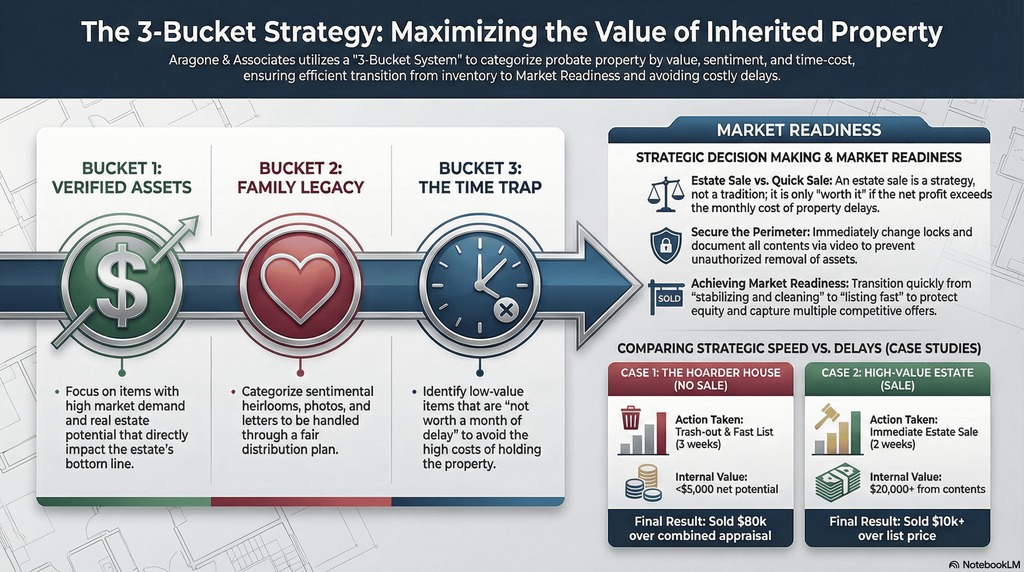
To clean out a deceased parent's house, sort the contents by logic instead of hope. Put every item into one of three buckets: financial value, sentimental items, or cost of time. Bucket three, which is usually most of the house, should leave quickly, because each month of delay brings carrying costs, and the personal representative or trustee has a duty to pay the taxes and preserve the property in the meantime.[1][2] Hold an estate sale only when the realistic proceeds clearly beat the cost of the extra weeks.
- Why an Inherited House Turns Into a Debt Trap
- Secure the Perimeter Before Anyone Starts Sorting
- How to Clean Out a Deceased Parent's House With the 3 Bucket System
- Bucket One: What Is Actually Worth Money
- Bucket Two: Sentimental Items Without the Family Fight
- Bucket Three: Putting a Price on Time
- An Estate Sale Is a Strategy Decision for an Inherited House
- When to Move Fast: The Hoarder House Case
- The Estate Sale Stress Test
- A Realistic Order for Cleaning Out a Parent's House
- Mistakes That Turn a Treasure Hunt Into a Debt Trap
- How We Help Families With an Inherited House
- Frequently Asked Questions
- Sources and How This Guide Was Written
You inherited a house, and with it came everything inside: forty years of furniture and a garage nobody has opened in a decade. Usually there is also a family convinced that somewhere in the boxes there is something valuable.
Sometimes there is. More often, the search costs more than the find. In this guide I walk through the 3-bucket strategy we use with Orange County families to sort an inherited home by logic, the questions I ask before recommending an estate sale, and a real case where skipping the sorting entirely produced 19 offers on one house and 11 on the other.
Why an Inherited House Turns Into a Debt Trap
Most families who inherit a house in Orange County do not lose money on the house. They lose it on the months they spend inside the house, opening drawers.
It starts innocently. Somebody finds a watch in a sock drawer, somebody else finds a stack of savings bonds behind the linen closet, and suddenly every box in the garage feels like it might be the one. The sorting turns into a treasure hunt. Weekends disappear. A sister flies in from Phoenix for a long weekend and gets through one bedroom. Meanwhile the property tax bill, the insurance premium, the utilities, the gardener and the HOA dues keep arriving on schedule, and none of them care what is in the boxes.
The law does not let the person in charge ignore those bills, either. In a California probate, the personal representative has a duty to pay the taxes on estate property in their possession and to take the steps reasonably necessary to protect and preserve it.[1] A trustee carries a parallel duty to take reasonable steps to take and keep control of the trust property and to preserve it.[2] So the clock is running whether or not anyone is actually sorting.
My opinion, after 23 years of estate sales and trust sales: the contents of an ordinary inherited home are rarely worth the months families spend on them. There are exceptions, and I will get to the one that paid off. But the default should be speed, and anyone who wants to slow the process down should have to show the family the numbers.
Secure the Perimeter Before Anyone Starts Sorting
The moment a property is inherited, the fiduciaries in charge must exercise total control. We frequently see cases where neighbors or distant relatives with keys begin "taking over" the inventory process, removing items they believe they are entitled to.
That happens far more than families expect, and it rarely comes from bad intentions. A neighbor who watered the plants for years feels part of the household. A cousin remembers being promised the piano at Thanksgiving in 2009. The problem is that once an item walks out the door, nobody can prove what was there, and the argument that follows can hold up the whole estate.
California is clear about who is in charge. In a probate, the personal representative has the right, and the duty, to take possession or control of all of the decedent's property.[1] The code does let real property or tangible personal property stay with the person presumptively entitled to it until the representative decides possession is needed for administration, and whoever is holding it has to surrender it when the representative asks.[1] For a trust, the trustee's duty to take and keep control of the trust property is written into the Probate Code as well.[2]
What I ask families to do in the first week
- Change or rekey the locks, including the side gate and the garage, and collect every spare key you know about.
- Walk every room with a phone and record a slow video before a single item moves. Open closets and cabinets on camera.
- Photograph jewelry, watches, firearms, artwork and anything with a serial number, then move the small valuables to a safe place with a written list.
- Look for paperwork before anything is thrown out: bank statements, insurance policies, property tax bills, the deed, and any trust or will.
- Forward the mail and keep the utilities on.
- Call the insurance carrier and tell them the house is now vacant.
- Tell relatives and neighbors, kindly and in writing, that nothing leaves the house until the inventory is done.
Work with Paula: Selling inherited property in Orange County
We wrote a separate guide on what to do in the first 72 hours after inheriting a property, and it goes deeper on that first walk through.
How to Clean Out a Deceased Parent's House With the 3 Bucket System
Families get stuck because every object gets the same question: is this worth something? That question has no end. The 3-bucket system replaces it with logic. Every item in the house goes into one of the buckets below, and each bucket has its own rule for what happens next.
| Bucket | What belongs in it | What happens to it |
|---|---|---|
| 1. Financial value | Items with verified market demand, including high-end collectibles, plus pieces with significant real estate staging potential. | Valued by someone qualified, then sold or kept for staging, or distributed to an heir with a number attached. |
| 2. Sentimental items | Heirlooms, letters, photos and family papers. | Distributed under a fair plan the family agrees to in advance, so the legacy is preserved without stalling the sale. |
| 3. Cost of time | Items that do not hold enough market value to justify even a single month of delay. | Donated or hauled away quickly, without a second round of debate. |
The third bucket is the one that changes outcomes. In most homes I walk into, it holds the large majority of the contents: the furniture from the 1980s, the kitchen drawers, the garage shelving, the clothes. Families resist putting things there because it feels like throwing a parent's life away. What they are really deciding is that a month of carrying costs is worth more than a sofa nobody wants.
The one rule that keeps the system honest. If nobody can name a buyer or a family member for an item within a few seconds, it goes in bucket three. A vague "this might be worth something" is how bucket three items end up costing the family another month.
Bucket One: What Is Actually Worth Money
Verified market demand is the phrase that matters here. The mahogany dining set that cost a fortune in 1994 usually does not have it. A signed piece of California plein air art, a Rolex, a coin collection or a mid century piece by a known designer often does. The way to know is to ask someone who sells those things for a living, not a relative with a phone and an auction site open.
There is a second kind of value people forget: staging potential. A good rug or a well proportioned sofa can help the house show better, and keeping them in place for the listing may be worth more to the estate than their resale price. I would rather keep a few strong pieces in the living room than empty the house down to bare carpet and let buyers stare at the wall marks.
A tax point worth raising with your CPA
For federal tax purposes, the basis of property inherited from a decedent is generally its fair market value on the date of death, or on the alternate valuation date if the executor elects it on the estate tax return.[5] Gain only arises when you sell for more than your basis.[5] That is one reason a written appraisal or a dated record of values is worth having before the estate sale, and it applies to the house as much as the contents. Our article on capital gains tax on an inherited house in California covers the real estate side.
I am not a tax adviser, and every estate is different. What I can tell you is that families who keep good records from the first week have much easier conversations with their CPA the following spring.
Bucket Two: Sentimental Items Without the Family Fight
Heirlooms, letters, photos and family papers require a fair distribution plan to preserve the family legacy without stalling the sale. The plan is the important part. Without one, sentimental items become the place where older grievances get argued, and the house sits.
A few approaches I have seen work well in Orange County families:
- Each heir gets a colored sticker and the siblings take turns choosing, in a rotating order, until everyone has what they want.
- Photos and letters get scanned so every branch of the family gets a full digital copy, and the originals go to whoever asks first.
- Anything two people both want is set aside and decided at the end, after the easy choices are done.
- Out of town heirs choose from a video walk through and a shared spreadsheet rather than flying in.
- A firm date is set, after which anything unclaimed moves to bucket one or bucket three.
The date is the piece families skip, and it is the piece that matters most. Sentiment is real and deserves time. It does not deserve open-ended time while the estate pays the bills.
When the disagreement is about the house itself rather than the contents, the issues are different. We cover that in what happens when siblings can't agree on selling an inherited house in California.
Bucket Three: Putting a Price on Time
Bucket three is defined by a single test: does this item hold enough market value to justify even one month of delay? To answer it, you need to know what one month costs. Very few families have actually added it up.
Use the table below with your own figures. The property tax line comes straight from the bill. In Orange County, secured property taxes are paid in two installments: the first is due November 1 and delinquent after December 10, the second is due February 1 and delinquent after April 10.[6] A late installment carries a 10% penalty, and a late second installment adds a $23 collection fee.[6]
| Monthly carrying cost | Where to find the number |
|---|---|
| Property taxes | The annual secured tax bill, divided by twelve |
| Mortgage or reverse mortgage interest | The most recent statement, or a payoff demand from the lender |
| Homeowners or vacant property insurance | The carrier, once you tell them the house is unoccupied |
| HOA dues | The association's latest statement |
| Utilities, gardener, pool service | The last few bills |
| Storage units and haul away already booked | Contracts and invoices |
| Travel for out of town heirs | Airfare and hotel for each sorting trip |
Then compare. If the house costs the estate several thousand dollars a month to hold and the garage contains a few hundred dollars of resale value, the decision makes itself. Families who do this math once almost never argue about bucket three again.
Price movement belongs on the scale too. A house that could have been listed in March and instead goes on the market in July is selling into a different set of buyers and a different rate environment. Sometimes that helps. Often it does not, and you cannot know in advance which way it will go.
Sitting on an inherited house and a garage full of boxes?
Paula is a CPRES certified probate real estate specialist. She will walk the property with you and help you decide what is worth sorting and what is costing you time.
Schedule a Free ConsultationAn Estate Sale Is a Strategy Decision for an Inherited House
Many families assume an estate sale is simply what you do when someone passes. I see it differently. An estate sale is one tool, and the question is whether it earns its place on the calendar for this particular house.
A good estate sale company can do things a family cannot: price items against what actually sells, bring in a buyer list, run the event, and leave the house broom clean afterward. For a home with real bucket one inventory, that can be the right call. For a home full of ordinary furniture, the commission and the weeks of preparation can cost more than the sale brings in. If you have never run one, our explainer on what an estate sale is and how it works is a good starting point.
Probate adds rules
When the contents belong to a probate estate, selling them is a legal step as well as a practical one. Under California Probate Code section 10250, estate personal property may be sold only after notice of sale, either posted at the courthouse at least 15 days before the sale date or published in a local newspaper, subject to exceptions in the code.[3] Section 10259 allows title to pass without court confirmation for property that is perishable or will depreciate in value if not disposed of promptly, and for property sold at public auction once the price is received and the item delivered.[4] The same section makes the personal representative responsible for the actual value of property sold that way, unless the sale is reported to and approved by the court.[4]
That last sentence is the one I want executors to read twice. It means a casual garage sale run by a well meaning relative can leave the personal representative answerable for the difference. Ask the estate's attorney how these rules apply before anything is priced. A trustee selling contents of a trust works under the trust document and the trustee's duties instead, and should ask the trust attorney the same question.
When to Move Fast: The Hoarder House Case
Some houses make the decision for you. We worked with a family on two hoarder properties, and the first walk through told us everything we needed to know.
The Decision: We determined a traditional estate sale would be detrimental. The man-hours required to sort the hoard far outweighed the realistic upside.
The man-hours required to sort the hoard far outweighed the realistic upside.
Paula Aragone
The Strategy: We skipped the three-month sorting process and moved immediately to a "trash out" and stabilization, followed by professional cleaning.
The Results: Both properties were listed within three weeks. We received 19 offers on the first home and 11 on the second.
| Property | Appraised at | Sold for | Offers received |
|---|---|---|---|
| First home | $800k | $860k | 19 |
| Second home | $940k | $960k | 11 |
Look at what did not happen. Nobody spent a summer in a garage sorting newspapers. No one paid three extra months of carrying costs in the hope of finding something. The value was always in the real estate, and the fastest route to it was a clean, safe, empty house that buyers could actually walk through.
Not every house is a hoarder house, and I would not treat a tidy home in Mission Viejo the same way. But the logic carries over. If the honest upside of sorting is small and the cost of time is large, skip the treasure hunt. You can watch the full Anaheim Hills story and more on the Aragone & Associates YouTube channel, and we wrote up another case in lessons from a live grenade in Anaheim Hills.
The Estate Sale Stress Test
Before a family books an estate sale company, I ask them to answer a short set of questions honestly. These are my working questions, and they take ten minutes at the kitchen table.
- Has anyone qualified actually looked at bucket one? An appraiser or a specialist dealer, rather than a guess from a relative.
- What does one month of holding the house cost? Use the carrying cost table above and write down a real number.
- How many weeks will the sale really add? Count the preparation and the cleanout afterward, not only the sale weekend.
- Is the house safe and clean enough for the public to walk through? If not, a sale may require a cleanup first, which changes the math.
- Does the sale fit the legal framework? In a probate, confirm the notice requirements with the estate's attorney before setting a date.
If the expected proceeds of the sale do not clearly exceed the carrying cost of the extra weeks, I recommend skipping it and moving to a donation and haul away. If they do, book the sale with a hard end date and hold to it.
I have seen estate sales pay off handsomely when the contents justified it. I have seen more of them break even after six weeks of work.
A Realistic Order for Cleaning Out a Parent's House
Every estate has its own legal path, and a probate moves on a different schedule from a trust administration. The physical work, though, tends to follow the same order. This is how I sequence it with families in Irvine, Newport Beach, Laguna Niguel, Yorba Linda and everywhere else we work.
- Week one. Secure the house, change locks, record the video inventory, pull paperwork and valuables.
- Weeks one and two. Confirm who has authority to act (personal representative or trustee) and talk to the attorney about any court steps.
- Weeks two and three. Have bucket one items looked at by someone qualified. Families make their sentimental choices against a fixed date.
- Week three or four. Run the stress test and decide on an estate sale, a buyout from an estate sale company, or a straight cleanout.
- Following weeks. Cleanout, repairs that actually move price, light staging with any pieces you kept for it, photography.
- Listing. Price against current comps, not against what the house would have sold for when a parent bought it.
Those are typical windows for the physical work, not legal deadlines, and court timing in a probate can stretch them. Use the property tax calendar as a fixed point: if a November 1 or February 1 installment falls inside your timeline, plan to pay it on time rather than let a 10% penalty eat into the estate.[6]
Mistakes That Turn a Treasure Hunt Into a Debt Trap
Most of the expensive mistakes I see are small decisions repeated.
Letting one heir sort alone on weekends for months. Paying for a storage unit to postpone decisions that will still be waiting there in a year. Holding an estate sale for a house full of ordinary furniture because that is what the neighbors did. Giving keys to people who are not fiduciaries.
The quieter mistake is letting the house sit empty with no plan. Vacant houses attract problems. A slow leak under a sink can run for weeks before anyone notices, and an obviously empty house invites a break in. The duty to protect and preserve estate property is on the personal representative or trustee, and so are the consequences when the property is not protected.[1][2]
Families caring for a parent who is still alive can avoid much of this by starting the sorting earlier and together. We wrote about that in 5 surprising realities every sandwich generation family needs to know.
How We Help Families With an Inherited House
As a CPRES certified probate real estate specialist with a background in law school, I spend much of my week inside exactly these houses. We coordinate the parts families should not have to manage alone: the locksmith, the estate sale company or the cleanout crew, the repairs that matter for price, the staging and the listing. We work alongside the estate's attorney and CPA rather than around them.
We are not attorneys, and we do not give legal advice. If you do not have legal representation yet, we can connect you with one of the attorneys we trust.
Frequently Asked Questions
What should I do first after inheriting a house?
Secure it. Change the locks, collect the spare keys, record a video of every room and move small valuables somewhere safe with a written list. In a California probate the personal representative has the right and the duty to take possession or control of the decedent's property, and a trustee has a similar duty for trust property.[1][2]
What is the 3-bucket strategy for an inherited house?
It sorts every item by logic. Bucket one is financial value: items with verified market demand, including pieces useful for staging. Bucket two is sentimental items such as heirlooms and family photos, distributed under a fair plan. Bucket three is cost of time: anything not worth even one more month of carrying costs, which leaves quickly.
Is an estate sale worth it for an inherited house?
Sometimes. It makes sense when there is real bucket one inventory and the expected proceeds clearly exceed the carrying cost of the extra weeks. For a house of ordinary furniture, a donation and cleanout is often the better financial choice. Run the numbers before you book a company.
Can relatives take items from the house before the estate is settled?
They should not. The personal representative is entitled to take possession or control of the decedent's property, and anyone holding estate property must surrender it when the representative asks.[1] Tell family and neighbors in writing that nothing leaves until the inventory is done.
Do I need court approval to sell personal property from a probate estate in California?
Generally the Probate Code requires notice before estate personal property is sold, by courthouse posting at least 15 days ahead or newspaper publication, subject to exceptions.[3] Perishable or rapidly depreciating property can pass without court confirmation, but the personal representative remains responsible for its actual value unless the court approves the sale.[4] Ask the estate's attorney before pricing anything.
Will I owe tax when I sell items from an inherited house?
The basis of inherited property is generally its fair market value on the date of death, or on the alternate valuation date if the executor elects it, and you only have a taxable gain if you sell for more than your basis.[5] Keep dated records of values and confirm the details with your CPA.
Who pays the property taxes on an inherited house before it sells?
The estate does, through the personal representative, who has a duty to pay taxes on estate property in their possession.[1] In Orange County the first installment is delinquent after December 10 and the second after April 10, with a 10% penalty for late payment.[6]
Should we clean out a hoarder house before listing it?
In most cases, yes, and quickly. In one case we handled, the family skipped a three-month sorting process and went straight to a trash out and professional cleaning. Both properties were listed within three weeks. They received 19 offers on the first home and 11 on the second, and both sold above appraisal.
How long does it take to clean out a deceased parent's house?
For the physical work, I aim for a few weeks, not a few months, with a fixed date for sentimental choices. Legal timing is a separate matter: a probate or trust administration follows its own schedule, and your attorney will tell you when the property can be sold.
Sources and How This Guide Was Written
Every legal and tax point in this guide was read from the source while it was being written. California code sections were read on california.public.law, a public copy of the official text, because the Legislature's own site was not reachable from our research environment; the Orange County dates come from the county Treasurer-Tax Collector.
- California Probate Code section 9650, which gives the personal representative the right and duty to take possession or control of the decedent's property, along with the duty to pay its taxes and preserve it. Read the statute
- California Probate Code section 16006, the trustee's duty to take reasonable steps to take and keep control of and to preserve the trust property. Read the statute
- California Probate Code section 10250, the notice of sale required before personal property of a probate estate is sold. Read the statute
- California Probate Code section 10259, when title to estate personal property passes without court confirmation and the personal representative's responsibility for its actual value. Read the statute
- Internal Revenue Service, Frequently Asked Questions on gifts and inheritances, including the basis of property inherited from a decedent and when its sale produces a taxable gain. Read the IRS guidance
- Orange County Treasurer-Tax Collector, Important Dates, with secured property tax installment due dates, delinquency dates, penalties and the collection fee. See the dates
Statutes and county deadlines change. Confirm the current rules with your estate attorney and CPA before acting on anything in this guide.
Stay Connected
New posts every week on probate and trust property sales in Orange County. Subscribe to the blog or listen to the podcast on Spotify. You can also find Paula on Instagram and YouTube.
Paula Aragone
Aragone & Associates
949-415-4784 | [email protected]
Paula Aragone, CA DRE #01364746
Aragone & Associates | First Team Real Estate, CA DRE #01008773
4 Corporate Plaza Dr #100, Newport Beach, CA 92660
This article is general information about handling the contents and sale of an inherited house and is not legal or tax advice. We are not real estate attorneys or tax advisers, so consult qualified counsel about your specific estate, and if you do not have an attorney we can connect you with one we trust.
Tags: inherited a house, inherited house Orange County, estate sale, probate personal property sale, trust property, hoarder house cleanout, executor duties California, 3-bucket strategy

Paula Aragone
Aragone & Associates | First Team Real Estate
Paula has spent 23 years in Orange County real estate, with more than 900 transactions and over $900 million in sales behind her. She holds the CPRES, SRES, Certified Luxury and Certified Relocation Specialist designations, is a member of Luxury Portfolio International, and went to law school before building her practice around probate, trust, divorce and luxury property.
Inherited a house and not sure where to start?
Call Paula. She will walk the property with you and help you separate what is worth keeping from what is costing you time.
Call (949) 415-4784Schedule a ConsultationCheck out this article next