Protecting your business and legacy in California starts with putting the handshake on paper. Two people running a business together for profit can be a partnership whether or not they meant to form one, and a partner's death dissociates that partner by statute[2][3]. Agreements to sell real property have to be in writing to be enforceable[1]. Property held inside an entity can be reassessed when more than 50 percent of control changes hands[5], and Proposition 19 protects a family home, not your company's building[6]. Write the buy-sell agreement and title the real estate on purpose.
- Why a Handshake Stops Working on the Worst Day
- Truth 1: California May Already Consider You Partners
- Truth 2: A Partner's Death Changes the Business Immediately
- Truth 3: Real Estate Deals Have to Be in Writing
- Truth 4: Moving Property Into an Entity Can Trigger Reassessment Later
- Truth 5: Prop 19 Protects the Family Home, Not Your Company's Building
- Protecting Your Business and Legacy From the Federal Estate Tax
- What a Buy-Sell Agreement Should Answer Before Anyone Needs It
- How to Hold the Real Estate Your Business Uses
- The Team That Protects a Business and Its Legacy
- A Legacy Protection Review You Can Start This Month
- When the Day Comes: Selling or Holding the Property
- Frequently Asked Questions
- Sources and How This Guide Was Written
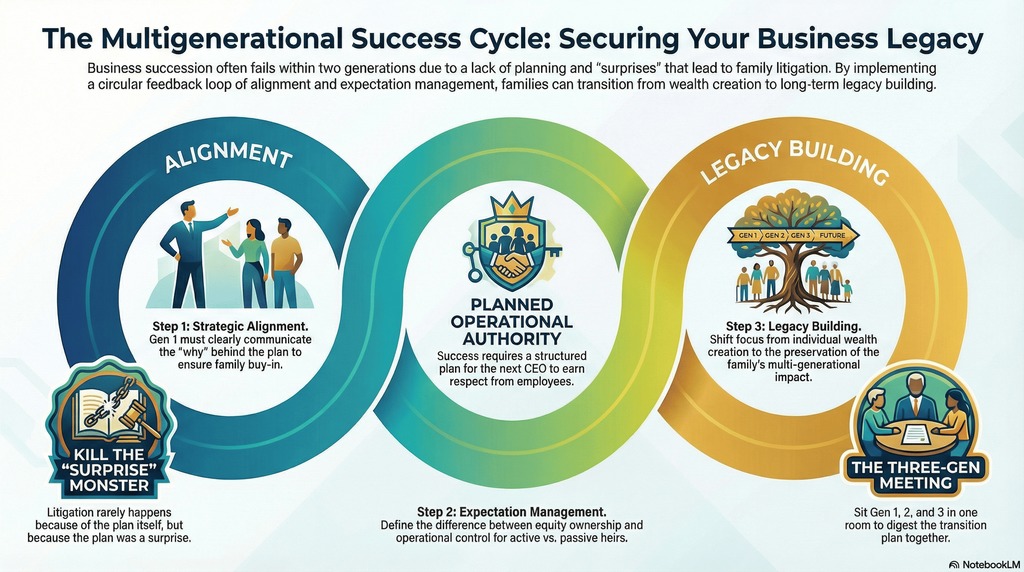
Most of the family businesses I have worked around in Orange County started with a handshake. Two friends and a lease on a small industrial unit in Santa Ana or Anaheim, and an understanding that nobody wrote down because nobody needed to. Protecting your business and legacy was not on the agenda then. Paying the next invoice was.
Thirty years later the business owns its building, maybe a second one, and the two friends are in their seventies. The understanding is still not written down.
I come into these situations at the end, usually after someone has died and a trustee or a surviving partner needs to sell or hold real estate that nobody quite knows how to handle. I am a real estate agent with a legal background, not an attorney, so this guide is not legal advice. What it does is lay out the five California rules that surprise families most often, each one checked against the statute or the agency that administers it, so you can walk into your attorney's office with better questions.
Why a Handshake Stops Working on the Worst Day
A handshake agreement works for exactly as long as both people who shook hands are alive and still on speaking terms. It depends on memory. When one of them dies, the memory that held the deal together goes with him, and what is left is a spouse, a set of adult children, a trustee and a surviving partner, each holding a slightly different version of what was promised.
None of them is lying. That is what makes it hard.
The surviving partner remembers that the two of them agreed whoever outlived the other would buy out the family at book value. The widow remembers her husband saying the building was "half ours, always." The children found a 2009 email that suggests a third arrangement entirely. The trustee, meanwhile, is holding a file that agrees with none of them. Each version is plausible, and none of them is signed.
From the real estate side, the practical consequence is delay. A title company will not insure a sale when it cannot tell who has authority to sign. A buyer's lender will not fund on a building whose ownership is in dispute. Every month the question stays open, the property taxes and insurance keep running, and the relationship between the families keeps getting worse.
The question to ask this week. If you died tomorrow, who would have the legal authority to sign a listing agreement on the building your business uses? If you cannot answer in one sentence, with the name of a person and the document that gives them that authority, the handshake is still doing work it was never designed to do.
Truth 1: California May Already Consider You Partners
Many owners assume that because they never signed a partnership agreement, they do not have a partnership. California law does not work that way. Under Corporations Code section 16202, the association of two or more persons to carry on as co-owners a business for profit forms a partnership, whether or not the persons intend to form a partnership[2].
Read that last clause twice. Intent is not the test.
So the two friends may have formed a general partnership the day they started splitting profits, and everything they did afterwards was done inside a legal structure they never chose and never documented. When there is no written agreement, the default rules in the statute fill the gaps, and the default rules were written for nobody in particular. They were certainly not written with your family in mind.
Why this matters for real estate
If the partnership bought a building, the questions multiply. Is the building partnership property, or does it belong to the two individuals as co-owners who happen to lease it to their business? The answer often depends on how the deed was taken and whose money went into the down payment. I have seen a single building reported one way on a personal tax return and another way on a partnership return. Untangling it took the attorneys months.
My opinion, for what it is worth after two decades of watching this: if you are in business with someone and you do not have a written agreement, the first protective step is not a trust or an LLC. It is a two hour meeting with a business attorney to decide what you already are, and then to write it down.
Truth 2: A Partner's Death Changes the Business Immediately
Families expect the legal consequences of a death to arrive slowly, after the funeral, after the attorney is hired. In a partnership, one of them arrives at once. Corporations Code section 16601 lists the events that cause a partner to be dissociated from a partnership, and for an individual partner the list includes the partner's death[3]. The same section also lists the appointment of a guardian or conservator, and a court finding of incapacity[3].
That second part is the one owners overlook. A partner does not have to die for the partnership to lose him. A conservatorship can do it too.
What happens after dissociation (whether the business continues, and how the departing partner's interest is valued and paid) is governed by the partnership agreement and by other sections of the statute. With a good agreement, the answer is already written and everyone follows it. Without one, the families find out what the default rules say at the same moment they are grieving, and the surviving partner and the estate are suddenly on opposite sides of a valuation.
If the business is an LLC
Forming an LLC helps, but it does not hand your seat at the table to your children. Under Corporations Code section 17705.04, when a member dies, the member's personal representative may exercise the rights of a transferee, and, for the purpose of settling the estate, the rights of a current member under section 17704.10[4]. That is a narrower set of rights than the member had in life. Whether your heirs can step into management is a question the operating agreement should answer, and many off the shelf operating agreements answer it badly or not at all.
I have seen this play out in the real estate. An LLC owns a fourplex in Costa Mesa. The managing member dies, and the remaining member and the estate cannot agree on whether to sell. The operating agreement is silent. The property sits.
Truth 3: Real Estate Deals Have to Be in Writing
California's statute of frauds, Civil Code section 1624, lists contracts that are invalid unless they, or a note or memorandum of them, are in writing and signed by the party to be charged. Several of them sit right at the center of a family business that owns property[1]:
- An agreement for the sale of real property, or for a lease of real property longer than one year[1].
- An agreement that by its terms is not to be performed within a year from the making of it[1].
- An agreement authorizing or employing an agent or broker to purchase or sell real estate for compensation or a commission[1].
- When an agent signs an agreement for the sale or long lease of real property on someone else's behalf, the agent's authority must itself be in writing, signed by the party being bound[1].
Now run your handshake through that list. "If I die first, you buy my half of the building" is an agreement about the sale of real property. "The business can stay in the building as long as it wants at the old rent" is a lease for longer than one year. Both are exactly the kind of promise the statute was written to keep from being enforced on someone's word alone.
There are exceptions and doctrines that courts apply in hard cases, and your attorney will know them. I would not build a family's future on the hope that a judge applies one.
The lease nobody signed
The most common version I see is a business that has occupied a building owned by the founder personally, or by the founder's trust, for twenty years with no written lease. When the founder dies, the trustee owes duties to the beneficiaries, and those beneficiaries may not include the people running the business. A trustee who lets the company stay at a below market rent because "that was Dad's wish" may be inviting a dispute. A trustee who raises the rent may be putting the family business under. A written lease, signed while the founder was alive, would have settled it.
Truth 4: Moving Property Into an Entity Can Trigger Reassessment Later
Owners hear that they should put their buildings into an LLC, and often that is good advice. What they rarely hear is how the property tax rules treat entity interests over time, and for a building bought decades ago in Irvine or Newport Beach, the property tax base is often the most valuable thing about it.
Revenue and Taxation Code section 64 starts with a general rule: the purchase or transfer of ownership interests in legal entities is not treated as a transfer of the real property the entity owns[5]. Two exceptions do most of the damage.
- Change in control. When a person or entity obtains control through direct or indirect ownership of more than 50 percent of the interests, the transfer is a change of ownership of the entity's real property[5].
- Original co-owners. When property was moved into an entity under the proportional interest exclusion in section 62(a)(2), the people who held interests immediately afterward are treated as original co-owners. Once those original co-owners transfer, cumulatively, more than 50 percent of the total interests, the property owned by the entity is reappraised[5].
The word "cumulatively" is the trap. A gift of 10 percent to a daughter this year, then a sale of 15 percent to a key employee in three years: each step looks small, but the statute adds them up, and nobody receives a bill in the mail warning that the line is close.
| Situation | What section 64 says | Question for your attorney or CPA |
|---|---|---|
| You transfer entity interests but nobody gains more than 50 percent control and the property was not moved in under 62(a)(2) | General rule: an interest transfer is not a transfer of the entity's real property[5] | Is anyone now close to a controlling interest after this transfer? |
| One person or entity ends up with more than 50 percent | Change in control, which is a change of ownership of the real property[5] | Can the succession plan avoid concentrating control, and is that worth the cost? |
| Property went into the entity proportionally and the original co-owners have now transferred more than 50 percent in total | Change in ownership, and the entity's property is reappraised[5] | What is our running total, and who is keeping the ledger? |
My view: every family entity that owns California real estate should keep a simple written ledger of every interest transfer since the property went in, with dates and percentages. It costs nothing. The families who did not keep one end up reconstructing it from old tax returns.
Truth 5: Prop 19 Protects the Family Home, Not Your Company's Building
Since February 16, 2021, the parent-child exclusion under Proposition 19 has applied to a family home that was the parent's principal residence and becomes the child's principal residence, or to a family farm[6]. A rental home transferred between parent and child does not qualify[6]. The Board of Equalization describes only those two categories, the family home and the family farm. The warehouse in Fullerton that your company has occupied since 1994 is neither.
Owners who remember the old Proposition 58 rules are often caught off guard here, because Prop 58 treated a broader range of property differently. Transfers on or before February 15, 2021 still fall under Proposition 58[6]. Everything after that date is under the new rules.
Even for the family home, the exclusion has a ceiling. The child keeps the parent's factored base year value only up to that value plus an adjusted amount, which is $1,044,586 for transfers from February 16, 2025 through February 15, 2027[6]. Market value above the limit is added to the base. The child also has to file for the homeowners' exemption, and the BOE says that claim must be filed within one year of the date of death or transfer for the exclusion to apply from the start[6].
I wrote a longer explanation of these rules in Proposition 19 Explained. For a business owner, the short version is uncomfortable: plan on the business real estate being reassessed when it passes to the next generation, unless your attorney finds a structure that legitimately avoids it, and run the numbers on what the new tax bill does to the business's cash flow.
Protecting Your Business and Legacy From the Federal Estate Tax
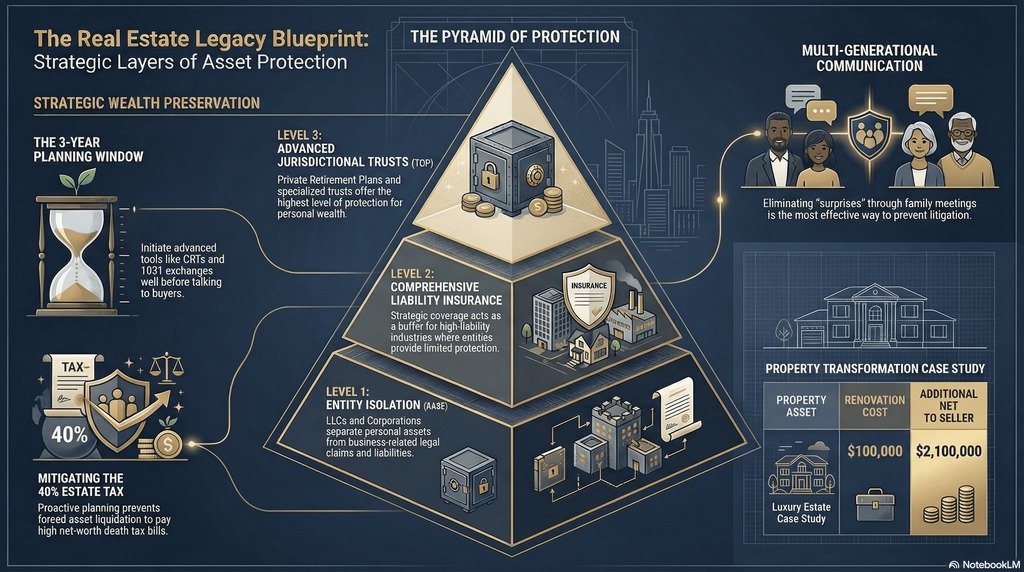
For most families I work with, the federal estate tax is not the problem. For some business owners, especially those holding several Orange County buildings bought long ago, it can be.
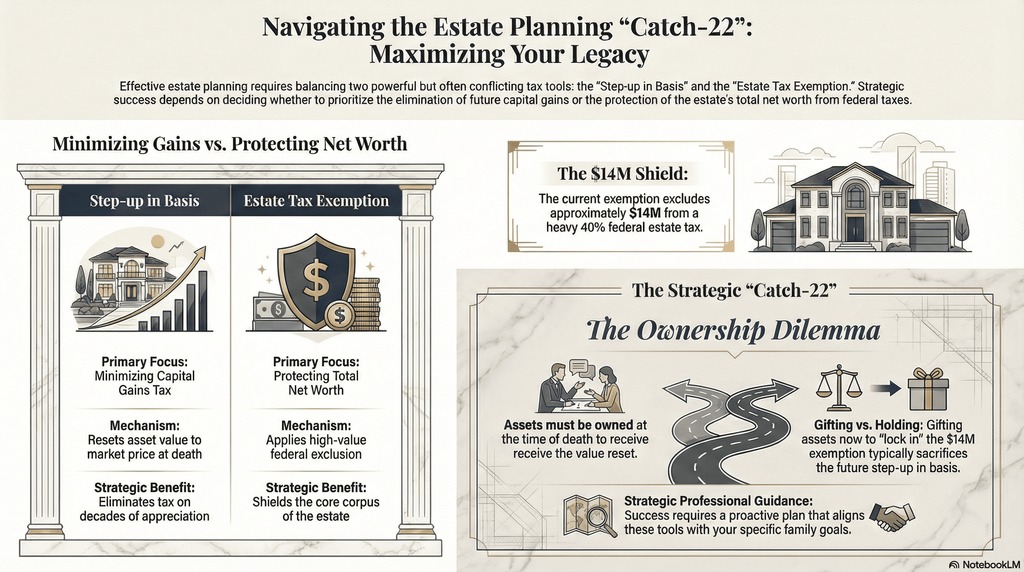
The IRS lists a basic exclusion amount of $13,990,000 for people who died in 2025, and $15,000,000 for 2026[7]. The IRS attributes the 2026 increase to Public Law 119-21, signed on July 4, 2025[7]. The annual gift exclusion for 2026 is $19,000 per recipient[7].
Those numbers are high enough that a lot of owners stop thinking about estate tax entirely. I understand why. But a business that owns a building in Newport Beach and a share of a shopping center in Irvine is worth what a buyer will pay for all of it, and that figure can surprise people who still think of their holdings at what they paid in the 1980s. A valuation is cheap compared with finding out at the wrong time.
Estate tax and the building are separate questions
Families sometimes mix up three different taxes in one conversation. The federal estate tax is a tax on what you leave. California property tax reassessment, discussed above, is a local tax that rises when ownership changes. Income tax on a later sale is a third question entirely, and it depends on the basis the heirs receive. Each one has different rules and a different professional who should be advising on it. I cover the inherited basis question for houses in Inheriting a House in California: Will You Owe Capital Gains Tax?
Does your business own Orange County real estate?
Paula works with trustees and family business owners on valuing and selling property, in coordination with your attorney and CPA.
Schedule a Free ConsultationWhat a Buy-Sell Agreement Should Answer Before Anyone Needs It
The single document that replaces the handshake is the buy-sell agreement, whether it lives inside the company's governing agreement or stands alone. Your attorney drafts it. What you can do is arrive knowing which questions it has to answer, because the attorney can only write down decisions you have made.
- Trigger events. Death, of course, and also incapacity, divorce, retirement, a partner who simply wants out, and a partner who is no longer working in the business.
- Who buys. The remaining owners personally, or the company itself.
- The price. A fixed number nobody updates is the most common failure I see. A formula, or an appraisal process with a named method, ages better.
- The money. Where the buyer gets the funds. Insurance is the usual answer, and the coverage amount needs the same regular review as the price.
- The real estate. Whether buildings the company uses are inside the deal or held separately, and whether the business gets a written lease from the family that keeps the building.
- Payment terms. Cash at closing, or installments, and what security the selling family receives if they are paid over time.
- Deadlines. How many days each side has to act, so a death does not open an indefinite standoff.
Notice how many of those items involve real estate. That is not an accident. In a lot of Orange County family businesses, the building is worth more than the operating company, and an agreement that values the company without saying anything about the building has solved the smaller problem.
One more opinion. Review the agreement every three years at a minimum, and every time something big happens, such as a new building or a new partner. An agreement priced in 2012 is a gift to whichever side benefits from the stale number.
How to Hold the Real Estate Your Business Uses
There is no single right way to own business real estate, and anyone who gives you one answer without asking about your family has not done the work. Here is how the main options compare from the point of view of the person who will eventually have to sell.
| How the property is held | What happens at death, in practice | What I see go wrong |
|---|---|---|
| Individual name | Usually requires a court process before heirs can sell, unless another transfer method applies | Sales delayed for months while the estate is opened and someone is appointed with authority to sign |
| Revocable living trust | The successor trustee steps in and can usually manage or sell under the trust's terms | Trusts signed but never funded, so the deed is still in the individual's name |
| LLC or partnership | The entity owns the property; what changes hands is the membership or partnership interest | Operating agreements silent on succession, and interest transfers that quietly add up past the 50 percent line[5] |
| LLC interests held by a trust | The trustee holds the interest, and the operating agreement governs what the trustee can do with it | Operating agreement and trust written by different attorneys who never compared notes |
The unfunded trust deserves its own warning. Families pay for a well drafted trust, sign it, put the binder on a shelf, and never record a deed moving the property into it. I explain what happens next in What Happens If a Home Was Never Transferred Into a Trust in California? The same thing happens with LLC interests that were supposed to be assigned to the trust and never were.
Pull a copy of the current recorded deed for every property you own. It takes minutes, and it is the only way to know how title actually reads today.
The Team That Protects a Business and Its Legacy
Protecting a family business takes more than one professional, and the failures I see usually come from people who never talked to each other. The estate planning attorney drafted the trust. A different attorney formed the LLC ten years earlier. The CPA prepares the returns and has never seen either document. The insurance agent sold a policy to fund a buyout at a price nobody remembers agreeing to.
Each of them did good work. Together they built something that contradicts itself.
Ask for one meeting, with everyone in the room or on the call, at least once. Bring the trust, the operating or partnership agreement, the buy-sell provisions, the insurance declarations, the current deeds and the most recent property tax bills. Ask each professional to say out loud what happens to the business and to each building if you die next month. If the answers do not match, you have found the work that needs doing.
Where do I fit? Usually later, when real estate has to be valued or sold as part of a trust administration or estate. I coordinate with the attorney and the CPA on pricing and on the documents the title company will require, and I can often tell a family early which problems are going to slow down a sale. That is the part of the process where my CPRES training and my legal background are most useful.
A Legacy Protection Review You Can Start This Month
If you own a business and real estate in Orange County, here is the order I would work through it. Each step produces something you can hand to your attorney.
- Write down what you think the deal is. Every percentage and every promise about who buys whom and at what price. Have each partner do it separately, then compare. The differences are your agenda.
- Gather the documents. Trust, will, partnership or operating agreement, any buy-sell terms, leases between you and your own company, insurance policies, and the recorded deed for every property.
- Check title against the plan. If the trust says a building is in the trust and the deed says it is in your name, fix the deed before you fix anything else.
- Get a current value. For the business and for each building. A broker opinion is a start for the real estate; your CPA will tell you when a formal appraisal is required.
- Map the property tax exposure. Which properties would be reassessed at the next generation, and what the new tax bills would look like against today's cash flow[5][6].
- Meet with a business attorney and an estate planning attorney together. Turn steps one through five into signed documents.
- Put a review on the calendar. Every three years, and after any major change.
Seven steps, and none of them is complicated. The hard part is the first one, because it is the step where partners find out they never agreed on as much as they thought.
When the Day Comes: Selling or Holding the Property
Sometimes the plan was not finished in time. The partner died with the trust half funded and the operating agreement silent. Now a family has to decide what to do with a building.
The first decisions are about authority and order, not price. Who can sign? Does the business have a lease, and if not, what is the family going to do about the tenant who also happens to be the business? My trust sale checklist for California trustees walks through the steps before a listing, and if the heirs are divided about whether to sell at all, Siblings Can't Agree on Selling an Inherited House in California covers the options families have when there is no consensus.
The first days after a death matter more than people expect. Lock the building, find the keys and the alarm codes, confirm the insurance stays in force, and do not let anyone remove records or equipment until the person with authority has been identified. I wrote about those early hours in The $10,000 Suitcase: What to Do in the First 72 Hours After Inheriting a Property.
And sometimes the right answer is to hold. A building leased to a stable business at market rent can be a better inheritance than the cash from selling it. I will tell a family that when it is true. I will also tell them when the building is carrying a business that cannot pay a fair rent, because that is a conversation the handshake was always going to postpone until someone had to have it.
Frequently Asked Questions
Can a handshake agreement between business partners be enforced in California?
Some can and some cannot. California treats two or more people who carry on a business for profit as co-owners as a partnership whether or not they intended to form one[2], so a handshake can create real legal obligations. Agreements for the sale of real property and leases longer than one year are among the contracts that are invalid unless they are in writing and signed[1]. If your business arrangement touches real estate, assume the handshake will not hold up and put it on paper.
What happens to a partnership when a partner dies in California?
Under Corporations Code section 16601, an individual partner's death dissociates that partner from the partnership[3]. What follows, including whether the business continues and how the departing partner's interest is valued and paid, depends on the partnership agreement and the rest of the statute. A written agreement answers those questions in advance; without one, the estate and the surviving partner work it out under default rules.
Do my heirs automatically take my place in my LLC?
Not necessarily. When a member dies, the personal representative may exercise the rights of a transferee and, for settling the estate, a current member's rights under section 17704.10[4]. Whether heirs can step into management depends on the operating agreement. Have your attorney read yours with that specific question in mind.
Will my business property be reassessed when my children inherit it?
Often, yes. If the property is held in an entity, a transfer that gives someone more than 50 percent control, or cumulative transfers by original co-owners of more than 50 percent, is treated as a change in ownership[5]. If you hold it personally, Proposition 19's parent-child exclusion is limited to the family home and family farms, and a rental home does not qualify[6]. Ask your attorney and CPA to model the tax bill your heirs would face.
Does Proposition 19 apply to commercial or business property?
The Board of Equalization describes the Prop 19 parent-child exclusion as covering a family home that was the parent's principal residence and becomes the child's principal residence, or a family farm[6]. A rental home between parent and child does not qualify[6]. A commercial building is in neither category, so plan on it being treated differently from the family home.
How much is the federal estate tax exemption in 2026?
The IRS lists a basic exclusion amount of $15,000,000 for 2026, up from $13,990,000 for 2025, and an annual gift exclusion of $19,000 per recipient for 2026[7]. Many business owners fall below the threshold, but owners of several long-held Orange County buildings should have a current valuation before assuming they do.
What should a buy-sell agreement include?
At minimum: the events that trigger a buyout (death, incapacity, divorce, retirement and voluntary exit), who buys, how the price is set, where the money comes from, what happens to any real estate the business uses, payment terms and deadlines. The most common failure I see is a fixed price nobody has updated in a decade. Review it every few years.
Should my business real estate be in an LLC or in my trust?
It depends on your liability exposure, your partners, your tax situation and what you want to happen at death, and it is a decision for your attorney and CPA. Many owners do both, with the LLC owning the property and the trust owning the LLC interest. Whatever you choose, make sure the deed and the assignment of interests actually match the plan; an unfunded trust protects nothing.
Do I need a written lease if my company uses a building I own personally?
In my opinion, yes. A lease longer than one year has to be in writing to be enforceable under California's statute of frauds[1]. More practically, when you die a trustee may owe duties to beneficiaries who are not running the business, and a written lease at a defensible rent spares that trustee an impossible choice between the family and the company.
Sources and How This Guide Was Written
Every statute and figure in this guide was read from the source while it was being written. California codes were read on california.public.law because the official leginfo site was not reachable from the research environment; agency figures come from the Board of Equalization and the IRS directly.
- California Civil Code section 1624, the statute of frauds, listing contracts that must be in writing, including agreements for the sale of real property and leases longer than one year (copy on california.public.law). Read the statute
- California Corporations Code section 16202, formation of a partnership, providing that two or more persons carrying on a business for profit as co-owners form a partnership whether or not they intend to (copy on california.public.law). Read the statute
- California Corporations Code section 16601, events causing a partner's dissociation, including an individual partner's death or conservatorship (copy on california.public.law). Read the statute
- California Corporations Code section 17705.04, the powers of a deceased LLC member's personal representative (copy on california.public.law). Read the statute
- California Revenue and Taxation Code section 64, change in ownership rules for transfers of legal entity interests, including change in control and the original co-owner rule (copy on california.public.law). Read the statute
- California State Board of Equalization, Proposition 19 information page, covering the parent-child exclusion for family homes and family farms and its adjusted value limit. Visit the BOE page
- Internal Revenue Service, What's New: Estate and Gift Tax, listing the basic exclusion amount for 2025 and 2026 and the 2026 annual gift exclusion. Visit the IRS page
Statutes and exemption amounts change. The figures above reflect the sources as published at the time of writing, so confirm the current rules with your own attorney and CPA before acting on them.
Stay Connected
New posts every week on trust and probate real estate in Orange County. Subscribe to the blog or listen to the podcast on Spotify. You can also find Paula on Instagram and YouTube.
Paula Aragone
Aragone & Associates
949-415-4784 | [email protected]
Paula Aragone, CA DRE #01364746
Aragone & Associates | First Team Real Estate, CA DRE #01008773
4 Corporate Plaza Dr #100, Newport Beach, CA 92660
This article is general information about protecting a business and its real estate and is not legal, tax or financial advice. We are not attorneys or tax advisers, so review your partnership, LLC, trust and tax questions with your own attorney and CPA before you act.
Tags: protecting your business and legacy, business succession planning California, buy-sell agreement, partner death California partnership, LLC member death, Proposition 19 business property, legal entity change in ownership, estate planning Orange County business owners

Paula Aragone
Aragone & Associates | First Team Real Estate
Paula has spent 23 years in Orange County real estate, with more than 900 transactions and over $900 million in sales behind her. She holds the CPRES, SRES, Certified Luxury and Certified Relocation Specialist designations, is a member of Luxury Portfolio International, and went to law school before building her practice around probate, trust, divorce and luxury property.
Does your family business own a building nobody has a plan for?
Tell Paula how the property is held today. She will walk through what would happen to it at a sale or a transfer and coordinate with your attorney and CPA on the next step.
Call (949) 415-4784Schedule a ConsultationCheck out this article next