1. Introduction : The Contingency of Longevity
In the affluent enclaves of Orange County and surrounding areas, the term "estate planning" is frequently misconstrued as a mere "death plan", a static set of instructions for the distant future. However, for high-net-worth families, true estate planning is a dynamic "long-term life plan." It serves as essential insurance for the contingency of longevity, addressing the critical juncture when one can no longer advocate for themselves.
The complexity of modern aging requires more than just signatures on a page; it requires a proactive architecture to protect autonomy and assets. Despite significant financial success, many individuals fail to account for the legal and social vulnerabilities that accompany aging, leaving their legacies at the mercy of backlogged court systems and potential familial discord.
2. The "Empty Bucket" vs. The "Trash Bag": The Criticality of Funding
A common, yet devastating, misconception is that the mere existence of a trust document provides protection. As attorney Cheryl Walsh notes, a trust is effectively an "empty vessel" or a bucket. Its utility is entirely dependent on "funding" the meticulous process of retitling assets into the name of the trust.
Within the Aragone & Advisors philosophy, Pia Aragone often uses the "trash bag" analogy—the trust acting as the container that keeps all your valuable assets together and protected. Contrast this with Walsh’s "empty bucket": if you fail to move your real estate, bank accounts, and investments into that vessel, you are left holding nothing but a stack of papers.
"A lot of people think that they're planning by creating this beautiful trust and getting their powers of attorney, and they forget to put assets into the trust. That just means the trust is not funded." — Cheryl Walsh
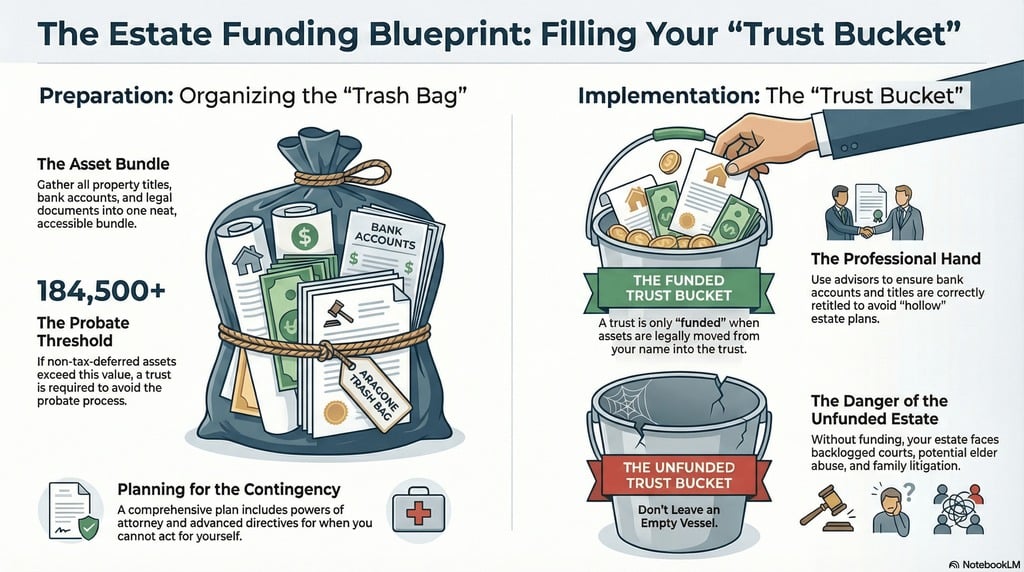
[Visual Placeholder: Infographic Suggestion: A "Funding Comparison" graphic.
3. The $184,500 Threshold: Escaping the Probate Trap
In California, the legal threshold for probate is remarkably low: $184,500. Any estate exceeding this value—excluding tax-deferred accounts like IRAs—is legally required to pass through the probate court unless those assets are secured within a trust.
In the Orange County luxury market, where median home prices comfortably exceed $1M, this threshold is almost negligible; it is often less than the down payment on a premier property.
0This reality makes comprehensive planning mandatory. Without it, a trust or estate property may be forced into a probate sale, a public, expensive, and protracted process that can diminish the estate’s value and strip the family of its privacy.
4. The Silent Signs of Vulnerability: Preempting Predatory Interference
Elder abuse rarely announces itself; it thrives on isolation and what experts call the "humiliation factor." As cognitive decline or memory loss begins, seniors often develop a protective paranoia or defensiveness to mask their diminishing capabilities.
Strategic proactive familial oversight is required to identify subtle red flags:
- The Avoidance Anecdote: A parent who suddenly insists on meeting at restaurants rather than their home may be concealing a hoarding situation they are too embarrassed to manage.
- Financial Secretiveness: Victims of sophisticated scams often suffer in silence, fearing that admitting to a mistake will result in a loss of independence.
- Tactical Isolation: Predators thrive when an elder is lonely.
By maintaining a "many eyes" approach and normalizing frequent financial check-ins, families can ensure that help is viewed as a supportive resource rather than a judgment, thereby preempting predatory interference.
5. The Reality of Conservatorship: A Five-Month Wait for Help
When an individual loses capacity without a Power of Attorney, the family is forced into the conservatorship process. However, the California court system is currently under a staggering backlog.
A non-emergency petition for conservatorship currently takes a minimum of five to six months for an initial hearing. If the petition is contested—a common occurrence when dementia-induced paranoia sets in—the timeline can extend to two years before reaching trial.
Consider a recent Court of Appeals decision regarding a case Cheryl Walsh handled. The litigation spanned six to seven years before a final resolution was reached.
While a traditional buy/sell in real estate is a streamlined market activity, a conservatorship transaction is a court-supervised ordeal that adds layers of bureaucracy and public record to a family's private affairs. A valid Power of Attorney serves as a vital deterrent to this expensive, public, and exhausting judicial intervention.
6. The Inheritance Hijack: Protecting the Right to Association
Not all legal interventions are motivated by care. In dysfunctional family dynamics, conservatorship can be weaponized for "non-altruistic" reasons. This "inheritance hijacking" involves bad actors—sometimes even siblings—attempting to isolate an elder to secure a larger portion of the estate or to prevent other family members from having contact.
Sophisticated legal advocacy is necessary to protect an elder’s right to association. Sometimes, the most important role of a legal team is to defend the senior’s independence against their own family members, ensuring they maintain their dignity and the right to see whom they choose during their final years.
7. The "Spokes of the Wheel" Strategy for Luxury Estates
Managing a high-value estate requires a multidisciplinary "Team Approach." In this model, the Elder acts as the "Hub" or the center of the wheel, with professional advisors serving as the essential spokes that maintain the structure's integrity.
A premier estate management team includes:
- The Attorney: To navigate trust litigation and elder law complexities.
- The CPA: To mitigate tax exposure for the heirs.
- The Financial Advisor: To ensure the longevity of the capital.
- The Real Estate Advisor: To manage a luxury listing, ensuring the property maintains its peak value through strategic staging and expert valuation even during a transition.
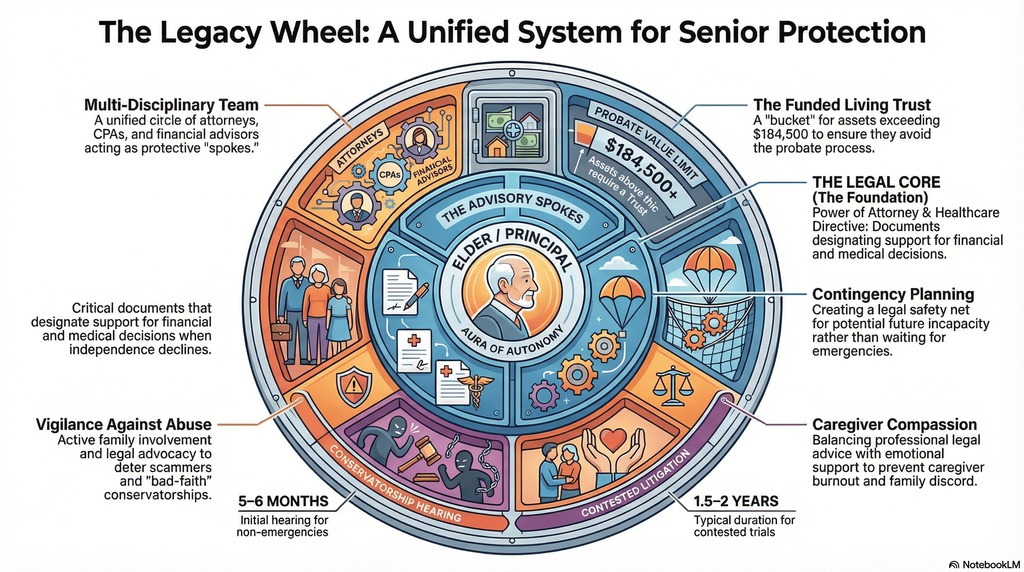
[Visual Placeholder: Infographic Suggestion: A "Legacy Wheel" diagram.
8. Conclusion: Caring for the Caregiver and the Legacy
A final, often overlooked element of a successful legacy is the health of the caregiver. The source of many estate crises is "caregiver burnout," particularly for spouses who are managing their own medical or emotional challenges while struggling to support a partner in decline.
Successful estate planning is an act of profound compassion for the entire family. It requires a funded "bucket," a professional team, and a commitment to "caring for the caregiver." As you look at your current plan, ask yourself: Is your bucket filled, or are you leaving your autonomy and your family’s harmony to a backlogged court system?
- Watch: See the full Anaheim Hills story and more expert tips on the [Aragone & Associates YouTube Channel].
- Subscribe: Visit our Blog Main page to sign up for our newsletter and receive in your inbox our latest blogs articles.
- Listen: Catch the latest episodes of the Aragone & Advisors podcast on Spotify for deep dives into Orange County real estate strategy.
- Connect: Follow us for daily insights and probate advice on [Instagram], [Facebook], and [LinkedIn].
Blog Article by Paula Aragone with Aragone & Associates
Let Aragone & Associates guide you through the process, helping to make the transition seamless. Call us at 949-415-4784 or email us at [email protected].
Disclaimer: We are not real estate attorneys, and the information provided should not be considered legal advice. We strongly recommend consulting with qualified legal counsel regarding your specific situation. If you do not currently have legal representation, feel free to reach out to us, and we can connect you with one of our trusted attorneys.
Check out this article next