The best way to help aging parents stay in their home is to plan before a crisis instead of during one. After a fall, Medicare can cover skilled nursing rehab following a three day inpatient stay, with days 1 to 20 at no daily cost in 2026.[1] Veterans may qualify for VA caregiver support or Aid and Attendance, whose net worth limit is now $163,699 with the home excluded.[2] An ADU can keep a parent close, and a caregiver paid in cash can create overtime liability. Sign a durable power of attorney while your parent still can.
- How to Know Your Aging Parents Need Help at Home
- After a Fall: What Medicare Actually Covers in Rehab
- Use the Rehab Window to Plan, Not to Rest
- The VA Caregiver Benefits Most Families Never Ask About
- Aid and Attendance: The Asset Limit Has Changed
- Can an ADU Keep Aging Parents Close? The Orange County Option
- What an ADU Can and Cannot Do for the Family Balance Sheet
- Hiring a Private Caregiver: You Become an Employer
- Licensed Agency or Independent Aide: What to Check
- Staying the Son or Daughter, Not the Enforcer
- What Elder Care Costs and How Families Pay for It
- Helping Aging Parents With the Paperwork Before a Crisis
- Frequently Asked Questions
- Sources and How This Guide Was Written
Helping aging parents rarely begins with a formal family meeting. For the sandwich generation, the adult children raising their own kids while looking after a mother or father, it usually begins with a small observation during a holiday visit. Then comes a fall, and a week of decisions made in a hospital hallway.
This guide grew out of our conversation with Dwight Brown, who owns a Home Helpers home care franchise, and it has been rewritten and updated against the current Medicare, VA and California sources. Where the first version contained a figure I could not confirm, I have removed it, and where a rule has changed since February, I say so.
I am Paula Aragone. I sell real estate in Orange County, much of it for trusts and older homeowners, and I see how care decisions and housing decisions collide. The goal here is simple: move your family from reacting to planning.
How to Know Your Aging Parents Need Help at Home
Nobody schedules this conversation. For most sandwich generation families, the moment arrives during a holiday visit, in a kitchen, while everyone is pretending things are normal.
You notice your mother has lost weight. Your father has become, in the word families use most often, wobbly. He holds the counter on the way to the refrigerator. She has stopped cooking the dish she always made for Thanksgiving and says she simply did not feel like it this year.
Dwight Brown, owner of a Home Helpers franchise, gave us the detail I now repeat to every family I sit with. One of the most telling red flags is a fitted sheet. When an 85 year old struggles to wrestle a fitted sheet onto a mattress, or to carry a heavy laundry basket down a hallway, that person is one slip away from a life altering crisis. It is a household chore. It is also a balance test, a grip test and a fall waiting for a hard floor.
What to look for on your next visit
- Weight loss you can see in the face or in clothes that no longer fit
- A hand on the wall or the furniture while walking through the house
- Beds left unmade, or sheets that have not been changed in weeks
- Laundry piling up near the machine rather than in it
- Unopened mail, especially from the bank or the county tax collector
- Expired food in a refrigerator that used to be carefully managed
- New dents or scrapes on the car
One of those on its own is a conversation. Three or four together usually mean the help is already overdue, and the family is still talking about whether it is needed.
I come at this from the real estate side. As a probate and senior real estate specialist in Orange County, I meet families after something has gone wrong, and the pattern is consistent: the house and the medical care were decided in the same frantic week. This guide is about moving those decisions earlier, while your parents can still take part in them.
After a Fall: What Medicare Actually Covers in Rehab
When a parent has what doctors call an acute event, such as a fall that breaks a hip, two clocks start at once. One is the recovery. The other is your planning time, and families waste a surprising amount of it by rushing a parent straight home from the hospital to a house that has not changed since the fall.
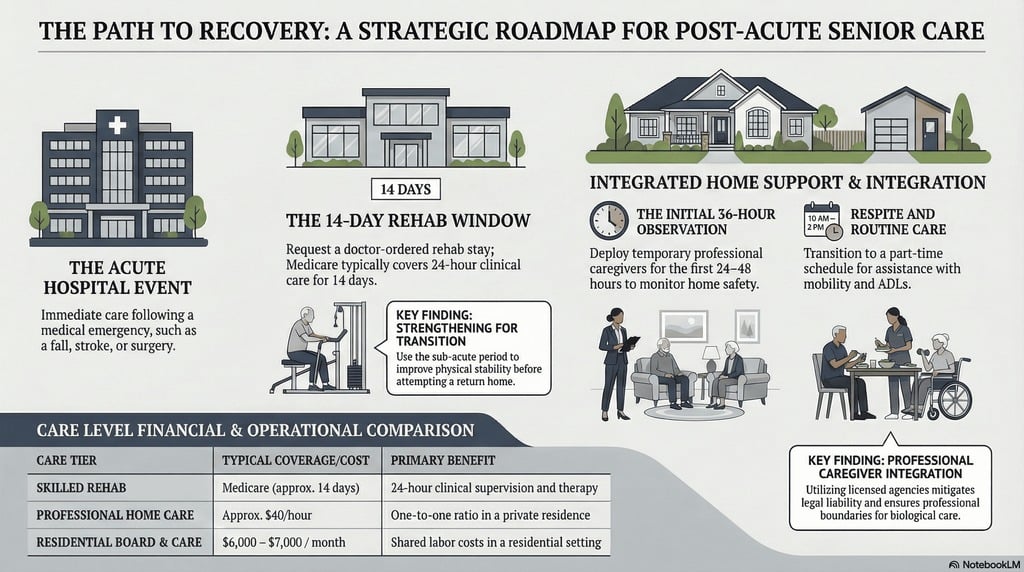
Dwight calls the alternative the hospital hotel. After a qualifying hospital stay, Medicare Part A can cover time in a skilled nursing facility where your parent gets around the clock nursing and therapy to rebuild strength. His advice in our conversation was direct:
"I always tell people: talk to the doctor. Say that mom or dad is potentially a fall risk, and they’ll keep you at a rehab for a couple of weeks... You get two weeks for mom and dad to get stronger and more capable, and then by the time they come home, hopefully, they’re able to stand up." That was Dwight Brown, and the practical instinct is right. Raise fall risk with the doctor and advocate for the stay.
The rules underneath are more precise than "a couple of weeks," and they are worth knowing before the discharge planner knocks on the door.
The 3-day inpatient rule
Medicare covers skilled nursing facility care only after a medically necessary inpatient hospital stay of at least three days in a row, and the day of discharge does not count.[1] Your parent generally has to enter a Medicare certified facility within about 30 days of leaving the hospital and must need daily skilled nursing or therapy.[1]
| Days in the skilled nursing facility | What your parent pays in 2026 (Original Medicare) |
|---|---|
| Days 1 to 20 | $0 per day, after the $1,736 Part A deductible for the benefit period |
| Days 21 to 100 | $217 per day |
| Day 101 and beyond | All costs |
Those figures come straight from Medicare's coverage page for 2026.[1] So the original version of this article, which described roughly two weeks of coverage, undersold it. Medicare allows up to 100 days per benefit period, with the first 20 at no daily cost, provided your parent keeps needing skilled care. In practice the stay often ends sooner, because coverage stops when the facility decides daily skilled care is no longer needed. Plan for two or three weeks and treat anything longer as a bonus.
The observation status trap. Hours spent under observation or in the emergency room do not count toward the three inpatient days, even when your parent sleeps in a hospital bed overnight.[1] Ask the hospital, in so many words, whether your parent has been formally admitted as an inpatient. If the status was changed from inpatient to observation, Medicare says you may be able to appeal that change.[1] Medicare Advantage plans can work differently, so call the plan as well.
Use the Rehab Window to Plan, Not to Rest
Families tend to treat the rehab stay as a pause. I think it is the most useful planning time you will get, and it is usually wasted.
While your parent is in a facility with nurses on the floor, nobody in the family is doing night shifts. That is when you can look at the house with clear eyes and get the siblings and the documents in order. Here is the order I suggest.
- Walk the house as if you were the physical therapist. Stairs to the bedroom, the step into a sunken living room, a tub instead of a walk-in shower, rugs on tile. Write down what would have to change for your parent to come home safely.
- Ask the facility for a realistic discharge picture. Will your parent need someone at night? Help bathing? Supervision with medications? The answer decides whether you are looking at a few hours of help a week or 24 hour care.
- Check the paperwork. Does your parent have a durable power of attorney and an advance health care directive that someone can find? If not, this is the moment to call the estate planning attorney, while your parent can still sign.
- Get a number on the house. Even if nobody wants to sell, knowing what the home is worth tells you what options exist: a reverse mortgage, a sale to fund care, an ADU in a child's backyard, or staying put with paid help.
- Hold the family meeting before discharge day. Decide who is the point person for medical decisions and who handles money. Two different people is often better than one exhausted one.
Some families I work with do all five in the first week. Others get to step two and stop, because step three forces a conversation about mortality nobody wants to have in a rehab lobby. Have it anyway.
The VA Caregiver Benefits Most Families Never Ask About
If either parent served in the military, stop here and check. VA support for family caregivers is one of the most overlooked tools in elder care, mostly because families assume it is reserved for younger veterans with combat injuries, or that it is means tested out of reach. Some of it is. Some of it is not.
The original version of this post described three avenues. They are still the right map, but the details have moved, and one claim in the old version could not be confirmed, so I have tightened it.
Program of Comprehensive Assistance for Family Caregivers
This is the program that pays a monthly stipend directly to the family caregiver. Eligibility is built around the veteran's service connection and need for care: VA requires a single or combined service-connected disability rating of 70% or more, from an injury or illness sustained or aggravated in the line of duty in any service era, and a need for in-person personal care for at least six continuous months.[3] The veteran can name one primary and up to two secondary family caregivers. The primary caregiver can receive the stipend, CHAMPVA health coverage if they have no other insurance, mental health counseling, certain travel benefits and respite.[3]
VA's published eligibility description for this program is about the disability rating and the care need. It does not list a net worth test.[3] That matches what the original article said about these caregiver programs, but confirm it for your own family with VA directly, because the program has been revised more than once.
Respite care for the caregiver
Respite means someone else cares for the veteran so the family caregiver can take a break. Primary caregivers in the comprehensive program receive at least 30 days of respite care per year for the veteran.[3] Families ignore this benefit more than any other, and I understand why. Taking a break feels like abandoning your post. It is the opposite: a caregiver who never gets relief is the one who ends up in the hospital bed next.
The old post also cited a utilization rate under 1% and billions set aside by Congress. I could not find a primary source for either figure, so they are gone. The point stands without them: ask.
Aid and Attendance: The Asset Limit Has Changed
The third avenue is different in kind. Aid and Attendance is an increase to the VA pension, paid to the veteran or surviving spouse, and the pension is means tested.
When this post was first published it said the pension generally required assets below $120,000. That figure is out of date. VA now states that the net worth limit for Veterans Pension is $163,699 for the period from December 1, 2025 through November 30, 2026.[2] The limit is adjusted each year, so check the current number before you file.
Two details matter enormously for families with real estate. First, the primary residence, the home where the veteran lives most or all of the time, is not counted as an asset.[2] Second, VA looks back three years at asset transfers when a pension claim is filed. If assets were given away or sold for less than fair market value and that pushed net worth over the limit, VA can impose a penalty period of up to five years with no pension.[2]
That look-back rule is where well meaning families get hurt. A parent deeds a rental to a child, or sells it to a grandchild at a family price, and a year later applies for Aid and Attendance. That is exactly the transfer VA reviews. If there is a trust or estate property in the picture, talk to an accredited VA attorney or claims agent before anything is retitled.
| Benefit | Who it pays | Key eligibility point | Net worth test |
|---|---|---|---|
| Program of Comprehensive Assistance for Family Caregivers | Family caregiver (stipend and support) | Service-connected rating of 70% or more and six months of personal care need | None listed in VA's eligibility description |
| Respite care (within the comprehensive program) | Care for the veteran while the caregiver rests | At least 30 days per year for primary caregivers | None listed |
| Veterans Pension with Aid and Attendance | Veteran or surviving spouse | Pension eligibility plus a need for help with daily activities | $163,699 net worth limit through Nov. 30, 2026, home excluded |
For reference, VA's current maximum annual pension rate with Aid and Attendance is $29,093 for a veteran with no dependents and $34,488 with one dependent.[2] The actual payment is reduced by countable income, so most families receive less than the maximum.
Can an ADU Keep Aging Parents Close? The Orange County Option
Here is where my world and the caregiving world overlap most directly.
In Orange County I see more families moving away from the traditional pattern of selling the parents' house and buying them something smaller. The alternative is the multi-generational lot: an accessory dwelling unit, or a converted garage, behind the adult child's home in Irvine, Mission Viejo, Yorba Linda or Huntington Beach. Mom and Dad keep a front door of their own. You are thirty steps away instead of thirty minutes.
The reason this has become realistic is California law. The state has spent the last several years overriding local rules that made ADUs hard to build, and the Department of Housing and Community Development updated its ADU Handbook in March 2026 to reflect the law in effect on January 1, 2026.[4] The original version of this post cited a specific old Yorba Linda lot size rule. I could not confirm that figure from a primary source, so I have replaced it with what the state handbook says today.
| State ADU rule | What the handbook says |
|---|---|
| Minimum lot size | A city cannot use a minimum lot size that blocks at least an 800 square foot ADU with four-foot side and rear setbacks (Gov. Code 66321) |
| Approval timeline | Ministerial review, with approval or denial within 60 days of a complete application (Gov. Code 66317 and 66335) |
| Owner occupancy | Cities cannot require the owner to live on the property for an ADU (Gov. Code 66315) |
| Garage conversions | Allowed, and the lost garage parking does not have to be replaced (Gov. Code 66314) |
| Impact fees | An ADU of 750 square feet or less of interior living space is exempt (Gov. Code 66311.5) |
| Junior ADU | No more than 500 square feet, created within the existing home (Gov. Code 66313 and 66333) |
Every row above comes from the HCD handbook.[4] Your city still controls design details inside those limits, so call the planning counter in your own city before you pay an architect.
My opinion, for what it is worth: for a parent who is still mostly independent, a garage conversion or a junior ADU in a child's home is the best value option in Orange County elder care. It costs less than most of the alternatives in the cost table further down, and it adds a legal unit to your property while keeping the parent close. For a parent who already needs 24 hour care, it solves the housing question and leaves the care question untouched. Be honest about which parent you have.
What an ADU Can and Cannot Do for the Family Balance Sheet
The original article described the ADU as a double win, and I still think it is one: dignity and proximity for your parents, and an investment in your own property. It also suggested the unit could later become a luxury listing on its own. That part needs a correction.
Under state law an ADU is generally not sold separately from the main house. The handbook notes that a local ordinance may allow the primary home and ADUs to be conveyed separately as condominiums, which is a specific path a city has to opt into.[4] Assume your ADU is part of your house for resale purposes unless your city has adopted that option.
What it can do after your parents move on is produce rental income. Cities may require that ADU rentals be for terms of 30 days or longer, and junior ADUs can no longer be used as short-term rentals at all.[4] So think long-term tenant or another family member, not vacation rental.
There is also a quieter benefit. When a parent moves into an ADU on your lot, their own house is suddenly free. Some families rent it to help pay for care. Others sell it, and if your parent is 55 or older and buying elsewhere, the property tax rules in our Proposition 19 guide for Orange County seniors may apply to their next purchase. If they are moving in with you rather than buying, Proposition 19 does not come into play, and the sale is a straightforward one, with the usual questions about capital gains on a long-held home.
I have seen this go wrong in one specific way. The family builds the ADU and moves the parent in, only to discover six months later that the parent needs memory care. Before you build, ask the doctor plainly how the next two years are likely to look.
Wondering what your parents' house could fund?
Paula is SRES certified and works with families every week on senior moves and trust sales. She can give you a realistic value and the options it opens up, with no pressure to list.
Schedule a Free ConsultationHiring a Private Caregiver: You Become an Employer
To save money, many families hire a caregiver through a neighborhood referral or an online classified ad, and pay cash. I understand the appeal. An agency hour costs more than a private hour.
The problem is that in California the person who hires a caregiver to work in a home is usually an employer, with an employer's obligations, whether or not anyone signed anything. The old version of this post put a specific dollar figure on the lawsuit risk. I have removed it because I could not source it, but the underlying exposure is real and specific.
California's Domestic Worker Bill of Rights covers caregivers who work as personal attendants. Under Labor Code section 1454, a domestic work employee who is a personal attendant may not be employed more than nine hours in a workday or 45 hours in a workweek unless overtime is paid at one and a half times the regular rate for the extra hours.[5] A live-in caregiver paid a flat weekly amount in cash, working twelve hour days, is accumulating unpaid overtime every single week.
The pattern that hurts families is predictable. Nobody tracks hours. The parent passes away. The caregiver, often someone the family genuinely liked, files a wage claim against the estate for years of overtime, with penalties on top. Now the executor is defending a labor claim in the middle of a probate, and the house sale is waiting on the outcome. I have watched estate timelines stretch because of exactly this kind of claim, and it is almost never budgeted.
If you hire privately anyway. Use a payroll service and keep written time records. Ask your insurance agent how your homeowners policy treats household employees. Then talk to an employment attorney once, before the first day, rather than after the last one.
Licensed Agency or Independent Aide: What to Check
California has required home care organizations to be licensed since January 2016, under the Home Care Services Consumer Protection Act, and the state maintains a public online registry of home care aides who have been background checked.[6] That registry is the first thing I would check for any caregiver, agency or private.
Dwight made the case for the agency model in our conversation, and the strongest parts of it apply to any well run agency, franchise or local. The agency is the employer, so the wage and hour obligations sit with them. The agency should carry workers' compensation and liability coverage, so a slip in your parent's bathroom becomes their insurance claim instead of a claim against your parent's home. A good agency also has rules about money: caregivers do not discuss their own finances with clients and do not touch the checkbook.
Those are claims any agency can make. Verify them.
- Look up the organization's license with the California Department of Social Services
- Look up each aide who will come into the home on the Home Care Aide Registry
- Ask for a certificate of workers' compensation insurance and a certificate of liability insurance, in writing
- Ask whether the agency is notified if an aide is arrested or charged after hiring, or whether the background check was a one time event
- Ask what the policy is when a caregiver is sick: who covers the shift, and how fast
- Ask in writing whether caregivers are allowed to handle cash, cards or checks
- Ask how they handle a client with dementia who becomes agitated or accusatory
An agency that answers all of those quickly is usually a good one. An agency that gets defensive at question four has told you what you need to know.
Staying the Son or Daughter, Not the Enforcer
Caregiver stress is real, and anyone who has done it for a year does not need a statistic to prove it. The original post cited one about caregiver health. I could not confirm it from a primary source, so I am leaving the number out and keeping the observation, which I have seen in my own client families many times: the adult child doing the hands-on care often looks worse at the end of a year than the parent does.
Part of it is the role reversal. Parents often feel deeply undignified when their children help with bathing or dressing. They resist, and the child takes the resistance personally.
Dementia makes it harder. A parent with Alzheimer's may become aggressive or accusatory, convinced that someone took the jewelry or moved the car keys on purpose. A daughter cannot switch off being a daughter, and every accusation lands. A professional caregiver is trained to acknowledge the accusation and redirect, without taking it home.
Dwight said it better than I can: "None of us want our kids taking care of our biological needs as we get older... by hiring a professional, you add that level of dignity. You get to remain the son or daughter, and we get to be the nurse."
I agree with him, and I would go further. Even a few hours a week of professional help for bathing and personal care changes the relationship. You stop being the person who insists on the shower and go back to being the person who brings lunch on Sunday. For a lot of families that is worth more than any line in the budget.
And if you are the sibling who lives far away, your job is to fund that help or to take over the paperwork, so the sibling who lives close does not burn out alone.
What Elder Care Costs and How Families Pay for It
Set expectations early. Whether the money will come from savings, a reverse mortgage, the sale of a rental or a probate sale later on, the family needs to know the monthly burn rate before choosing a path.
The ranges below are the estimates Dwight Brown gave in our conversation for the Orange County area. They are one provider's figures, not a published survey, and prices vary with the level of need, so treat them as a starting point for your own quotes.
| Option | Estimate shared by Dwight Brown | Level of care |
|---|---|---|
| Board and care | $6,000 to $7,000 per month | Shared residential home with 24 hour care divided among residents |
| Memory care unit | About $20,000 per month | Specialized facility for dementia and Alzheimer's |
| 24 hour in-home agency care | About $30,000 per month | One-on-one professional support in the home |
The wellness check middle ground
If 24 hour care is out of reach, or simply more than your parent needs, ask agencies about short visits. Many can send a caregiver for a 90 minute block on the way to other clients. That puts a trained eye in the house for medication reminders, a meal, light tidying and a quick look at how your parent is moving, at a fraction of the round the clock cost. For a parent in the wobbly stage, I think this is the most underused option on the menu.
Where the money comes from
For most Orange County families the largest asset is the house. Some fund care with a reverse mortgage; if that is on the table, read our explainer on what a reverse mortgage is and, before signing, how selling a house with a reverse mortgage works later, because that sale will happen eventually. Others sell the family home and move a parent closer to a child or into a community designed for it; our guide on when seniors should downsize in Orange County covers the timing.
Whatever you choose, run the numbers on a net sheet first. I would rather a family see on paper that the house funds six years of board and care, or eighteen months of in-home 24 hour care, than discover it as the checking account drains.
Helping Aging Parents With the Paperwork Before a Crisis
Everything above gets slower and more expensive without two documents. A medical crisis does not wait for the attorney's calendar.
The first is a durable power of attorney for finances. Under California Probate Code section 4124, a power of attorney is durable when it is in writing and states that the agent's authority is not affected by the principal's later incapacity, or that it takes effect upon that incapacity.[7] Without that language the document may stop working at exactly the moment you need it. The second is an advance health care directive, which names who makes medical decisions.
A revocable living trust that actually holds the house is the third piece many families want, because it keeps a later sale out of probate court. If your parent signed a trust years ago, check the deed. I regularly meet families who discover the house was never retitled into the trust.
When none of this is in place and a parent can no longer sign, the family's route is usually a conservatorship through the court, which is slower and public. Our article on selling a home under conservatorship in California explains what that process involves if you are already there.
Having an estate plan and a power of attorney in place before a crisis means your family makes the choices, rather than a court or a hospital system making them for you. Is your family's current plan based on strategy, or is it waiting for a medical emergency to make the decisions?
Senior downsizing in Orange County
Further reading: Essential Estate Planning for Aging Family Members: Start the New Year Right
Frequently Asked Questions
How do I know when my aging parent needs help at home?
Look for changes in ordinary chores. Weight loss, holding onto furniture while walking, unmade beds, laundry piling up and unopened mail are common signs. Dwight Brown of Home Helpers points to a fitted sheet: if an 85 year old cannot get one onto a mattress, the risk of a serious fall is already high.
How long will Medicare pay for rehab after a fall?
Original Medicare covers up to 100 days of skilled nursing facility care per benefit period after a qualifying three day inpatient hospital stay. In 2026 days 1 to 20 cost $0 per day after the $1,736 deductible, days 21 to 100 cost $217 per day, and coverage continues only while daily skilled care is needed.[1]
Does time under observation count toward Medicare's three day rule?
No. Time under observation or in the emergency room does not count toward the three inpatient days, even if your parent stays overnight.[1] Ask the hospital directly whether your parent has been admitted as an inpatient.
What is the VA Aid and Attendance asset limit in 2026?
VA's net worth limit for Veterans Pension, which Aid and Attendance is added to, is $163,699 from December 1, 2025 through November 30, 2026. The primary residence is not counted, and VA reviews asset transfers made in the three years before the claim.[2]
Can a family member get paid by the VA to care for a veteran parent?
Possibly. The Program of Comprehensive Assistance for Family Caregivers pays a monthly stipend to a primary family caregiver when the veteran has a service-connected disability rating of 70% or more and needs at least six continuous months of personal care.[3]
Can I build an ADU in Orange County for my parents?
In most cases, yes. State law limits how cities can restrict ADUs: a minimum lot size cannot block an 800 square foot ADU with four-foot side and rear setbacks, and a complete application must be approved or denied within 60 days.[4] Check design rules with your own city's planning department.
Can we sell the ADU separately later?
Generally not. An ADU is usually sold with the main home, unless your city has adopted an ordinance allowing separate conveyance as condominiums.[4] It can be rented, and cities may require rental terms of 30 days or longer.
Is it legal to pay a caregiver in cash in California?
Paying is not the issue; the employer obligations are. A caregiver working as a personal attendant in a home is entitled to overtime after nine hours in a day or 45 hours in a week under Labor Code section 1454.[5] Unpaid overtime can later become a claim against your parent's estate.
How do I check whether a home care agency is licensed in California?
California has required home care organizations to be licensed since January 2016, and the Department of Social Services keeps a public online registry of background checked home care aides.[6] Check both the agency and each aide.
What documents should aging parents sign before a crisis?
At minimum a durable power of attorney for finances and an advance health care directive. Under Probate Code section 4124 a power of attorney is durable when it says the agent's authority survives the principal's incapacity.[7] Many families also use a living trust that holds the home.
Sources and How This Guide Was Written
This guide was updated in October 2026 by reading each source below during the rewrite. The official California legislature site is not reachable from our research environment, so the Labor Code and Probate Code sections are cited from the california.public.law copies. The care cost ranges are estimates given by Dwight Brown of Home Helpers in our original conversation and are attributed to him, not to a published survey.
- Medicare's official coverage page for skilled nursing facility care, including the three day inpatient rule and 2026 costs per benefit period. Read Medicare's coverage page
- U.S. Department of Veterans Affairs page on Veterans Pension rates, the net worth limit for December 1, 2025 to November 30, 2026 and the asset transfer look-back rule. Read VA's pension rates
- VA Caregiver Support Program page describing eligibility for the Program of Comprehensive Assistance for Family Caregivers and its benefits for primary caregivers. Read VA's caregiver benefits
- California Department of Housing and Community Development Accessory Dwelling Unit Handbook, updated March 2026 to reflect state ADU law in effect January 1, 2026. Read the ADU Handbook
- California Labor Code section 1454, overtime for domestic work employees who are personal attendants (copy on california.public.law). Read the statute
- California Department of Social Services overview of the Home Care Services Consumer Protection Act, including the Home Care Aide Registry. Read the CDSS overview
- California Probate Code section 4124, the requirements for a durable power of attorney (copy on california.public.law). Read the statute
Medicare costs and the VA net worth limit change every year, and benefit rules are revised often, so confirm current figures with Medicare, VA, your attorney or your CPA before relying on them.
Stay Connected
New posts every week on senior moves and estate real estate in Orange County. Subscribe to the blog or listen to the podcast on Spotify. You can also find Paula on Instagram and YouTube.
Paula Aragone
Aragone & Associates
949-415-4784 | [email protected]
Paula Aragone, CA DRE #01364746
Aragone & Associates | First Team Real Estate, CA DRE #01008773
4 Corporate Plaza Dr #100, Newport Beach, CA 92660
This article is general information about caring for aging parents and related real estate decisions and is not legal, tax, medical or financial advice. We are not attorneys, so please consult qualified legal counsel about your family's situation, and if you do not have an attorney we are happy to connect you with one we trust.
Tags: helping aging parents, sandwich generation, Medicare skilled nursing coverage, VA Aid and Attendance, ADU for aging parents, in-home care Orange County, caregiver overtime California, senior real estate Orange County

Paula Aragone
Aragone & Associates | First Team Real Estate
Paula has spent 23 years in Orange County real estate, with more than 900 transactions and over $900 million in sales behind her. She holds the CPRES, SRES, Certified Luxury and Certified Relocation Specialist designations, is a member of Luxury Portfolio International, and went to law school before building her practice around probate, trust, divorce and luxury property.
Trying to work out what to do with your parents' house?
Call Paula at 949-415-4784. She will walk the home with you and explain what it is worth and what it could fund for your parents' care.
Call (949) 415-4784Schedule a ConsultationCheck out this article next