The Exhaustion of the Executor
Imagine standing in the threshold of a residence that has remained virtually untouched for three decades. As the executor of a probate estate or the trustee of a family trust, you are likely navigating a dual burden of immense proportions: the profound emotional weight of grief and the staggering physical overwhelm of a property laden with decades of accumulated personal property, dated finishes, and deferred maintenance.
In this state of exhaustion, the prospect of an "as-is" sale often feels like a necessary lifeline. When a real estate agent suggests that the property is merely a "tear-down" and advises you to liquidate it quickly for land value, the promise of immediate closure sounds like a relief.
However, this is precisely where many fiduciaries fall into the "as-is trap." By opting for the path of least resistance, you may inadvertently fail in your duty to the beneficiaries, leaving hundreds of thousands—or in some cases, millions—of dollars of equitable distribution on the table.
As a fiduciary, your legal and moral obligation is to act prudently and pursue the strongest possible financial outcome for the estate’s beneficiaries.
This is where sophisticated, strategic guidance becomes essential. Paola Aragone, founder of Aragone & Associates, specializes in helping fiduciaries look past the immediate overwhelm to identify the latent value that "lazy agents" often ignore in favor of a quick commission.
Busting the "Tear Down" Myth in Orange County
In the high-stakes luxury markets of Newport Beach and the surrounding Orange County coastal enclaves, a "land value only" assessment is frequently a sign of professional negligence or a lack of market insight.
For a fiduciary, the easiest option is rarely the one that aligns with the goal of capital preservation and maximization.
Consider the case of 1436 West Bay Avenue in Newport Beach.
This waterfront property occupied a premier location but suffered from a tired, antiquated presentation.
Two separate agents initially assessed the home as a complete demolition project, valuing it at a maximum of $5 million to $5.2 million. They urged the family to avoid the "hassle" of repairs and sell it immediately as-is.
Before the family signed away their equity, their estate planning attorney, Cheryl Barrett at Ferruso & Ferruso, intervened. Recognizing that a second opinion was vital for the protection of the estate, she suggested the family consult with Paola Aragone.
Where previous agents saw a wrecking ball, Paola recognized architectural integrity, a functional floor plan, and a world-class view obscured by decades of neglect.
"Quick doesn't mean best. Quick often means discounted. When you are acting as a fiduciary, your job is to act prudently and to pursue a strong outcome for the estate, not accept the easiest option and the quickest way."
— Paola Aragone
By rejecting the "tear-down" myth and implementing a bespoke strategy, the property was transformed. It didn't just sell; it ignited a competitive bidding environment. Within forty-eight hours of hitting the market, the estate received four high-quality offers and ultimately closed at $7.2 million.
This represents a staggering $2.2 million swing in value—wealth that would have been gifted to an investor had the fiduciary followed the "as-is" advice.
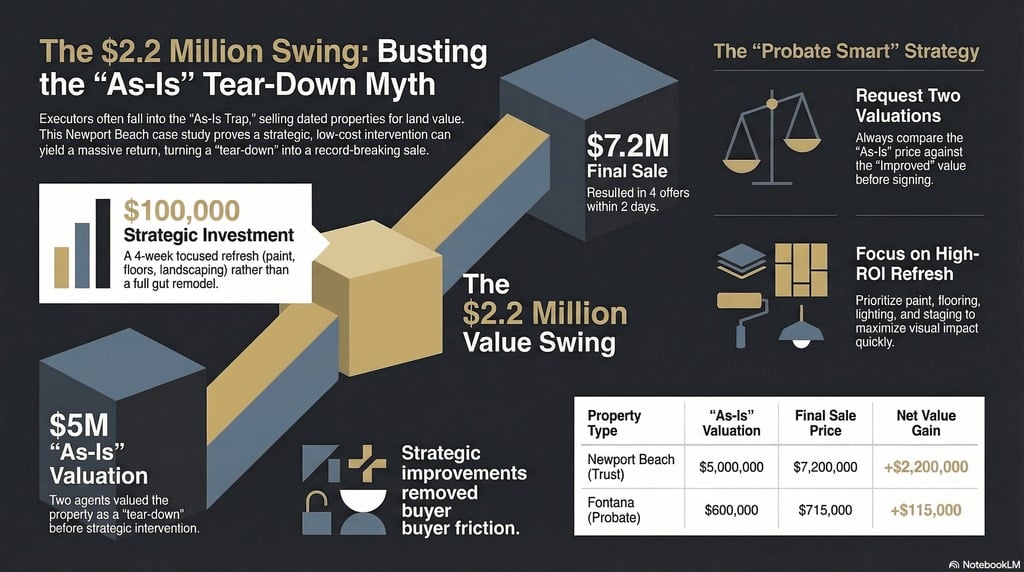
A "Before and After" comparison chart showing the $5M "Tear-Down" valuation vs. the $7.2M final sale price to visualize the $2.2M swing.]
The Power of Strategic Improvements: The Aragone Strategy
The key to maximizing an estate’s value is not a "gut remodel," which is often a waste of time and capital.
Instead, it is the "Aragone Strategy"—a focused, high-impact renovation plan designed specifically to remove "buyer friction" and "market resistance."
Buyer friction occurs when a prospective purchaser cannot see past dated aesthetics, peculiar odors, or minor repairs. In a luxury market, buyers pay a premium for "turn-key" convenience.
By removing these psychological barriers, you expand the buyer pool from a small group of predatory investors to a vast group of emotional, high-net-worth end-users.
In the Newport Beach example, the estate invested $100,000 in strategic improvements. This project was executed with surgical precision on a condensed three-to-four-week timeline. Most importantly for the exhausted executor, the Aragone & Associates team managed every facet of the labor, ensuring the fiduciary remained focused on their legal duties rather than managing contractors.
The core strategies for removing friction and driving demand include:
- Neutralizing the Palette: Fresh, high-end paint that maximizes natural light and provides a clean canvas.
- Contemporary Flooring: Replacing worn or dated carpeting with modern finishes that create a cohesive flow throughout the home.
- Strategic Lighting: Updating fixtures to brighten rooms and elevate the home’s overall aesthetic appeal.
- Comprehensive Environmental Cleanup: Removing decades of accumulated personal property and "garage clutter" to restore the sense of space.
- Curated Landscaping: Enhancing "curb appeal" to ensure the property makes a powerful first impression the moment a buyer arrives.
- Professional Staging: Providing the scale and luxury necessary for buyers to mentally move into the space.
Probate Realities: From Fontana to Luxury Listings
While the Newport Beach case was a trust administration, the underlying principle of value-add strategy is perfectly scalable to the probate process. Whether you are liquidating a waterfront estate or a suburban residence in the Inland Empire, the duty to maximize the asset remains constant.
Consider 7537 Red Bluff Lane in Fontana. This probate property had been neglected and stood vacant, presenting a picture of stress and liability to the executor. However, applying the Aragone Strategy yielded remarkable results for the beneficiaries:
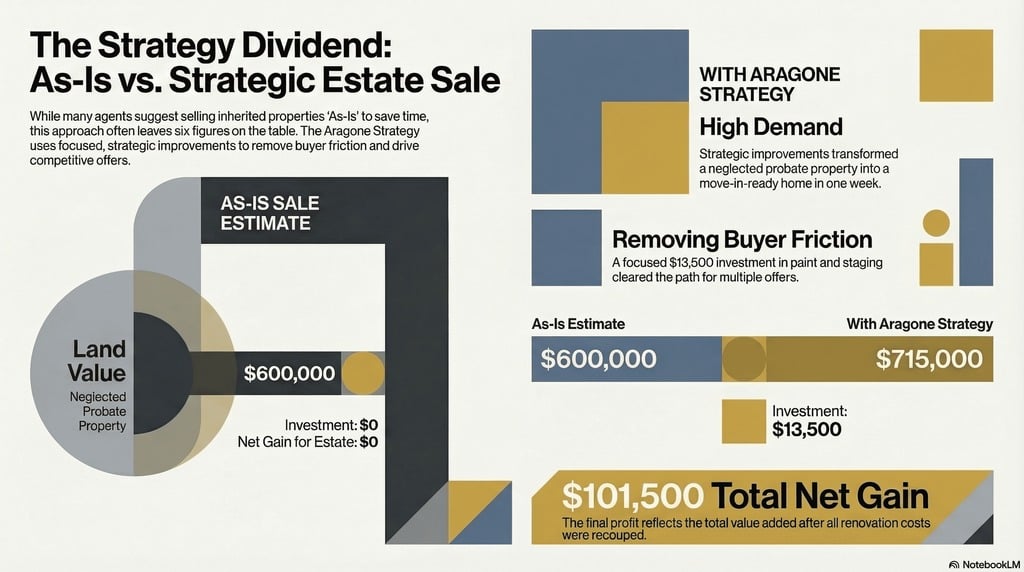
By investing a modest $13,500 in focused improvements, the property sold within a week for $115,000 more than its as-is value.
Authority and Transparency: Protecting the Fiduciary
Fiduciaries often worry about their level of authority under the Independent Administration of Estates Act (IAEA). Whether you have "Full Authority" or "Limited Authority" (which may require court confirmation and a 10% overbid process), the goal of maximizing the initial listing price is paramount.
In a court-confirmed sale, starting with a higher, improved-value offer sets a higher floor for the bidding process, ensuring the court sees the highest possible return for the heirs.
Furthermore, transparency is your greatest shield against beneficiary disputes. At Aragone & Associates, we emphasize a "document, document, document" philosophy. We maintain meticulous records of every receipt, the specific scope of work, and comprehensive before-and-after photography. Providing this level of detail to the estate's legal counsel and the beneficiaries proves that every dollar spent was a prudent investment that yielded a significant return, thereby insulating the fiduciary from claims of mismanagement.
The "Two Numbers" Rule for Fiduciaries
When interviewing real estate professionals to handle an estate or trust sale, fiduciaries must look for technical proficiency over a charismatic sales pitch. To ensure you are meeting your professional obligations, you must insist on the "Two Numbers" Rule.
Always demand that an agent provide:
- The As-Is Value: The price the property would command today, in its current state, likely from an investor or developer seeking a discount.
- The Improved Value: The projected sale price if a targeted "Aragone Strategy" of strategic improvements is implemented.
The Red Flag: If an agent is unable to provide both numbers—supported by data—or lacks a dedicated team to manage the improvements on your behalf, it is a definitive sign of professional inadequacy in an estate context. An expert should be able to articulate exactly how a specific investment will translate into a higher net return for the estate.
When "As-Is" is Actually the Right Move
While strategic improvements typically yield the highest return, a sophisticated consultant must recognize when "as-is" is the logically sound choice. This decision, however, should never be based on an agent’s desire for a fast paycheck; it must be a mathematical certainty presented to the beneficiaries.
An "as-is" sale may be appropriate under the following conditions:
- Compromised Structural Integrity: If the property has foundation failure, extensive systemic mold, or major structural issues where the cost of remediation exceeds the projected market upside.
- Negative ROI Math: If the carrying costs of the property (taxes, insurance, HOA) during the renovation period eat into the projected profit to a degree that makes the risk-adjusted return unattractive.
- Market Impracticality: In rare market conditions where buyer demand for "fixers" is so high that the spread between as-is and improved values is negligible.
Conclusion: Strategy Over Luck
The difference between a "tear-down" and a record-breaking estate sale is rarely a matter of luck. It is the result of a rigorous plan, specialized knowledge, and a team capable of executing under the complexities of probate law. As a fiduciary, you are the steward of a decedent’s legacy. Your choice of representation determines whether that legacy is preserved or significantly diminished.
Before you succumb to the fatigue of the process and sign an "as-is" contract, ask yourself one critical question: Am I choosing the easiest path for my own convenience, or the best path for the beneficiaries I am sworn to protect?
- Watch: See the full Anaheim Hills story and more expert tips on the [Aragone & Associates YouTube Channel].
- Subscribe: Visit our Blog Main page to sign up for our newsletter and receive in your inbox our latest blogs articles.
- Listen: Catch the latest episodes of the Aragone & Advisors podcast on Spotify for deep dives into Orange County real estate strategy.
- Connect: Follow us for daily insights and probate advice on [Instagram], [Facebook], and [LinkedIn].
Blog Article by Paula Aragone | CPRES · SRES® with Aragone & Associates
Let Aragone & Associates guide you through the process, helping to make the transition seamless. Call us at 949-415-4784 or email us at [email protected].
Disclaimer: We are not real estate attorneys, and the information provided should not be considered legal advice. We strongly recommend consulting with qualified legal counsel regarding your specific situation. If you do not currently have legal representation, feel free to reach out to us, and we can connect you with one of our trusted attorneys.
Check out this article next