Inherited a House? Don’t Let the "Treasure Hunt" Become a Debt Trap: The 3-Bucket Strategy for Success

1. Introduction: The Overwhelming Reality of Inherited Property
 
Inheriting property is a transfer of both legacy and liability. While it marks a significant family transition, it frequently introduces a crushing logistical burden: sorting through a lifetime of belongings while the primary asset sits vacant.
 
This vacancy is more than an emotional weight; it is a financial ticking clock. Without a decisive plan, families often fall into a "delay spiral," where months of indecision lead to mounting carrying costs—mortgage interest, property taxes, insurance, and utilities—while the home’s condition deteriorates.
 
At Aragone & Associates, our philosophy is rooted in protecting the estate’s equity through logic-based decision-making. We believe in maximizing value while minimizing stress by decoupling emotional attachment from the cold mathematical reality of asset protection.
 
  • Takeaway 1: The "3-Bucket System" for Logic-Based Sorting
To prevent a sorting process from becoming a multi-month anchor, we utilize a systematic inventory framework called the "3-Bucket System." This allows fiduciaries to audit the contents of a home based on their actual impact on the estate:
 
  • Bucket 1: Financial Value: Items with verified market demand, high-end collectibles, or significant real estate staging potential.
  • Bucket 2: Sentimental Items: Heirlooms, letters, and photos. These require a fair distribution plan to preserve the family legacy without stalling the sale.
  • Bucket 3: Cost of Time: Items that do not hold enough market value to justify even a single month of delay.
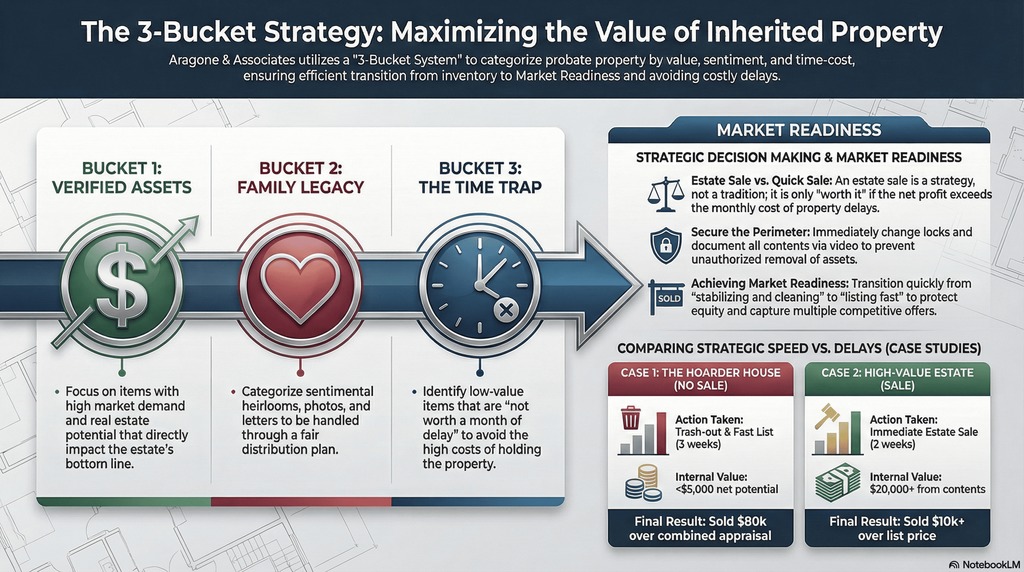
Analysis: The goal is to conduct a "treasure hunt" with a strict timeline. By identifying Bucket 3 items early, you prevent the common error of spending $2,000 in labor and $3,000 in carrying costs to uncover $500 worth of vintage kitchenware. Mitigating this "delay spiral" is the first step in successful asset management.
High-Impact Visual
 
Blog Image 5.2 (1)
 
[Infographic Layout] column visual representing the buckets: Bucket 1 (Dollar sign/Verified Asset), Bucket 2 (Heart icon/Family Legacy), and Bucket 3 (Clock icon/The Trap). 
 
  • Takeaway 2: "Estate Sale is a Strategy, Not a Tradition"
One of the most expensive mistakes an heir can make is assuming an estate sale is a mandatory ritual. In professional estate planning, an estate sale is a tactical tool, not an automatic requirement.
 
"Estate sale is a strategy, not tradition... sometimes an estate sale is brilliant, sometimes it becomes an expensive trap." — Aragone & Associates
 
Analysis: Your primary objective must be protecting the core asset. In most markets, the real estate is an $800,000+ asset. If chasing $5,000 in furniture sales creates a three-month delay that risks property damage or buyer fatigue, the estate sale has become an "expensive trap." You must prioritize the equity of the home over the liquidation of its contents.
 
  • Takeaway 3: When to Move Fast—The Case of the "Hoarder House"
 
In many probate sales, speed is the highest form of "respectful protection." Consider a recent case study involving two properties from a single estate where the owner had struggled with hoarding. The homes had been sitting vacant for an extended period, leading to active rat infestations in one and a damaging roof leak in the other.
 
Key Data Points:
 
  • The Decision: We determined a traditional estate sale would be detrimental. The man-hours required to sort the hoard far outweighed the realistic upside.
  • The Strategy: We skipped the three-month sorting process and moved immediately to a "trash out," stabilization, and professional cleaning.
  • The Results: Both properties were listed within three weeks. We received 19 offers on the first home and 11 on the second.
  • • The Financial Impact: The first home (appraised at $800k) sold for $860k; the second (appraised at $940k) sold for $960k.
 
By prioritizing speed, we realized over $80,000 above the appraised value for this trust or estate property, proving that skipping a low-value "treasure hunt" can be the most profitable move a family makes.
 
  • Takeaway 4: When an Estate Sale Wins—The $20,000 Success Story
Conversely, an estate sale is the correct move for a luxury listing when the contents hold verified value and can be liquidated without stalling the real estate transaction.
 
In one notable probate matter, the home was filled with high-value items, but the estate was facing a "reverse mortgage" deadline.
 
Analysis: To beat the ticking clock of the reverse mortgage, we moved with extreme aggression.
 
An estate sale team was brought in immediately, completing the process in just two weeks and netting the estate 10,000 above list price in addition to the content profits.
 
  • Takeaway 5: The 5-Question Estate Sale "Stress Test"
Before committing to a timeline, every fiduciary should put the property through this diagnostic "Stress Test":
 
1. Verified Value: Is there documented market demand for the contents, or is the value purely emotional?
2. Time Commitment: Will sorting take days, or will it take months?
3. Property Risk: Are there active threats (rats, mold, leaks, or potential vandalism)?
4. Hard Deadlines: Are there looming pressures from a reverse mortgage, court orders, or property taxes?
5. Cost-Benefit Ratio: Will the "carrying costs" (mortgage, insurance, taxes) of the delay exceed the net profit of the contents?
 
Reflective Insight: If the contents net $5,000 but the delay costs $20,000 in holding expenses and market depreciation, you aren't on a treasure hunt—you are in a trap.
 
  • Takeaway 6: Secure the Perimeter Immediately

The moment a property is inherited, the fiduciaries in charge must exercise total control. We frequently see cases where neighbors or distant relatives with keys begin "taking over" the inventory process, removing items they believe they are entitled to.

This is a significant fiduciary risk. If items go missing before a professional inventory is completed, the person in charge of the estate may be held liable for the loss. Whether the property is part of a probate, trust, or conservatorship transaction, the rules of security remain the same:
 
• Change the Locks Immediately: This is the single most important step to prevent unauthorized "rummaging."
• Video Documentation: Before a single item is moved or donated, perform a full video walkthrough of the property to establish a baseline inventory.
• Control Access: Do not allow family members to pick through belongings until a strategic plan—and a professional inventory—is in place.
 
 2. Conclusion: Moving Forward with Clarity
 
Inheriting a property should be a benefit to the heirs, not a financial drain. By adopting a strategy-first mindset, you protect the legacy of the deceased and the financial health of the beneficiaries. Strategy, not sentiment, is the mechanism that protects an estate’s equity from the "delay spiral."
 
Closing Thought: Is your current plan protecting the property's equity, or is it feeding a 'delay spiral' that costs your family more in the long run?
 

Blog Article by Paula Aragone with Aragone & Associates

Let Aragone & Associates guide you through the process, helping to make the transition seamless. Call us at 949-415-4784 or email us at [email protected].

Disclaimer: We are not real estate attorneys, and the information provided should not be considered legal advice. We strongly recommend consulting with qualified legal counsel regarding your specific situation. If you do not currently have legal representation, feel free to reach out to us, and we can connect you with one of our trusted attorneys.

Check out this article next

Helping Aging Parents: 5 Surprising Realities Every

Helping Aging Parents: 5 Surprising Realities Every "Sandwich Generation" Family Needs to Know

1. Introduction: The Silent ShiftFor the "Sandwich Generation"—those adult children balancing the needs of their own kids with the care of aging parents—the realization that…

Read Article