1. Why Your Inheritance Isn’t Just About the Deed
In the current Orange County real estate market, properties are hitting all-time high prices, from the coastal estates of Newport Beach to the suburban family hubs of Irvine. For many local families, a single home represents the culmination of a lifetime of hard work, the cornerstone of their "generational wealth."
However, with such high stakes come high tensions. On a recent episode of the Aragone & Advisors podcast, guest Paul Velasco, founder of Velasco Law Group, shared a startling reality: without the right plan, a trust or estate property transition can quickly spiral into years of family infighting and exhausting legal fees. With a firm of 7 attorneys and 25 dedicated staff members, Velasco has seen it all.
He understands the relatable fear that inheriting a property means inheriting a lawsuit, but he also knows that protecting your legacy is less about the paperwork and more about navigating the emotional and economic realities of the modern estate.
2. Takeaway #1: The "Collegial" Secret of Probate Litigation
Many people avoid estate planning or shrink away from disputes because they associate "litigation" with the aggressive, "hide-the-ball" tactics common in civil court. Paul Velasco admits he originally wanted to be a civil litigator, but quickly found the environment toxic and unnecessarily combative.
However, he discovered a "secret" in the probate world: it is fundamentally more settlement-focused.
For Orange County families, this is vital information. A "probate sale" or a trust dispute does not have to mean declaring war on your siblings. Because the field is more collegial, specialized attorneys who prioritize resolution over ego can often reach a compromise that preserves both the estate’s value and the family's relationships.
Choosing a non-combative attorney actually increases your chances of a payout because it fuels settlement rather than court fees.
"I found that in the trust and estate world, people were much more collegial. Just because your clients are in a dispute doesn't mean you have to fight the other attorney. Being that way helps to fuel more settlements."
— Paul Velasco
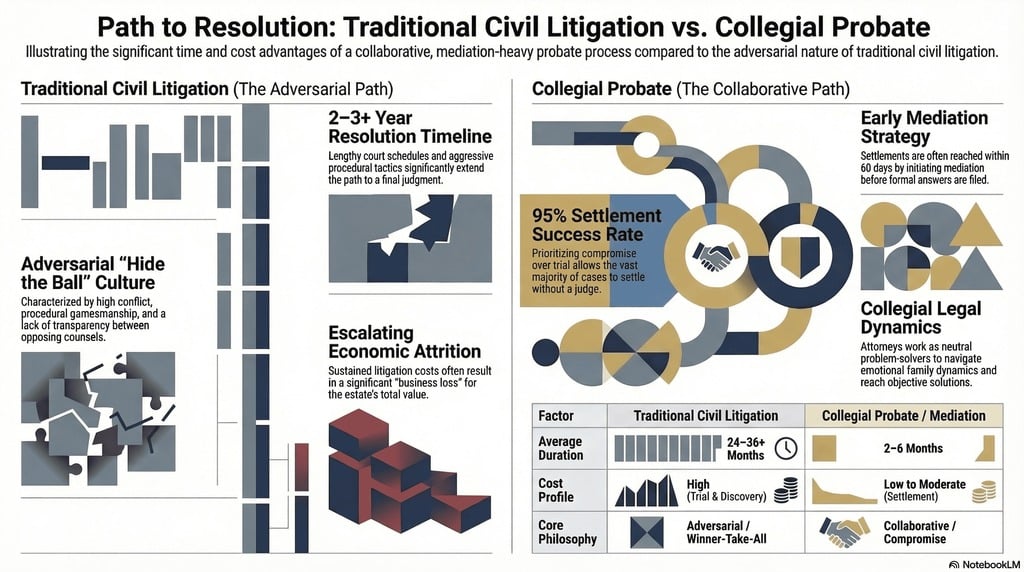
A "Path to Resolution" comparison chart showing the aggressive, 3-year timeline of traditional Civil Litigation versus the collaborative, mediation-heavy path of Collegial Probate which often resolves in months.
3. Takeaway #2: The 60-Day Window to Save Your Sanity (and Equity)
Time is the greatest enemy of your inheritance. While traditional court battles in California can drag on for three years or more, Velasco advocates for early mediation to reach a settlement before the "economic bleed" begins.
He recently handled a complex case involving 10 siblings divided into three competing "camps" (two trustees and eight siblings). Instead of a protracted battle, they moved to mediation immediately. Within 60 days, before the legal team even had to file a formal answer to the complaint—the matter was settled. In the high-value OC market, settling early is a strategic business decision.
As Velasco puts it: "Even though everybody likes to say it's not about the money, don't kid yourself... at some level, it is about the money."
Settling in 60 days ensures that the money stays with the family rather than being consumed by years of discovery and depositions.
4. Takeaway #3: The "Age 18" Legal Cliff
A common misconception among Orange County parents is that they retain the right to help their children with medical or financial decisions indefinitely.
In reality, the moment a child turns 18, parents lose their legal standing. Whether you have a student away at UCI or Chapman, or an elderly parent residing in a local assisted living facility, having a Power of Attorney and a Healthcare Directive is essential.
Without these, if a loved one becomes incapacitated, the family is forced into a public court process to gain control—an emotional and financial hurdle that can be avoided with simple planning.
5. Takeaway #4: The Blended Family Trap and the "First Death" Risk
Orange County is home to many luxury listings and high-value assets, but these are uniquely at risk in blended family scenarios. A critical piece of advice Velasco offers is planning for the "first death." In many marriages, if the first spouse to pass leaves everything to the survivor without restrictions, the surviving spouse could remarry and accidentally (or intentionally) disinherit the children from the first marriage.
Furthermore, California’s "community property" presumptions can be weaponized if assets are only in one spouse’s name. Velasco shares a cautionary case study of a widow who did not read or write English.
Her late husband had held all properties in his name, and she had signed deeds she didn't understand. She was originally pressured to accept a 50/50 split with a stepchild, but by proving the assets were community property, Velasco secured 85% of the estate for her. Without this intervention, she might have been forced into a "conservatorship transaction" or lost her home entirely because of a language barrier and a lack of informed consent.
6. Takeaway #5: The "Two-Year Tune-Up" Rule
Estate planning is not a "one and done" event; it is a living strategy for generational wealth.
Velasco recommends a trust review at least every two years. Surprisingly, this is rarely about changes in tax law—it’s about "family dynamics."
Children grow up, marriages happen, and relationships sour or mend. In the context of shifting real estate values and family needs, these biannual reviews ensure that your legacy planning remains flexible. For example, if one child is living in the family home, how do you balance their housing needs against the other siblings' right to a timely inheritance? These are the questions a "tune-up" addresses before they become lawsuits.
7. Takeaway #6: The "Thankless" Reality of Being a Trustee
Serving as a trustee or executor is a "thankless job." It carries immense fiduciary responsibility and puts a "target on the back" of the person in charge. It is nearly impossible to please every beneficiary, and many trustees find themselves personally liable for mistakes made while trying to "do it on their own" to save money.
However, the planning process itself is the antidote to this stress. While the role of trustee is difficult, the act of creating the plan is not. As Velasco notes, the most common thing he hears from clients once their trust is finalized is: "This was a lot easier than I thought it was." Professional guidance makes the planning simple so the eventual administration doesn't become a nightmare.
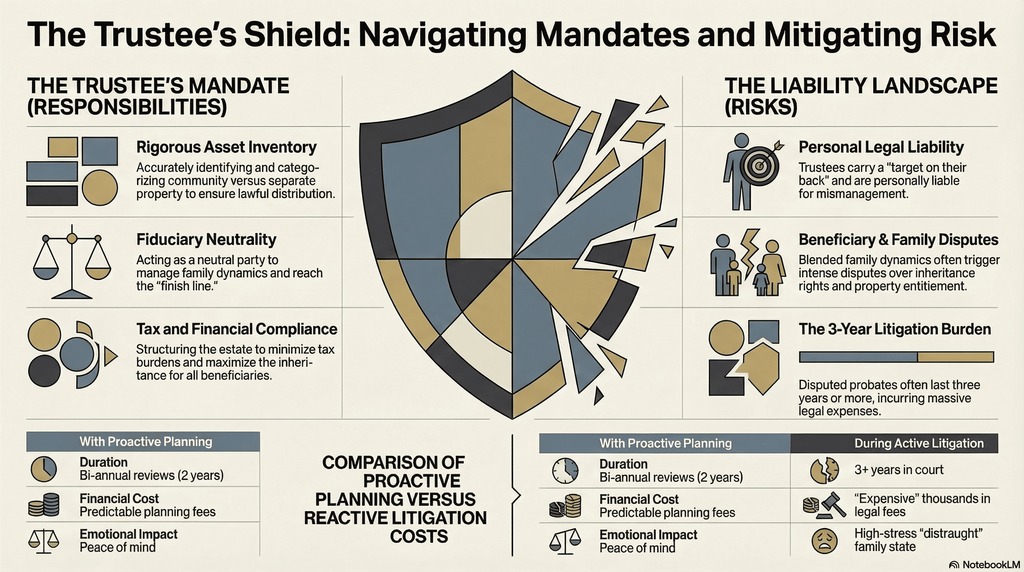
A "Trustee’s Shield" Checklist: Responsibilities (Asset Inventory, Tax Filings, Neutrality) vs. Risks (Personal Liability, Beneficiary Disputes, Breach of Fiduciary Duty.
8. Protecting the Latino Homeownership Movement
The protection of hard-earned assets is a growing priority for the Latino community. Currently, Latino homeownership in California stands at 45%, which is slightly below the national average of 49%. As more Latino families in Orange County acquire property and build successful businesses, the need for bilingual legal support becomes critical.
The case of the widow who couldn't read English is a stark reminder: when you work with an attorney who is fluent in Spanish, you ensure that your intent is never "lost in translation." For the 45% of Latino homeowners in the state, a trust is the only way to ensure that the "American Dream" they worked for actually makes it to the next generation.
9. Conclusion: Peace of Mind is the Real Asset
At its core, estate planning is "Legacy Planning." It is an economic and emotional safety net designed to keep your family out of the courtroom. As you look at your current plan—or your lack of one—ask yourself: Does this account for the reality of my family's dynamics and the actual value of my property?
Peace of mind is the ultimate goal. As Paul Velasco reminds us, death is going to happen eventually; the only question is whether you will leave your family a clear path forward or a map to the courthouse.
- Watch: See the full Anaheim Hills story and more expert tips on the[Aragone & Associates YouTube Channel].
- Subscribe: Visit our Blog Main pageto sign up for our newsletter and receive in your inbox our latest blogs articles.
- Listen: Catch the latest episodes of the Aragone & Advisors podcast on Spotifyfor deep dives into Orange County real estate strategy.
- Connect: Follow us for daily insights and probate advice on[Instagram], [Facebook], and [LinkedIn].
Blog Article by Paula Aragone | CPRES · SRES® with Aragone & Associates
Let Aragone & Associates guide you through the process, helping to make the transition seamless. Call us at 949-415-4784 or email us at [email protected].
Disclaimer: We are not real estate attorneys, and the information provided should not be considered legal advice. We strongly recommend consulting with qualified legal counsel regarding your specific situation. If you do not currently have legal representation, feel free to reach out to us, and we can connect you with one of our trusted attorneys.
Check out this article next